Showing posts with label translated work. Show all posts

Wednesday, October 3, 2018

Peter's Pretentiously Pedantic and Prodigious Proust Project


Every year, I make it a point to read Marcel Proust's In Search of Lost Time, or at least the first volume, Swann's Way. And every year, I fail, big time. I can't recall a time when I made it past page 50. My editor self always feels attacked by Proust's looping sentences. And what the eff is the deal with describing one's going to bed in no less than 10 pages. Go to bed, get a kiss from mama. That's it. But not with Proust. Every act, however mundane, gets the royal treatment. Fortunately, there aren't any scenes set in the bathroom. Otherwise, we'll get long, winding sentences about a character's efforts and musings in doing the number 2.

But the hell with it—I am going in. I will read not just the first volume, but all effing seven. I will be so deep in In Search of Lost Time (or Remembrance of Things Past, if you go by C. K. Scott Moncrieff's translation) that I'll be sick of madeleines and long pages of French prose wherein nothing seems to be happening. I will laugh in the face of boredom. I will wallow in the fields of ennui. I will fight the urge to throw the books at walls or at annoying people. I will fart run-on sentences and elliptical clauses.

And why am I doing this? Because I have masochistic tendencies, and Proust's books will be my outlet. Because every time I see a picture of Proust, he seems to be mocking me. "Weakling!" "You're like the lowest form of reader? Merde!" "Tu pues du cul!" (I have my French teacher to thank for this wonderful bit of profanity. I think it means something like smelling like you came out of an ass.) Because I feel a special affinity for Proust. I mean, this was a guy who spent most of the daylight hours in bed and only left it just to go to dinner invites. The life! Also, he was gay. So we're like sisters.

But, but, but. This doesn't mean that I'll read all seven volumes in one go. There will still be the occasional suspense novel or the sappy gay romance or the latest hyped bestseller. If anything, I'll probably read a volume between one or two other books that I finish. Right now, I've rediscovered how enjoyable it is to read the Agent Pendergast novels by Douglas Preston and Lincoln Child. (I stopped reading the series a few years ago.) So Swann's Way after a couple of these thrillers. Because nothing makes a better palate cleanser than a French novel about French people doing French things (except for French kissing and the blowjob, which I heard the French apparently invented).

So I figure it'll take me at least 3 years for this project, no? But I'll be blogging about my progress every now and then. And probably, just to annoy some people, I'll follow Proust's writing style in my posts. It's like my "eff you" to Twitter shoutouts. Because why would you use just 140 characters to say something when you can go with 10,000? 

Friday, March 21, 2014

G is for Gotthelf

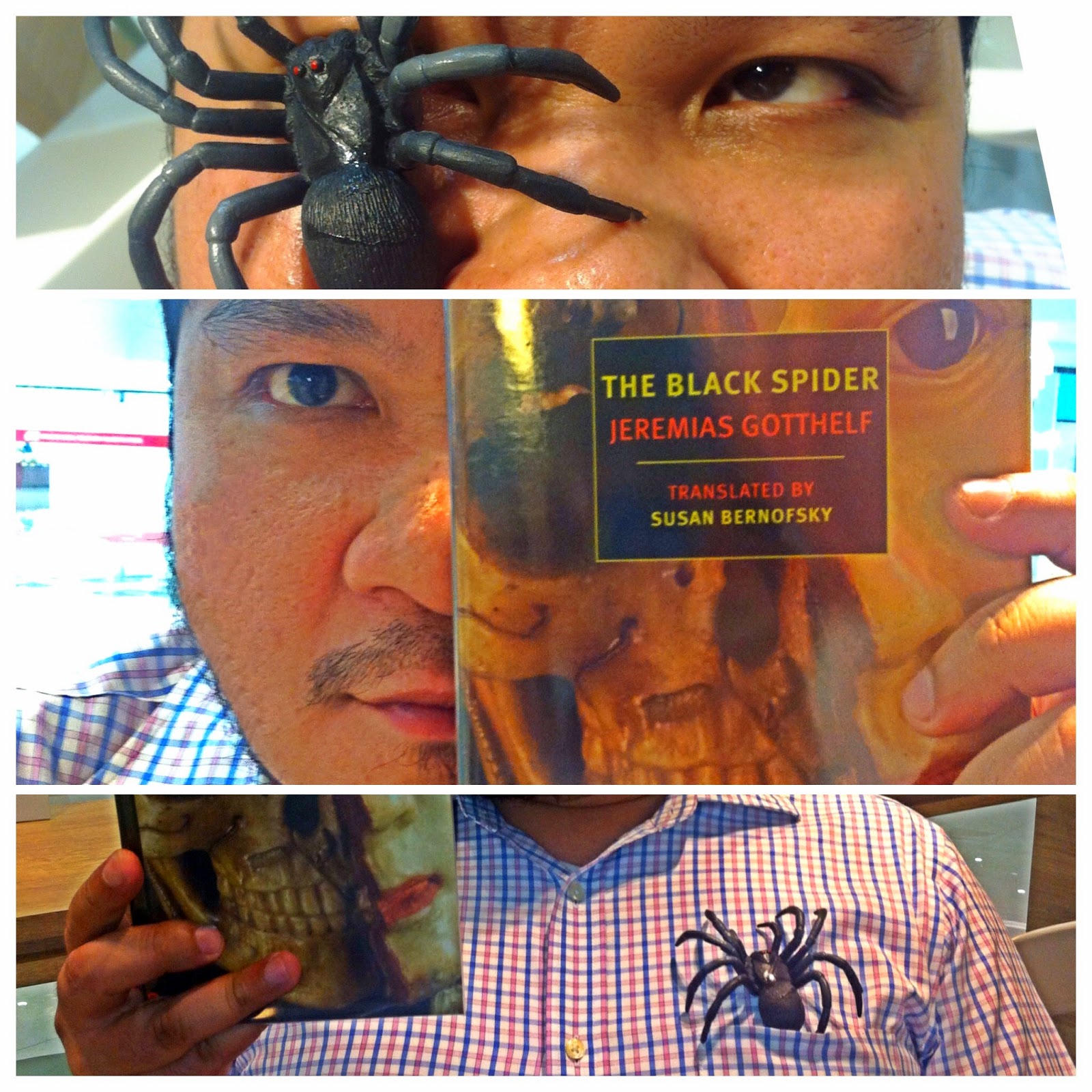
I love a good horror story. And after reading mostly the Victorians in my dead guy reading challenge, I believe the time is now ripe to go beyond the British realm. So I picked up Jeremias Gotthelf's The Black Spider. Gotthelf is a curiosity. He was a Swiss pastor who was a contemporary of Edgar Allan Poe. According to his biography, one difference between Gotthelf and Poe is that Gotthelf believed in the reality of the demon he created in his short stories. This thought gives me goosebumps, as the monster he created in The Black Spider is quite the character.

Upon opening the novel, which was published in 1842, one might think that it isn't a horror novel at all. The opening lines paint a picture of quaintness and the mundane. Gotthelf begins with a very vivid, albeit poetic, description of the town of Sumiswald, where the events of the novel take place.
Above the mountains rose the sun, shining in limpid majesty down into a welcoming but narrow valley, where it woke to joyous life creatures that had been created to take pleasure in the sunshine of their days. From the forest's gilded edge the blackbird trilled its aubade while the amorous quail intoned monotonous minnelieder from amid the flowers sparkling in the dew-bespangled grass, and high above the dark firs, lusty crows danced nuptial roundelays or else cawed tender lullabies above the thorny little beds of their unfledged chicks.
But all will not be well at Sumiswald, for in The Black Spider, a dark period in the history of that little fictional town will be told. It begins with a brutal knight, one Hans von Stoffeln, who makes a most inhumane demand on the farmers of his estate. It's a demand so impossible for the residents of Susmiswald that one of the women, Christine, is forced to make a pact with the devil. The devil in The Black Spider is one I haven't encountered before. No horns, fangs, and serpertine eyes and tails here. What Gotthelf conjured is a tall, red-beared huntsman dressed all in green and with a red feather in his cap. All he asks in return is an unbaptized child.

So the knight is made happy and all seems well in the little town. Until the first child is born. Christine takes it upon herself to get the child and bring it to the devil. But she is thwarted, as the child is baptized as soon as it is born. Then the second child is born, and the same thing happens. All this time, a black mark has been growing on Christine's face. The mark grows and grows till little spiders come out of it and kill all the cattle in Sumiswald. When the third child is born, Christine hurriedly goes to the mother's house and steals the child. But alas, when she was about to hand the baby over to the green huntsman, a priest sprinkles holy water on these two. The devil flees, and Christine shrinks and transforms into a small spider, which the priest casts aside in rescuing the poor baby.
The story does not end here. It's too clean, yes? The black spider wreaks havoc in the town, appearing in one house, killing people, and then disappearing instantly, only to appear again in another place. It's at this point that I begin to think how The Black Spider is very similar in theme to the story of the pied piper of Hamelin. But instead of people realizing their fault and correcting it by doing what has been previously agreed on, the people of Sumiswald resort to their faith. (Gotthelf, after all, was a pastor.) Of course they can't give a child to the devil, whether it's baptized or not. It was up to one of the residents of Sumiswald to outwit the black spider and trap it in a wooden post.

Gotthelf's novel is a quick read. It's just a little over 100 pages. One assumes that this tale, written in the mid 1800s, would have a plot that took its time to unfold. No. The Black Spider's narrative pace is a hectic one. And an atmosphere of dread and creepiness pervades throughout the pages.

Nightmarish—that's how I would describe Gotthelf's novel. I couldn't help but look over my shoulder every now and then. Just to check whether an 8-legged thing is slowly finding its way into one of my pockets. Don't get me wrong, I love spiders. They kill pests, and they'd mostly leave you alone if you leave them alone too. But the spider in this novel is something you'd wish you'd never meet. You might as well practically kill yourself if you do. There's just no escaping it. It's evil incarnate.

Again, I'm grateful that NYRB has published this forgotten classic. It's wonderful reading about the traditions and customs of small towns in ages gone by. There's an opening scene about a baptism that's about to happen. I never knew that there was so much eating involved before and after the ceremony. I guess in olden times, one stuffs himself silly when a baby enters the Christian world. Fascinating trivia.

Read this book if:
  1. You have a thing for classic horror stories.
  2. You love spiders.
  3. You're looking for a quick and scary read.

Saturday, December 28, 2013

Of collaborators and resistance fighters

I guess I spoke too soon when I posted my 10 favorite reads for 2013 in the previous post. I never knew that I'd be making a late addition to it, and it's this debut novel by Laurent Binet—HHhH. Somehow, I'm glad that this would probably be the last book that I'll be reading for the year, for HHhH is one truly glorious read.

HHhH is Laurent Binet's debut novel, but it doesn't feel like it. This historical novel really makes other books in the genre feel like they've been written by history undergraduates who are just too lazy with their research. If there's anything that Binet pulls off in this novel, these are the meticulous details that make HHhH very richly textured.

HHhH stands for "Himmlers Hirn heisst Heydrich" or Himmler's brain is called Heydrich." Now, Heydrich: If there's one man more feared that Hitler during WW2, it was this blond who was responsible for carrying out the Jewish solution, the systematic killing of Jews. I can't imagine how one person can think of all those gruesome ways just to exterminate a group of people. But Heydrich was able to do it, until he died of an infection after an assassination attempt.

So HHhH is about how two exiled operatives living in London were able to change the course of this dark period in our history. And these two are Josef Gabcík and Jan Kubiš, a Slovak and a Czech, resistance fighters extraordinare. I have much admiration for these men after reading the novel. I wouldn't have the courage to go into enemy territory and plot to kill a person so close to Hitler. You know that if you've been tasked to do this mission, there really is no coming back.

Most of the chapters of the novel focus on Reinhard Heydrich though. It provides details from his youth up to his quick rise leading to Hitler's cabinet. The Blond Beast, everyone called Heydrich, for he really had those "prized" Aryan features—he was tall, had blue eyes, and striking blond hair. But what makes Heydrich truly Hitler's soldier is that he shared the Führer's plan—to rid all of Europe of Jews.

The novel's very postmodern in its narrative. Oftentimes, the narrator strikes a conversation with the readers, telling us how such and such detail were arrived at. And the narrator can be funny too, especially when he mentions how certain dialogues by famous men in history can never be truly confirmed. When the narrative makes way for conversation, the narrator is quick to point out this caveat. In a way, this technique seems to be quite endearing, as if the author makes fun of himself or at least criticizes the way he presents his story.

Because HHhH is about an assassination, it reads like a thriller and adventure story. How can it not be, no? At the part where the actual assassination is described, the reader is left breathless. And during the hair-rising climax when the resistance fighters were trapped in a church surrounded by Nazi stormtroopers, you can't help but root for them, even though you know that that's one situation where it's impossible to get out of.

I just wish that there were many historical novels written this way. History is exciting. We shouldn't be forced to read boring texts about events that influenced how we are now. I think this is why I loved HHhH so much. It shows us that history was made by people, and that these people thought of us when they risked their lives or did remarkable things.

Read this book if:
  1. You love historical fiction.
  2. You want to give postmodern novels a try.
  3. You are, like I am, fascinated by all things related to WW2

Wednesday, September 11, 2013

Unbearable

In a bibliophile's life, there are always books that people would rave about which you would wonder why. And one of those books for me is Milan Kundera's The Unbearable Lightness of Being. It's a book heavy on philosophical themes, a historic period in the then Czechoslovakia, the impact of repressive political regimes on art, and the significance of sex in its 4 major characters. I found it hard to digest. And believe me, I digested a lot of things in my life, edible or otherwise.

TULoB has been a book I've always wanted to read, and luckily for me, it was chosen as the book of the month by the book club for August. So, up it went to the top of my humongous, robust, virile, eye-popping to-be-read pile. (Now if I can only say that to certain parts of my anatomy, no? Life would be awesome. But alas...) I read it in a span of a week, and what a week it was. I felt I was high on drugs the whole time, but not in a good way. In fact, it was almost akin to having taken a date rape drug. You had no idea you already took it, but you know that all's not well and sooner or later you're gonna get fucked.

The novel opens with a study in contrast of lightness and weight. Lightness apparently has something to do with living for the moment and not putting too much importance on things. Apparently it's based on a philosophical idea of Paremenides. (And it was at this point that my eyes glazed over.) Weight, on the other hand, stems from the idea of Nietzsche, which has something to do with eternal return, which Kundera doesn't really believe in, which has something to do with people putting way too much weight on sex, their political ideologies, their husbands and wives and mistresses, which has something to do with me believing that it's all just crappy nonsense. The last time I've heard of something like the eternal return, I was probably watching an episode of Dr. Who.

The concept of lightness and being does lead us to Kundera's 4 main characters, two of which are "light" and 2 "heavy." The heavy characters are Teresa and Franz, characters so heavy that they'd probably sink into the ocean if I threw them overboard a ship. Teresa, the photographer, who marries one of the light characters, Tomas, the doctor and philanderer who ends up cleaning windows by the novel's end. Teresa is someone that I hoped to understand but I couldn't. All this coming and going from one country to another. All the issues she feels with marrying a man who cheats. Lady, you knew from the start what you're getting into when you married that perennially horny Tomas. He'd fuck a tree if you draped a dress over it. Get over it.

I did like one of the light characters though—Sabina. She's an artist coping with the insane standards of the country's socialist regime. Sabina is one who knows how to survive; she literally packs up all her bags and moves to the US when she can no longer stand the artistic ideals of her country. During that time, all art forms should be realistic and any other forms which are otherwise are deemed unpatriotic. Sabina is the only character in the novel who has an epiphany. When a drop of red paint unintentionally falls on a painting she's working on, she stumbles on the wonderful concept of accidental beauty. Yes, like Sabina, I believe that art should be organic and truly express the artist's feelings.

While I didn't like The Unbearable Lightness of Being, I did enjoy the discussion nonetheless. A lot of members consider Kundera's most famous novel as their favorite, and it was interesting to note their opinions and thoughts. I thought, on the other hand, that the novel was just too much work. It's the kind of novel that you deconstruct to fully appreciate and understand. It did make me curious about the Prague Spring and how it affected the lives of artists during the Soviet occupation of this eastern European country. But other than that, I found The Unbearable Lightness of Being, well, simply unbearable in its entirety. Too preachy, the language too flowery, the milieu too European, the characters lacking conflict that I could relate with. It's the kind of book that I'd give to frenemies.

Anyway, here are some pics that R. (best photographer ever) took during the discussion. You can click on them to enlarge.

I have no recollection of what I'm telling here.
Yes, that happens when I talk about books I have no strong feelings on.
Gege, the moderator for this month, gave each member a bowler hat.
The bowler hat figures prominently in the story.
It somehow symbolizes erotic playfulness. Whatever.
And each one of us received this loot.
It had a notebook and a bookmark.
Because one cannot have too many bookmarks.
R. made gorgeous illustrations of the members who attended.
Here's mine.
Yes, I was wearing hot pink shorts that time.
Read this book if:
  1. You're a sucker for Kundera.
  2. You want to know whether you're a light or a heavy person.
  3. You fall for flowery language.

Thursday, August 1, 2013

Is this my favorite read of the year so far? Probably.

Although we're still only halfway through the year, my experience reading Fyodor Dostoevsky's Crime and Punishment would be hard to top. If there's a novel wherein I completely immersed myself in, it's this Russian classic novel. I love, love, love every bit of it.

Crime and Punishment was our book club's selection last month, so I was really looking forward to the discussion. I kinda had an inkling that not many people would like this, and I was indeed correct. We did have a very engaging discussion nonetheless.

Dostoevsky's novel is the kind of book that elicits a lot of feelings from the reader. Dostoevsky is a realist, so his treatment of poverty isn't romanticized at all. More than anything, I felt that poverty in Russia during the 1800s was a way of life. I wouldn't want to live in St. Petersburg during the 1800s. Fyodor describes it as very bleak, cramped, and poverty-stricken.

Rodion, the novel's main character, murders an unscrupulous woman and her sister early in the novel. He considers the crime to be a rational act, thinking that he did everybody else a favor by killing this pawnbroker who seems to take advantage of people. Crime and Punishment has a plethora of other characters, but I chose to just keep my eyes on Rodion. Everything revolves around him anyway.

The punishment mentioned in the title is meted only by the novel's end, the epilogue actually. So what, you may ask, does Rodion do throughout the novel? Dostoevsky chooses to take the character redemption route. We see Rodion get sick as soon as he committed the murder. We witness how irrational he can be when he justifies to himself the crime. We experience his dealings with the people in his surroundings (his family included). In the cramped world of Crime and Punishment, everyone seems to know everyone else.

Of course, redemption can come when one accepts that he or she did something wrong and is prepared to suffer the consequences for it. For Rodion, that path is never easy. But he meets Sonya, a prostitute, who becomes instrumental to Rodion's confessing to the crime. Reading this entire journey, from the murder to the confession, is one very satisfying experience.

I know that one shouldn't compare apples and oranges, but I can't help doing so with Dostoevsky and Tolstoy. I love Anna Karenina, which I also read recently. However, finishing Crime and Punishment is something I consider more rewarding. Now I want to read The Idiot or even reread The Brothers Karamazov!

I even took a few notes before coming to the discussion.
Yes, that's how much I love Crime and Punishment!
Read this book if:
  1. You love them Russians.
  2. You'll read anything translated by Pevear and Volokhonsky. (I know I would.)
  3. See more reasons here.

Sunday, July 21, 2013

Feels like Hitchcock

I've always wondered why there hasn't been a global Japanese crime fiction phenomenon. We all see Scandinavian crime novels everywhere. I say the Japanese ones should be just as popular. There's a certain darkness, an edginess bordering on the crazy, that make me love them.

Keigo Higashino's The Devotion of Suspect X is a different kind of mystery. For one, you know early on who committed the murder and how. Another, you read the novel to find out if the Japanese detectives will eventually find out who the killer is and weed out one red herring after another. It's very stimulating, this novel is.

The murder in question involves Yasuko, a single mother to Misato who works at a food stall. Enter Togashi, her ex-husband, a man whom she hasn't seen in 5 years. One day, Togashi walks into the lunch box shop where Yasuko works. For Misato, it's all deja vu, remembering the countless times Togashi has asked her money. Naturally, the meeting leaves a bad taste in Yasuko's mouth.

When Togashi goes to the apartment where Yasuko lives, he harasses her. Things get pretty ugly to a point when Misato, out of anger, clubs Togashi in the head. Togashi then retaliates and a skirmish ensues. Yasuko panics and ends up killing Togashi by strangling him. And this is where things get a bit complicated when they receive a call from Ishigami, their neighbor, with his offer to help dispose of the body. Ishigami is the novel's Suspect X, and his devotion refers to his affection for Yasuko. We learn that he doesn't frequent the lunch box shop where Yasuko works because of the food; he is just deeply infatuated with, nay, adores Yasuko.

The body is eventually found near a river and it's identified as Togashi. Of course, we should have a smart detective, and that comes in the person of Kusanagi, who becomes dedicated to finding out the killer. Everything points to Yasuko though, despite her weak alibi. Things get complicated when the detectives discover the connection between Yasuko and Ishigami, who we now learn is a math genius. While we do know that Ishigami was the one who crafted Yasuko and Misato's alibi, we are left to question how will the police look beyond the clues and finally get Yasuko.

But Higashino still has something up his sleeve in his novel. In The Devotion to Suspect X, we are introduced to Yukawa, a brilliant physics professor at the Imperial University, who serves as an unofficial consultant to the police regarding the cases that confound them. Yukawa, who is also affectionately known as Detective Galileo, somehow comes up with his own theory regarding who really did kill Togashi and how Ishigami, who appears to have been just an accomplice in getting rid of the body, could have actually committed murder. The ending is just too priceless to spoil.

What really made the The Devotion of Suspect X truly enjoyable is the apparent battle of minds between Ishigami and Yukawa. We learn that both went to the Imperial University and who were once good friends. Ishigami becomes a master of creating a deception, a veneer, which Yukama sees right through. As I said, how Yukama reveals the whole workings of the mystery is just too juicy to spill here.

I've heard that there a new Detective Galileo novel. And if it's half as good as The Devotion of Suspect X, I will happily gobble it up. Yukawa can be so charmingly geeky.

Read this book if:
  1. You love elegant plot twists.
  2. You have the patience to wait until the end for that satisfying reveal.
  3. You have a thing for Japanese crime fiction.

Saturday, May 11, 2013

Adieu, soleil

This week, I reread Jules Verne's Twenty Thousand Leagues under the Sea as part of the book club's month-long sci-fi read-along. If you love sci-fi or are simply interested about the genre, do join us. We've just begun this week, and we'll be reading 3 more sci-fi books in the coming weeks.

Anyway, what's not to love in Verne's seminal sci-fi work. Twenty Thousand Leagues under the Sea may not have spaceships or space travel or aliens, but it's still sci-fi nonetheless. When it was published in the late 1800s, people were enthralled with Verne's description of the underwater world. Groundbreaking stuff, I tell you.

In the novel, a French intellectual named Aronnax, his servant Conseil, and a brash Canadian named Ned Land find themselves in a huge submarine aptly called the Nautilus. In the vessel, they meet its maker, the enigmatic Captain Nemo, a man who tells them that people who have boarded the Nautilus are never allowed to leave. It doesn't men that he treats Aronnax, Conseil, and Ned as prisoners though. They're more of like perpetual guests in the ship. They're free to roam around the Nautilus, but they can't ever leave it.

The title refers to the distance that the Nautilus has traveled while the 3 were kept in its 'captivity'. And during this time, Captain Nemo has allowed them to experience adventures that they wouldn't have been able to do on land—a trip to an underwater forest, an underwater burial, encounters with giant squid and sharks, a trip to a coal mine inside a volcano, and even a tour of the forgotten city of Atlantis. I believe these episodes are the heavy sci-fi aspects of the novel. During the time the book was published, the submarine was never thought of as a vessel with military potential. Even the mechanics of underwater breathing apparatuses weren't that solid yet. But Verne presented a possibility, and these possibilities are already a reality in our present world.

Captain Nemo is undoubtedly the star of the novel. Verne doesn't even give names to the other crew member of the Nautilus. When you think of the submarine, you immediate associate it with its tough, stubborn captain. Verne even teases the reader that Captain Nemo has forsaken the world above ground for it took away his country and his family.

Verne had the propensity to rattle off the flora and the fauna of the various places that the Nautilus visits. It can get sometimes get very cloying, especially since Verne mentions the Latin names of these life-forms. The lists certainly add texture to the narrative.

If you want a sci-fi novel that's heavy on the adventure stuff, I do recommend Twenty Thousand Leagues under the Sea. The novel may feel dated at certain points. However, it does highlight the fact that sci-fi, as a genre, can fascinate, inspire wonder, somehow describe what the future holds, and basically entertain. And that's why sci-fi is timeless.

Read this book if:
  1. You has a fondness for overbearing figures of authority.
  2. You've always thought that the city of Atlantis was real.
  3. You love classic sci-fi.

Wednesday, May 1, 2013

Rereading a sci-fi classic


This month is when the book club is having a month-long sci-fi read-along. I love this genre, and I think that more people should read sci-fi novels. Personally, whenever I read about sci-fi being not a 'serious, literary genre', I can't help but think that the writer of that article is a complete dumbass. These people don't know what they're missing.

We're starting with Jules Verne's Twenty Thousand Leagues under the Sea. I remember reading it when I was 13, and I can't wait to go aboard the Nautilus again. Verne was a visionary, for he have foreseen how the submarine can become a vital military resource.

At heart, Verne's novel is a story about adventure. I guess I was a very gullible teenager, as I recall being amazed and wide eyed at Verne's description of the places the crew visited. I was truly fascinated. I wonder if I will have the same level of enjoyment now that I'm reading it in my late 30s. I will soon find out!


Friday, March 29, 2013

So many questions

Reading Haruki Murakami's latest novel, 1Q84, feels like having your favorite dish at an expensive restaurant and then realizing that the chef has changed the recipe. The chef might not have scrimped on the ingredients, but he certainly has changed the flavor. You expect to be satisfied but end up really wanting.

I love Murakami. One of my favorite books is The Wind-Up Bird Chronicle, and I enjoyed Sputnik Sweetheart and Dance Dance Dance. But 1Q84 is a totally different animal. It's as if Murakami is taunting us: "Yes, I can write something completely different. Why? Because I can."

To think that 1Q84 is more than a thousand pages, Murakami at least could have answered some of the questions the reader would have in his mind. Instead, we are left wondering. Who are the Little People? Why do they make air chrysales? What's that alternate universe all about? What the hell is the problem with Fuka-Eri?

At heart 1Q84 is a love story involving the two protagonists: Tengo, the writer and mathematics teacher, and Aomame, the assassin who first realizes that they're living in another parallel universe. We do realize that Tengo and Aomame are destined to be together, as Murakami drops not-so-subtle hints that these two will become a couple. But must it really take a thousand pages?

If you're a Murakami fan, there are still lots of familiar elements in 1Q84 to make you feel at home. There's the weird sex, the weird goings-on, the weird fascination with earlobes, the weird inclusion of cats in the story. However, 1Q84 feels distinctly different from his other works. It feels a lot like it was done by a Hollywood writer drunk on sake.

Read this book if:
  1. You love Murakami.
  2. You like all things weird.
  3. You've been a ghostwriter at one point in your life.

Tuesday, March 12, 2013

Of fetishes and human body parts

Reading Asa Nonami's short story collection, Bødy, is both an enjoyable and uncomfortable experience. The 5 featured stories here all have one thing in common: how we can become totally focused on one body part and ultimately compromising our wholeness as persons.

Let's face itwe all have our bodily fetishes. Be it the nape, the fingers, the belly button, or whatever, there's that body part that turns us on. (I have a kinky fetish, but of course I won't tell.) But the characters in Bødy take it to the extreme.

And what are these 5 stories? The first is about a housewife who gets so addicted with plastic surgery that her husband goes home one night and fails to recognize her. The second concerns a guy who's so paranoid about his hair loss that he eventually loses his girlfriend because of it. We also meet a guy who fondles women's knees on the train. Then there's the girl who goes on an extreme diet to avoid defecating. The last is about a teenage boy who becomes a target of men's fists in boxing matches.

All of these stories are very much disturbing. But I've come to expect it from Nonami, whose previous novel, Now You're One of Us, has elements of Rosemary's Baby, hallucinogens, and dysfunctional families. As a collection, Bødy lets us peek into modern-day Japan, with its unhealthy materialism, fast-paced lifestyle, and warped fixations.

If I were to pick 1 story that I liked best, it would have to be "Buttocks." In that story, a girl goes to an elite boarding school in Tokyo, gets ridiculed for having a fat ass, discovers blood in her stool, and swears off food to avoid making use of her rectum. If that isn't sick enough, I don't know what is.

Read this book if:
  1. You know you could be more good looking if not for this one body part.
  2. You like reading about fetishes.
  3. You love short story collections.

Sunday, March 10, 2013

Dusk


Finishing a really thick book is like saying good-bye to an old friend. That's exactly how I felt when I turned the final page of Haruki Murakami's 1Q84.

This novel isn't Murakami's best work, I feel. But I took my time with it, spending a few chapters every night, slowly reading each word. I got lost in the make-believe world of 1Q84, with its 2 moons, little people coming out of dead people's mouths, and the frequent references to Janáček's Sinfonietta.

I think that's the allure of doorstops, those thick books that require commitment and stamina. Since you spent a great deal of time with them, you're very much sad to let them go. 1Q84 had 1,150 pages, and there were indeed times when I felt that I might as well throw the book in the air unfinished.

I'll stop posting my further thoughts on this book for a later entry. We're still meeting this week to cap off the discussion of this book, which was our selection for a read-along lasting for more than 2 months. I sure would love to hear the thoughts of the other members of the book club on this much-sensationalized work by one of Japan's contemporary novelists.

Now I'm scanning my shelves on which doorstop to read next. Should I read Proust's Remembrance of Things Past? Or Cervantes's Don Quixote? Decisions, decisions...

Sunday, February 3, 2013

Eeny meeny miny moe

I've a happy problem: I can't remember if I've ever read Fyodor Dostoevsky's Crime and Punishment. I seldom reread, considering that there are still tons of unread books on my shelf.

I do remember reading The Brothers Karamazov on a whim back in high school. I recall that I surprisingly liked it. Back in high school, I went through a phase wherein I read most of an author's works if I enjoyed the 1st book of his that I read. This explains my extensive yellowing paperback collection of Stephen King, Agatha Christie, Jules Verne, and Clive Barker. Also, I must admit that I have Judith Krantz and Jackie Collins, too. Krantz and Collins are enjoyable on another level. Hihihihihi.

Anyway, I'll probably read/reread Crime and Punishment for the book club discussion sometime this year. The fact that I can't even remember reading it means that I just have to suck it up and just read the darn thing. I love me some Dostoevsky and it's been a while since I picked up one.


I did see a graphic novel of C&P at the bookstore and bought it on the spot. For a few minutes, I considered just reading this "lighter" version. When I say lighter, I mean just that: the graphic novel does weigh less.

Oh, there's one good thing about reading C&P now. Pevear and Volokhonsky, them husband and wife award-winning translators, did a new translation of this beloved work by Dostoevsky. I've read their translation of Tolstoy's Anna Karenina last year, and I must say that they did great work on it. (Yes, I actually compared a few versions just to check.)

Update:
I gave the graphic novel version to R. over the weekend. If I see it on my shelf, well, I just might choose the graphic novel instead of the full doorstop of a novel. Besides, if there's one person who understands graphic novels, it's R.

Sunday, January 20, 2013

Book > stage > movie

Yesterday, I finally saw the movie version of the musical based on Victor Hugo's novel Les Misérables. All I can say was that it was, ummm, good but a bit underwelming. (Now I have to hide from my friends who really, really love the movie. I fear for my safety.)

What I can remember from the movie are the extremely tight shots of the actors while they're singing. You can really see the snot from their noises while they're crying and singing at the same time. And yes, Amanda Seyfried (Cosette) has no pores whatsoever, and Eddie Redmayne (Marius) has 1,697 freckles.


Somehow, seeing the movie recently made me want to listen again to a recording of the musical. Finally, songs from people who can actually sing! 

And the movie did inspire me to look for my copy of Les Misérables, which I've read almost 20 years ago. I did find it, and I was aghast about its condition. Yellowing pages, foxing everywhere, silverfish feasting on its paper. It was almost crumbling when I handled it.


Anyway, I do remember enjoying this novel when I read it during one summer when I was still in college. It's very melodramatic though. And it's très depressing. Apparently, French people living during that time had no joie de vivre. You can't blame them though. You can smell the stink and taste the poverty and misfortune of these unfortunate characters.

Sunday, November 25, 2012

Poverty, politics, poultry

If you've read at least one novel by Gabriel García Márquez, then you might be in for a surprise if you read No One Writes to the Colonel and Other Stories. If you're expecting magical realism (e.g., people suddenly ascending into heaven as if it's the most natural thing), then the stories in this collection might disappoint. For in this collection, García Márquez chooses the path of a realist. Compared with his other works, you can probably refer to this short story collection as GGM lite.

I, however, wasn't a bit disappointed when I finished No One Writes to the Colonel and Other Stories on this fine Sunday morning. I'm one day late though, as the book club discussed this collection yesterday afternoon. And because I didn't even finish the novella No One Writes to the Colonel, I just decided to keep my mouth shut yesterday.

The thing about the novella is that García Márquez drives you smack in the middle of things. You feel the inescapable poverty of the town, the sickening reek of bureaucracy, the uncomfortable humidity of the town, the futile hopefulness of the characters. You know that nothing's going to come out a situation wherein a retired colonel pins his hopes on a rooster. It's the rooster that's supposed to bring in the money, much needed after so many years of not receiving a pension from the government. The colonel and his wife is so poor that she has been reduced to boiling stones in the kitchen, in the hopes of deceiving their neighbors that they have something to eat.

The novella isn't a pleasant read. The story just gets bleaker at every page. But you plod on, because García Márquez's writing is beautiful. Unlike his novels, here the sentences are terse, the dialogue natural, and the sense of place given in detail. And like most shorter works of fiction, the ending makes you ponder. Is there still hope for the colonel and his wife? I believe not.

During the discussion, Marie, the moderator, mentioned something about the iceberg model of short stories. In an iceberg, the part that is visible on the ocean surface is just a very small fraction of the actual size of the iceberg. I fully agree. Short story writers are masters of the tease. They offer you just mere spoonfuls instead of the whole dish. They leave it up to you on how you interpret the story and, ultimately, on how you appreciate it. They make you question. And such is the pleasure of reading short stories.

The other stories in this collection are just as good as the novella. In fact, my favorite in this book isn't the novella itself but an 8-page short story entitled "Tuesday Siesta." My mind can't stop thinking of all the various scenarios that can transpire after the last scene. What happens when folk learn that the mother of the thief whom they've killed has come to their town to visit his son's grave? Such delicious possibilities.

It's quite fascinating how Gabriel García Márquez has assembled a treasure of stories in this collection. I don't read a lot of short stories, but each small gem in No One Writes to the Colonel and Other Stories is enough to urge me to read some more.

Read this book if:

  1. You'll read anything by Nobel laureates.
  2. You love Latin American fiction.
  3. You like your fiction bite sized.

Wednesday, July 11, 2012

Ruminating on the count

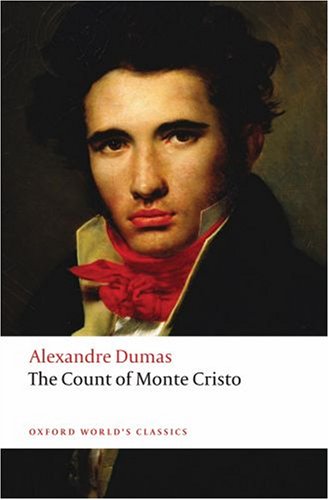
Is the story of The Count of Monte Cristo one about revenge? Or is it about justice? Well, it does start out as a novel wherein one character plans his revenge on a few people who were responsible for his being in prison for several years. And then it ends with the characters getting what I think they should deserve, so there's that justice component. But I think that The Count of Monte Cristo works best as an adventure story.

I loved every minute I spent reading this 1,000+ page door stop of a novel. And it was quite enjoyable keeping track of the several characters Dumas introduces in this work. It's epic, I'm telling you, dear reader. And reading it is akin to getting shots of adrenaline every now and then. Yes, it's a book with caffeine that seems never to let up.

Most readers would feel daunted by the heft. But the effort is truly worth it. I like that it also somehow gives you a history lesson on France during the time of Napoleon, and its depiction of French society in the mid 1850s is fascinating. I never knew that so much financial aspects go into one's marriage, to the point that the families involve would compute for the exact amount the families would be getting from the marriage.

It's a good thing that I've never seen a movie adaptation of this book, so I have no expectations whatsoever. Reading it is more or less similar to watching a daytime soap, complete with all the betrayals and the backstabbing and the fainting ladies and the hissy fits. Ah, The Count of Monte Cristo is melodrama in its finest form!

One of the criticisms against this book is that it apparently has very weak female characters. I think that this book doesn't have these characters because it really was a product of its time. Women were just seen as individuals raised to be pretty and to get married to somebody preferably with position and money. But there's one interesting female character in this novel though, and that's Eugenie, who does get what she wants in the end, which is to get the hell out of the circus that is French society.

And other criticism is that some chapters seem contrived and some situations tend to be too convenient for the reader's taste. I agree. The scene where Abbe Faria discovers who specifically betrayed Edmond Dantes comes off as a bit iffy. And the count does seem to be in the right pages at the right time. But what the hey, I just went with it. It was a great ride, and one that I'd like to take again soon.

Now I'm curious. Is The Three Musketeers as thrilling as this one? Would Dumas's other works be loosely based on real-life events like the one in The Count of Monte Cristo? There's only one way to find out, no?

Read this book if:

  1. You never feel daunted by French door stoppers.
  2. You just can't say no a classic adventure story.
  3. You love melodrama in your novels.

Sunday, April 29, 2012

Good-bye, Lisbeth Salander

It's been more than 3 years since I last read and wrote my thoughts on The Girl with the Dragon Tattoo and The Girl Who Played with Fire. So it's been more than 3 years since I was first floored by Stieg Larsson's talent and thought how unfortunate that we'll never read more of his works.

In the 3rd and last book of Larsson's Millennium trilogy, The Girl Who Kicked the Hornet's Next, it seems that the author went all out to give Lisbeth Salander a grand farewell. However, I found myself wanting that it somehow lacked the thrilling action elements present in the 1st and 2nd book. We saw Salander fight it out in the first 2 books. In the 3rd, she's mostly in her hospital bed, with only a PDA to keep her connected to the Internet.

I was surprised with a number of things as I was reading The Girl Who Kicked the Hornet's Nest. It turned out to be your 'thinking thriller', filled with lengthy expositions about the organization that played a large role in Salander's circumstances. There's also a good number of characters to keep track of, and the Swedish names does get some getting used to. I was surprised that the one person whom I thought would face Salander at the conclusion is murdered early on.

One thing was not very surprising though -- how you know that Salander would be acquitted with all the charges against her. Considering the sheer number of people who seem to be at her side knowingly and unknowingly, her vindication seems a foregone conclusion. Still, it was very satisfying to read her enemies brought to their heels in a fascinating courtroom drama. You can't help but smile.

Of the 3 novels, I especially love The Girl with the Dragon Tattoo. Perhaps it was the novelty of getting my hands on Scandinavian crime fiction for the first time that made me really like the novel. Or maybe it was the novel's closed murder room mystery that worked for me. I love murder mysteries and the 1st book was a brilliantly conceived one. Nevertheless, it was a treat to finally finish the trilogy, even though it took me a few years to get to it.

The Girl Who Kicked the Hornet's Nest is one 'talky' novel. Lots of dialogue is found on the page. Larsson's characters have well-developed voices, making the dialogues easy to follow. And you have to hand it to Larsson for making sure to tie everything together in the end. By the close of The Girl Who Kicked the Hornet's Nest, Salander is redeemed in every aspect, perhaps even in her personal relationships. Farewell, Lisbeth Salander. I'll miss you. I'll miss the girl who kicked ass.

Read this book if:
  1. Scandinavian crime fiction is your thing.
  2. You are a completist. You just have to read all the books that make up a trilogy or a series.
  3. You can't get enough of Lisbeth Salander.

Thursday, April 26, 2012

My one doorstop for this year


I haven't been reading doorstops lately. Just one look at these books, with their thick spines and pages running to more than 600 pages or so, is enough to make me feel all cringe-y.

But this year, the book club has chosen The Count of Monte Cristo as its book for June. Now, dear reader, I have yet to read a novel by Dumas, and I've heard several bibliophiles mention that this book as a favorite. This got me to thinking: I might as well read the unabridged edition, no?

So bring on those 1,000 pages! I could surely use a challenge, not to mention lots of caffeine.


Thursday, October 6, 2011

This little book deserves a big place in your shelf

We've all seen this book by Nobel laureate Herman Hesse. But how many of us have picked it up and bothered to read it? Dear reader, you should. If read with an open mind, Siddhartha can truly be a very meaningful reading experience.

Now I'm not one to pick up a self-help or inspirational book. (I read Paulo Coelho's The Alchemist this year and found it totally unbelievable. I still don't know what the fuss is all about The Little Prince despite having read it twice.) But I figured I might as well read Siddhartha, since I've been seeing this little pocket-sized edition in bookstores for the longest time ever.

Siddhartha is still basically a novel though, one that concerns an Indian, named Siddhartha, who lived during Buddha's time. He goes through the usual experiences when one seeks spiritual enlightenment. He leaves his father and mother to join the mystics in the forest. He listens to Buddha preach. He joins the secular world and becomes a rich man and a lover of a courtesan. Finally, he becomes a boatman, shuttling people back and forth across the river.

The novel makes it clear that, for a person to succeed in his or her spiritual journey, it's not the individual experiences that matter, but rather the sum of them. It is through these experiences that we gain an understanding, an appreciation of things.

I don't doubt it if people would see differing messages conveyed by the novel. After reading, I felt that the novel spoke to me about happiness and contentment. I don't need to search far and wide to be happy. The things, the experiences, the people that will make me happy are all in front of me. Maybe the message I'll glean after re-reading Siddhartha might change. We'll see.

Read this book if:
  1. You'll read anything by a Nobel laureate.
  2. You're fascinated by Indian mysticism.
  3. You're not into inspirational books but are willing to give this one a try.

Saturday, January 1, 2011

From an absurd idea to the sublime

The book club is set to discuss José Saramago's novel, Blindness, in March. The book club is in for at treat. Blindness is brilliant. Saramago is brilliant. Blindness is a novel unlike anything you've read. Saramago isn't your usual novelist. Yes, he won the Nobel Prize in Literature in 1998. No, he doesn't use quotation marks to set off speech, he doesn't employ short readable paragraphs, and he loves the comma splice. (Just read the excerpt below.) And those, dear reader, are some of the things that make reading Saramago both a challenging and a rewarding experience.

I'll reserve my opinion on Blindness in the coming months. But to start off the year 2011, I've decided to read Seeing, a novel that somewhat serves as a sequel to Blindness. It touches tangentially some of the characters and themes of Blindness.

It's been 4 years since the epidemic of blindness has struck the unnamed nation in the Iberian peninsula. It's local election day, a day characterized by torrential rain that prevents the citizens from voting. At exactly 4 pm, the rains stop and the citizens queue up to vote. The following day, the government calls for another election. The first is declared a failure. Why? 70% of the ballots are blank. In the next election, the results are even dismal. Close to 80% of the ballots are blank.

The nation's government, fearful of this mysterious situation, decides to relocate the capital and leave the city's citizens to fend for themselves. It's a "punishment" of sorts imposed by the government on its citizens who have chosen to exercise their right of putting in a blank ballot.

Here is where a brilliant moment of irony lies in Saramago's narrative. For having not put any name or party on the ballot, the citizens clearly see that none of their options in the elections is favorable to them. Saramago has let the reader now that its citizens know that their officials are corrupt, prone to lay the blame on innocent civilians, and basically incompetent.
...Let's say that you provided the nothing and I contributed the whatsoever and that the nothing and the whatsoever together authorize me to state that the blank vote is as destructive a form of blindness as the first one, Either that or a form of clear-sightedness, said the minister of justice, What, asked the interior minister, who thought he must have misheard, I said that the blank vote could be sign as a sign of clear-sightedness on the part of those who used it, How dare you, in the middle of a cabinet meeting, utter such antidemocratic garbage, you ought to be ashamed of yourself, no one would think you were the minister justice, cried the minister of defense... [page 159]
In Blindness, Saramago focused more on the people, on a society where anarchy reigns in the absence of a government. In Seeing, Saramago does the reverse -- he highlights what the government does to its citizens, specifically, what the government does wrong. And in Seeing, there are a lot of things that the government screws up. First, they incited rebellion by placing bombs, setting them off, and blaming the citizens of the city who they have now called rebels. Second, they declared a state of emergency, imposed stricter laws, and shut off the city from the rest of the nation.

None of these government actions worked. On the other hand, the city's people become a peaceful and cooperative lot, helping one another even after a small group of them get turned away by the government. In this novel, Saramago writes about the goodness inherent in people, a goodness that will allow us to survive with or without the help of an othewise useless group such as the government.

Seeing is a satire. Among other things, it shows that our officials may not have the best intentions at all times. The president in the novel is a weakling, who bows to the prime minister, who's always in a power struggle with the interior minister. These 3 characters are so terribly pathetic, but you know that they do exist in real life. Scary, no?

I'm glad I started this year with a Saramago novel. Seeing isn't as brilliant as Blindness, but it will show the reader that people, deep inside, will do good things.

Read this book if:
  1. You'll read anything written by Saramago.
  2. You like political satires.
  3. You love a challenging read.