Showing posts with label book reviews. Show all posts

Tuesday, January 20, 2015

Très funny

Oy, this book! I laughed myself silly. No wonder that everyone in the country wants to have a copy. Actually, the demand for this book is so huge that it sold its initial print run in just a few days.

Miriam Defensor-Santiago's funny book, Stupid Is Forever, is simply a compilation of all the anecdotes, pick-up lines, and jokes that made her a darling of the Filipinos. Who would've thought that senators would have a sense of humor?

Here are a few of my favorite lines from the book:
  • “Miss, kutsara ka ba? Kasi papalapit ka pa lang, napanganga na ako.”
  •  “Mag-exchange gift tayo? Akin ka at sa iyo naman ako.”
  • “Ang sabi nila, ‘An apple a day keeps the doctor away.’ Kung guwapo o maganda ang doctor, ayoko na ng apple.”
  • “Good news: Wala ka nang pimples! Bad news: Dahil wala nang space.”
  • “Question: What is the plural form of iced tea? Answer: Bottomless iced tea.”
  • “Hindi lahat ng sweet ay loyal sa ’yo. Tandaan, sweet nga ang candy, pero nakabalot naman sa plastic.”
  • “Mention – Ang laki ng bahay nila, parang mention.”
  • “A smart wife is one who makes sure she spends so much that her husband can’t afford another woman.”
  • “If you are in a relationship, stop trying to figure out who wears the pants between the two of you. Relationships work best when both of you are not wearing pants.”
  • “Marriage is not a word. It is a sentence – a life sentence.”
  • “Hindi naman ako mataba eh. In fact, I’m so sexy that it overflows.”
Yes, some of these jokes aren't original, but the senator doesn't hide this fact. I guess what's funny is when she gives these jokes her acerbic spin and witty delivery. I read these funny bits on the bus, and I have to tell you that I it was a pain to keep myself from laughing out loud.

Is stupid really forever?
The author thinks so, especially after looking at other politicians.
What didn't work for me was the inclusion of some of her speeches which she delivered to school during their graduation and other special events. Somehow, these speeches dampened the humorous tone of the book. Thankfully, these ran for just a few pages.

I love Stupid Is Forever. It's the kind of book that you pass on to your friends. It's the book you read after a stressful day at work. It's your proof that maybe you're misunderstood because the people around you are, well, stupid.

Read this book if:
  1. You could use a good laugh.
  2. You know that some politicians are not the smartest people on the planet.
  3. You do believe that stupidity can't be cured.

Tuesday, January 13, 2015

Not so fun anymore

My third read for the year left me wanting. Trese Volume 6, the Philippine graphic novel by Budgette Tan and Kajo Baldisimo arrived with much anticipation. I kept hearing that bookstores have run out of stock. So when I saw several copies in an out-of-the-way bookstore, I didn't think twice about getting it.

Yes, every time there's a new Trese volume, it's a major publishing event here in the Philippines. There hasn't been a local graphic novel that has sparked the interest and captured the imagination lately. Who wouldn't love a graphic novel that delves heavily in Philippine mythology and has elements of horror, action, and mystery?

Think Jim Butcher's The Dresden Files. Trese, a detective who comes from a very mysterious family, specializes in solving crimes of supernatural origins. All the tropes of a police procedural are here: Trese's close relationship with the local police force, the noir atmosphere, the couple of sidekicks who inject humor, red herrings, smoking guns.

Read this in the dead of night hoping it would be scary.
Huge disappoint, that was.
Yet somehow, when I read this latest installment, I didn't feel the same sense of wonder that I did when I finished the first three volumes. Gone were the horror, the fascination with seeing local monsters on the page, and the thrill of having discovered the perpetrators. The overall effect was just cheesy, to say the least.

And the characters . . . Trese still is the same Trese when you met her in the first volume. The Kambal, Trese's sidekicks, are still goofballs. The villains are cookie cutter creations that show no other emotions except the desire to wreak havoc in the city. Everything feels superfluous. I would've been happier rereading the early installments.

Baldisimo's illustrations are still superb though. I would've wanted Tan to make full use of the panels in developing the narrative. However, the dialogue felt "talky," as if the author felt the need to explain everything and not let the panels tell the story. The conversations also seemed unnatural and formal-ish. Trese is the kind of work that needs street-smart language, which unfortunately was severely lacking in this volume.

One good thing to come out of the sixth volume is that we do discover more details about Trese's family (her father and her siblings) and several other supernatural characters that are allied to Trese and her family. But this aspect still feels derivative. I kept expecting someone to just blurt out, "Avengers, assemble!"

I'm not so sure if I'd read the succeeding installments anymore. I've friends who are huge fans of the Trese series, and I hope that they persevere. Who knows, maybe the 7th, 8th, and nth volumes would be better.

Read this book if:
  1. You're curious about Philippine mythology.
  2. You like police procedurals, murder mysteries, noir, and crime fiction.
  3. You're a completist.

Friday, January 9, 2015

And so the killing ends

Don't you just hate it when a book series with characters whom you've grown attached to finally ends? That's how it is when I turned the final page of the 3rd book of Barry Lyga's fantastic trilogy I Hunt Killers. The final installment, Blood of My Blood, is my 2nd read for 2015. And boy did it deliver.

For some reason, I can't help but think of the trilogy's protagonist as a uber handsome teenager with all the angst and grit that goes with being the son of America's most dangerous serial killer. I grew to love Jasper Dent. He's very grounded. Lyga makes the Jazz's character very realistic that you keep on going back to the time when you were at that age and had the same issues.

The I Hunt Killers trilogy is basically a cat-and-mouse story. Would Jazz finally be able to help the authorities catch his evasive serial killer of a father, Billy Dent, who's murderous spree spans several years? Would Jazz be the one himself to kill his father? What about Jazz's mother? Is she somehow involved in all this gore?

Blood of My Blood tied everything together and gave a truly satisfying ending to the nail-biting story. Yes, there were even a couple of mind-blowing twists to what the reader may have believed from the start. And I'm thankful that Lyga didn't proceed with the idea that Billy Dent may not be the father of Jazz after all. Having that premise would just mess up the notion that it's impossible to escape the things that your family imposes on you, genetic or otherwise.

Read this one during the first day of the year,
literally while the fireworks were still ongoing after 12 mn.
That's my just-got-out-of-bed look.
However, I would have liked to have read more of Jazz's best friend, Howie, in the final installment. That's one quirky character. I loved that teenage hemophiliac. Unfortunately, his character becomes a minor one. Blood of My Blood, after all, is the book that needs to have all the Dent family at center stage.

I highly recommend the series to people who are into thrillers. Looking back though, the series isn't just about that. It's a coming-of-age tale too. In Blood of My Blood, Jazz confronts his family, really see the evil that they have done, and learns that he does have free will. His name will forever be tied with his family, but that is not all that defines him. You really can't choose your family, but you can choose to go a different way.

Read this book if:
  1. You've seen The Silence of the Lambs at least 7 times.
  2. You've wanted to kill a family member at some point.
  3. You love thrillers.

Saturday, January 3, 2015

Life in miniatures

My first read for 2015 arrived with a lot of hype riding on it. Unfortunately, Jessie Burton's debut novel, The Miniaturist, doesn't live up to it. It's entertaining, yes, but I got a feeling of want after turning the last page. And my immediate reaction was, "That's it?"

Burton's novel concerns itself with one Petronella Oortman, a 17-year-old who arrives in Amsterdan to join her husband, the wealthy Johannes Brandt, after their arranged marriage. Johannes doesn't have that much time for Nella, being a busy merchant trader that he is, and leaves her to the company of her spinster-ish sister, Marin Brandt.

Nella and Marin don't hit it off. Ah, the usual in-law rivalry. So what is Nella to do to while away her days of ennui? Apparently, nothing. Just go through with being a trophy wife. But then Johannes gifts her with a cabinet-sized replica of the Brandt home. Nella decides to hire the services of a mysterious miniaturist, who has an uncanny ability to produce miniatures that mimic what is happening in real-time in the Brandt household.

My first read for 2015
Who is this miniaturist? How come he or she somehow predicts events through the miniatures that he or she creates? When one of their dogs gets killed, for example, the replica has a blood stain on it. And what the hell's the matter with Johannes and his non-ability to consummate the marriage? And how about Marin? Why is she so bitchy all the time?

The Miniaturist does provide answers to these questions. But the way it does so has the feel of lazy storytelling. The miniaturist turns out to be a woman, who has the supernatural ability to "see." Sounds simplistic? It is. Oh, and Johannes turns out to be gay, which explains his inability to keep it "up" even when Nella attempts to cop a feel. Marin turns out to have been involved with a man who seems to be Johannes's nemesis in the heavily enterprising world of 17th century Amsterdam.

The clichés continue to pile up on top. Marin becomes pregnant with their black servant. When Johannes find himself imprison for the crime of sodomy, it is Nella who takes over the business. Somehow, we're made to believe that Nella acquires her business acumen overnight. And for the life of me, I can't figure out why Nella feels to have this deep connection with her husband even when they've hardly spent any time together. It's a mystery.

The Miniaturist could've been a beguiling piece of historical fiction. All the elements are there—manipulative in-laws, nosey househelp, devious businessmen and their wives, and nail-biting courtroom drama. But Burton just skims over these aspects. What you get is just a watered-down atmosphere of Amsterdam in the 1600s, which just feels damp and cold all the time.

Read this book if:
  1. You find doll houses creepy.
  2. You're into historical fiction.
  3. You're curious about the hype.

Wednesday, October 1, 2014

Not my kind of story

I was prepared to like this book. Even thought that it would end up as a favorite. It has all the things that a bibliophile can relate to—collecting rare books, running a bookstore, having a partner who's also into books, being a part of a book club. But at the final page, Gabrielle Zevin's novel, The Storied Life of A. J. Fikry, just didn't deliver.

Maybe because it touched on a whole lot of things, that the result is just several story lines spread too thinly. It's like biting into a supposedly dense cheesecake but what you really feel is a light chiffon cake. Or just plain air. Perhaps the flaws lie on the themes? They're just all over the place.

Anyway, there's really nothing new about this novel. A. J. Fikry, a recent widower, runs a bookstore in a small island. He's grumpy as hell, and one fat ass book snob. Then one day his rare copy of Edgar Allan Poe's Tamerlane gets stolen. Then he adopts a precocious baby that's left on his doorstep, who becomes instrumental in changing his dark demeanor.

It would've been more palatable if the novel focused on the story between Fikry and his adopted daughter. But no, there has to be romance and mystery. Fikry eventually marries a book agent, who helps him run his bookstore. And the mystery of the stolen Tamerlane has to be solved, albeit in a most unimaginative manner. Along the way, you meet a host of other characters: the detective who runs a book club, Fikry's sister-in-law, Fikry's sister-in-law's philandering husband, to name a few.

If the other characters in the novel remain unnamed in this blog entry, it's because they're so cookie cutter figures; I've forgotten their names. Even Fikry was someone I couldn't relate to, much as I tried.

The whole novel reeks of Hallmark. You know those movies when everything just works out cleanly in the end? The Storied Life of A. J. Fikry is that. It's so clean and wholesome that it feels antiseptic. Where's the conflict? Where's the dilemma that the characters have to face? Where are the destestable villains? Unfortunately, there are none. And that's why Zevin's novel is one such work that feels hollow.

I'm not going to say that this is a terrible book. But it's a cliche. The grinch becomes lovable. The philandering character dies in a car crash. The dying bookstore gets a second life in the hands of its patrons. Money magically appears. I. Die. Of. Sugar.

Read this book if:
  1. You have nothing else to do.
  2. You love books about books.
  3. Oh, don't bother.

Wednesday, August 20, 2014

Not afraid to fly

It isn't often that I get to read a feminist book. But when I do, I make sure it counts. So I'm glad that another book club chose to read Erica Jong's seminal novel, Fear of Flying. If this isn't a feminist novel, then I don't really know what is. It tackles a lot of issues: female sexuality, sexual freedom, women's liberation, female psychology, family dynamics, and even religious (Jewish) themes.

The person who's afraid of flying is one named Isadora Wing. At the start of the novel, she's 29 years old, once divorced, and is currently married to a psychologist of Asian-American descent named Bennett. The marriage is by all means not an unhappy one, but Isadora is flighty. She has too many issues, too many questions, that she needs to figure out. And it doesn't help that she has to go with her husband in his conference in Austria, especially with her fear of flying.

One immediately wonders why she would choose to have an affair with another psychologist named Adrian. For one, he couldn't get it up. And another, he seems hell-bent on psychoanalyzing Isadora's every move. When they escape to the countryside, all these two have are profound conversations. Perhaps Isadora is looking for a change: from Bennett's clear-cut, rule-abiding persona to Adrian's brash, in-the-moment way of thinking. We would never know, wouldn't we? And I think that's the point of the novel.

You see, no matter what confusing choices Isadora makes, no matter the foolish repercussions of these choices, what's more important is that she was able to make these choices. She alone is to be blamed for these choices. After all, isn't women's lib all about the freedom to choose? In the '60s and '70s, women were slowly being given these choices. Some, like Erica Jong, embraced this freedom. The result is this wonderfully semi-autobiographical novel that is Fear of Flying.

In the novel, we see Isadora go against the tide. She refuses to bear any children, she decides to leave her first husband when the relationship has turned abusive, she acts on a whim even though she knows she'll regret her actions later. All of these boil down to choices. She is her own person. And you know why she does these things? Because she can.

It would be nice to meet Isadora in real life. I can just imagine the conversations I would have with her. She may not sound rational at times, but that's one of the pleasures of being with her. In the novel, Isadora is very learned, having a degree in literature and even being a lecturer on 18th century literature. Ah, just at the turn of the 20th century, it was impossible for women to have academic degrees. Isadora's choice of profession even goes against the wishes of her family, who seem to think that one needs to make money to become truly successful. Isadora would have none of that. She just loves books. Ergo, literature.

Unlike Isadora, I've no fear of flying. I love it, in fact.
It was fascinating to hear the thoughts about Fear of Flying from the members of another book club. It was my first time to attend their discussion. I must say that there isn't that much difference to discussing books. Just a few questions thrown to the group, with everyone being free to pipe in. Jong's novel is very polarizing. A few hated it for its crass language and Isadora's irrational behavior. A few commented on how the novel was groundbreaking for its time. I agree with the latter. Jong's honesty in her narrative is very refreshing. With the words "fuck" and "penis" occurring on every page, it can certainly be shocking. But let's face it, if it were a man writing those words back in the '70s, there wouldn't be any controversy.

I'm one of the people who love Fear of Flying. I think it's primarily because of Isadora. The novel may not have a very distinct plot, but I enjoyed reading about Isadora's journey of transformation. She was unsure of herself at the start of the novel. By the novel's end, she has realized that she indeed has choices that she alone can make and that she has to learn to be comfortable with these choices. The transformation is far from over in the last chapter, but at least the beginnings are there. Transformation and realization, I like.

The discussion was held in a wine cellar.
I had this fruity, Argentinian wine with Marie, the moderator.
I think I must have finished 3 glasses. Hehehe.
Read this book if:

  1. You've always been curious about feminist litereature.
  2. You love reading about sex.
  3. You're into semi-autobiographical novels.

Monday, July 28, 2014

Particularly endearing

Sometimes, I wish that I had super taste buds. You know, being able to detect the different ingredients that make up a dish, or being able to tell whether a specific fruit or vegetable has been farmed or grown organically. In Aimee Bender's The Particular Sadness of Lemon Cake, we meet one character who has an extraordinary ability—being able to taste the emotions of the people who cooked the food.

So Rose Edelstein discovers that she can find out her mother's emotions when she takes a bite of the lemon cake her mother baked for her ninth birthday. In that instant, Rose detected a hollowness, a loneliness, in the lemon cake. Eventually, as she learns to come to grips with her particular gift, she soon finds out that these "tastes" are actually the feelings that the persons have at the time they make the dish.

The Particular Sadness of Lemon Cake is a novel that touches heavily on the family. And the Edelsteins make up a family that's unbearably sad. Rose's mother carries on an affair that lasts for years, even though she puts up this cheery veneer every time she's home. Rose's father can't seem to bear to go to hospitals, and seems oblivious to his wife's affair. Through the different emotions that Rose encounters during family meals, she gets to discover all the painful words left unsaid, the missed connections, and the frustrations of her family.

Apparently, it's not just Rose who is blessed/cursed with a gift. Her brother, Joseph, can make himself disappear for several months, eventually coming back looking tired, dehydrated, and basically clinging to life. Joseph's sadness is one that's not very easy to read. He was the one who supposedly had the brains in the family. But his potential is not realized, beginning with the fact that he failed to secure a spot at Cal Tech.

Rose doesn't fully learn to appreciate her extraordinary ability. For her, every meal taken at home is torture. She becomes obsessed with the vending machine in her school, who dispenses factory-made junk food. I can empathize. I'd rather eat a Twinkie than have a home-made omelet wherein I can taste all the sadness that goes with it. So yes, for me, Rose's ability is in fact a curse.

Bender writes beautifully. Her prose is lyrical without being too cloying. In a way, the reader can "taste" the sadness in her prose, the emptiness that clings to the Edelsteins. And I find it very apt that food is used as the conduit for the emotions. One can't just say that her or she is feeling unhappy; that person has to find a way to make the other person feel his unhappiness. What better way than to let that person consumer your emotions. Call it transference, if you will.

The Particular Sadness of Lemon Cake looks like a very light read. Well, it is, at around 200 pages. But it's dense with drama and its characters fully realized. You feel sad for Rose, Joseph, their parents. You want to reach the end to find out if everything goes well with each of them. It's a heartbreaking novel, this one. But you'll still be happy that you finish it.

Read this book if:
  1. You value the importance of shared meal times.
  2. You're super picky with your food.
  3. You love lemon cakes.

Monday, July 14, 2014

Everyone's supposedly talking about this book

Apparently, E. Lockhart's novel, We Were Liars, is the hot ticket this season. It took me a while to get my hands on a copy, as bookstores can't seem to replenish their stocks fast enough. We Were Liars is a quick read, something that you can read to pass a lazy weekend afternoon.

What's it about? Well, WASPs. How waspy can you get when a family, the Sinclair family to be specific, spends summers in their private island in Cape Cod. They all have trust funds and have their own huge houses on the private island. Goodness, give me that kind of life now!

Anyway, the Liars referred to in the novel are four teenagers who seem to be inseparable every time they summer together. Cadence, Johnny, Gat, and Mirren form a very tight bond, and it's this tight bond that makes them believe that they can do anything. We Were Liars somewhat touches on a mystery, and that mystery focuses on Cadence, our main character.

One summer, on her fifteenth year, Cadence wakes up on the beach with absolutely no memory of what happened to her. Her mother makes it a point to shield Cadence from remembering the terrible thing that occurred on that fateful night. Was Cadence raped? Did she play a role in burning the house of their grandfather, the head of the Sinclair clan? What made the rest of the Liars seem changed after that summer?

I don't want to give away the mystery, as there's this big reveal at the end about Cadence and the Liars. I, myself, was even surprised at the ending. It's like a punch in the gut, that reveal.

We Were Liars touches on the hurt, the frustration, and the sadness that family members inflict on one another. Most of the Sinclair women are divorced, and they can throw barbed words at one another. Cadence's grandfather has been threatening to donate a substantial amount of money to Harvard. And Cadence is, well, a mess.

The novel's very entertaining. The mystery motivates you to keep on reading. Also, Cadence's voice, providing the novel's point-of-view, is very candid and touching. You just want to make sure that she'll be all right. By the novel's end though, you know that she'll pull through.

Read this book if:
  1. You know that family is important, no matter how eccentric and sharp-tongued they can be.
  2. You looked forward to spending your summers away from home.
  3. You miss your childhood friends.

Sunday, July 6, 2014

Checking out a local bestseller

This weekend, I decided to go local with my reading. Considering that stories originally published in Wattpad are all the rave, I checked out the grandmama of them—Bianca Bernardino's She's Dating the Gangster. Bernardino's online novel has found its way to print, and I've heard that it's even going to be adapted to the big screen. So I'm curious.

My curiosity eventually becomes a huge disappointment as I turned the final page. I had high hopes for She's Dating the Gangster. But it's confusing, infuriating, frustrating, and tiring. Is this what young people these days are reading? Shallow drivel. If this novel began the trend of new adult novels in the country, then I shiver at the thought of reading the countless stories it has spawned.

Bernardino's novel starts interestingly enough. Kenji, the high school heartthrob, missends a text message to Athena, who he thinks is his ex-girlfriend, who is also named Athena. The ex is later called Abigail, probably to avoid confusion. I think that the ex can be called anything, as she has absolutely no character at all. It would even have helped it she'd have been nameless. (I think the same is true for the supporting characters. They're cookie cutter characters without any distinct voice.)

Anyway, Kenji is hellbent on getting back with Abigail, so he strikes a deal with Athena. All Athena has to do is to pretend that she's now Kenji's girlfriend. Hopefully, Abigail will see them all lovey-dovey and become jealous. (Yes, the novel somehow makes you think that jealousy leads to exes getting back. Warped thinking, if I may say.)

All the clichés are here. Good girl eventually falls for the bad boy. Female character gets sick and dies, but not before male character proposes marriage. Video footage being played that shows the dead character's stupid message to the one left behind. Screaming, lovesick teenage girls squeal a lot and defend the high school gangster. This is so unintentionally funny because they would even gang up on the girl they're jealous of.

I find no redeeming quality to She's Dating a Gangster. There's a pretentious allusion to Shakespeare's "Romeo and Juliet," but it just leads to even more stupidity. When Athena dies and leaves Kenji still a mess (even if one year has already passed), Kenji decides to take his own life by swallowing pills. By dying, he thinks that Athena and he will never be apart anymore. Whatever.  I'd rather have a root canal than read this pointless story again.

I'm glad that more and more people are reading though. And that a lot of them are coming up with stories that other people read. I only hope that these readers develop a hunger, a craving for something more satisfying. And that our local writers recognize this craving and answer it by telling stories with more substance.

Read this novel if:
  1. This is the last book on earth.
  2. You have no qualms about two sweethearts calling each other Sexylove and Lovebabe.
  3. Oh, don't bother.

Thursday, June 19, 2014

The book about the bees

A lot of people are surprised to find out that my college degree is in biology. Yes, I know a lot more about the birds and the bees than literary criticism. So most of the time I muster the guts to read my past book reviews, I cringe. I know diddly squat about how to properly write a book review.

When a novel comes out that has a lot to with science, especially biology, I tend to gobble it up. That's what happened when I heard about Laline Paull's novel The Bees. I just knew that I'd enjoy it. It's a fantastic mash-up of sorts of a National Geographic show and an adventure story. Also, it provides the reader a broad view of what goes inside a beehive.

Unlike other people, I've no qualms on having talking animals as characters. Yes, the bees in The Bees talk to one another. Paull makes it not just seem that the bees communicate using words, but that they also employ their body chemistry to convey different emotions such as fear, mirth, and ecstasy. It's a fascinating biological concept—how many animals use their bodily secretions to reach out to others.

The hive is a collective, but one bee stands out in this novel, and it's a humble sanitation worker named Flora 717. In The Bees, we are introduced to the various groups of bees; there are the sages who have the queen's ear, the drones who collect nectar, to name a few. It's like a strict caste system. If you're born a sanitation worker, you aren't supposed to be talking; you just clean the hive of its mess for the rest of your lives.

Here's where Flora 717 is different. She isn't supposed to have any ability to talk, but she can. And she's big for a sanitation worker. She also makes decisions which she thinks would be good for the hive. She encounters wasps and manages to have a decent conversation with one. She even goes against the rule that only the queen can breed when she lays her own eggs.

While the naturalistic elements of The Bees have the feel that Paull has a good scientific background (or at least did extensive research on the topic), the plot can seem to drag at some points. What is it exactly that Flora 717 is meant to do? There are chapters wherein we just read about Flora 717 assume different roles. These chapters just do not carry the story forward. They just keep on emphasizing that our beloved sanitation worker is different.

Loving it
Halfway through the novel, I had this wish that Flora 717 would assume the role of queen. But I realized that she's way too interesting to become a boring monarch, whose only purpose is to breed. In a way, my wish was somehow granted because Flora 717 does play a huge role as to the queen's successor.

As a whole, The Bees is a enjoyable novel. The biology major in me was totally geeking out. The book's thrilling chapters were indeed very satisfying, edge-of-your-seat levels even. There's also drama, especially every time Flora 717 gets confronted by a sage. There really is something for everyone.

Read this book if:
  1. You love honey.
  2. You're not a big fan of labels because they perpetuate the idea of stereotypes.
  3. You know that bees are an important part of ecology.

Sunday, May 25, 2014

Creepy dolls

Dolls are creepy. And what's even creepier is if dolls find their way in the hands of Susan Hill. Yes, Hill of The Woman in Black fame has a new ghost story, and it involves decaying house, two young cousins, and lots of Gothic atmosphere. I knew at the onset that I would like this.

In Dolly, we meet Edward Cayley, an orphan, who would spend one summer at his Aunt Kestrel's creepy house in Iyot Lock. Edward would be spending the summer with his cousin, Leonora von Vorst. While the two children almost have the same ages, they couldn't be more different. Edward is pensive and sensitive, and Leonora is terribly spoiled.

Everything seems to be quite an uneventful summer, notwithstanding Leonora's tantrums and complaints. But this is a ghost story after all, and there must be a turning point for these innocuous happenings. In this novel, everything changes on Leonora's birthday, when Aunt Kestrel presents Leonora with a beautiful lifelike doll. But it's not what Leonora had in mind though. Leonora then flings the doll to the wall, cracking its porcelain face and storms out of the room. Edward takes it upon himself to get rid of the doll by burying it outside the house.

Years pass and Edward recalls the many times he has spent other summers at his aunt's. Leonora, on the other hand, never returns. It's only upon the death of Aunt Kestrel when the two meet again to discuss the terms of the will. It appears that their aunt has left everything to Edward. And what about Leonora? She gets the doll her aunt gave her on her 9th birthday. Edward shows Leonora where he buried the doll and reveals it. What was inside the box shocked them. The doll has aged in all those years it was under the ground.

Dolly doesn't stop here though. We get to read how Edward has suffered many sleepless nights hearing a disturbig sound, a sound made by someone, or something, scraping on paper. Edward knows that it's the buried doll, of course. It's calling out to him, as if it were asking him to set it free.

In the novel's final chapters, we get to know how Leonora runs out of money and asks Edward to give her the house. She's down on her luck—divorced, with a 2-year-old baby daughter, and without money. Edward, now a successful man, agrees to have Leonora stay at Iyot Lock. But then makes a very unwise decision. He finds an intricate Indian princess doll in one of his trips and gives it to Leonora. She wouldn't accept it though, and sends it back to him. When he opens the package from Leonora, what the doll looks like now would haunt him. Gone were its beautiful Indian features. The doll now had the features of a crone.

Dolly is one chilling read. Like her other ghost stories, it's almost like a novella at 150 pages. It doesn't quite hold up to the scariness of The Woman in Black, the bleak mood of The Small Hand, or the sense of dread of The Man in the Picture. But it's still a very satisfying read. I just hope that Susan Hill never stops coming out with ghost stories.

Read this book if:
  1. You love short scary reads.
  2. You know that dolls are creepy.
  3. You'll read anything by Susan Hill.

Monday, May 12, 2014

K is for Kipling

I have a certain feeling of ambivalence after reading Rudyard Kipling's Kim, my 11th writer in my dead guy challenge. After turning over the last page, I thought that it was merely a coming-of-age novel. But then I checked out the novel's summary online, and boy oh boy was I surprised. How could I have missed all those details! To say that I felt stupid would be an understatement.

Kim, the main character, is a boy of Irish descent living in India during the British empire in the 19th century. He's a ruffian, a jester, a street rat in Lahore. Then he befriends Teshoon Lama, a former abbot whose dream is to free himself from the Wheel of Things. Teshoon Lama is on a quest to find the River of the Arrow, and he and Kim find themselves in many adventures in their quest.

As the novel progresses, we witness how Kim grows from the unruly orphaned boy that he is to a chela (servant) of the lama, a student in an English school in Lucknow, a government appointee, a surveyor (a spy of sorts), and a key player in the battle between the British empire and the Russians. And this last role is where I have a problem with. I felt that Kim was never really offered a choice in his role as a spy. Everything was laid out for him to become one.

What I did like were the amusing parts where Kim and lama travel to many exotic locations in India. Also, I found their encounters with several characters (e.g., a prostitute, a sick child, a sorceress) charming. This is where Kipling's novel shines. As for the grand plot involving espionage, everything was like a blur. I would have preferred more details, more texture, on these parts of the novel.

Kim is still an entertaining read. Although one major aspect of my ambivalence toward is whether the novel can be enjoyed by children or not. I do see Kim in many bookstores under the children's section, and there's a Puffin edition of it. But the novel's political themes may be too overwhelming for young readers. I guess if the readers are guided to focus on the characters' adventures, then I guess it could very well work as a children's book.

Read this book if:
  1. You like your adventure stories set in exotic locations.
  2. You've always been curious about the actions of the British empire.
  3. You'll read anything by Nobel Prize-winning authors.

Monday, April 28, 2014

J is for James

Henry James is a novelist whom I feel I should be reading more of. I was in book love heaven with A Portrait of the Lady. And I was genuinely creeped out by his short story "The Turn of the Screw." But The Wings of the Dove was another matter. I found reading it, uhmm, difficult.

The novel's plot is classic Henry James. A couple, Kate Croy and Merton Densher, are ridiculously in love. However, Kate's aunt, Maud Lowder, is vehemently opposed to their romantic involvement, as Merton is just a lowly clerk without any money. Enter Milly Theale, an American millionaire who's terminally ill. Kate comes up with an idea of Merton accompanying Milly in Italy, hoping that Milly would fall made in love with Merton and leave some of her inheritance to Merton upon her death.

First, there are the characters. For some reason, I couldn't root for any of them. Kate comes off as being manipulative, Merton as a wuss, and Milly as a gullible expat. And am I bad person if I wish that Kate and Merton's romance be doomed? Even Aunt Maud feels a little oily for me.

Second, the narrative feels long and winding. Long paragraphs wherein characters just describe their mood made me want to fling this book at a wall. I almost did it though. Almost. But my A to Z challenge calls, and there's no way I'm going to switch The Wings of the Dove with two other Henry James novels that I have. I don't care about the American expat community in The Ambassadors, nor about the ending in The Golden Bowl, which is the only James novel where everything turns out well for the characters in the end. Blecch. Give me tragedy any time.

The ending of The Wings of the Dove almost had me screaming. Almost. Merton, you should've opened that envelope. You should've allowed yourself just a peek at what Milly left you. You owe it to yourself to have done so. Never mind about Kate. She had it coming. When she asked you to be close to Milly, she basically gave you away. Your falling in love with Milly was but natural.

I love the movie adaptation of this novel though. Helena Bonham Carter and Linus Roache were perfect for their roles. Alison Elliott's acting as Milly Theale was so beautifully subtle. The sense of place of the movie was spot on. However, in the novel, the setting can get a bit confusing, especially with James's penchant for long paragraphs and his focus on the characters' train of thought.

The Wings of the Dove is considered by many to be one of James's brilliant novels. But James was never really happy with it. He felt that his characters aren't that fully realized and that the novel's final structure was defective, whatever that means. I agree with James. I would have loved to read more about Kate and Merton and their relationship with Milly. I would have loved to read more about Milly's eventual falling for Merton. In the novel, Milly just . . . dies.

I'm guessing that The Wings of the Dove is one of those novels that gets better after a reread. It is a classic after all. And perhaps I just had way too many expectations about it. In any case, a reread is definitely in order.

Read this book if:
  1. You love doomed romances.
  2. You have a devious and manipulative romantic partner.
  3. You have a thing for Henry James and his long paragraphs.

Saturday, April 19, 2014

I is for Irving

Totally unexpected, this one. I know all about the big screen adaptation by Tim Burton, but that movie takes a liberal shot at Washington Irving's novella, The Legend of Sleepy Hollow. Liberal, like 50%. When I think about it, all the movie had in common with Irving's material is the Headless Horseman and Ichabod Crane. And Burton just borrows the name of the latter. Because when you break it down, Johnny Depp's character doesn't share any similarities with the Ichabod Crane that Irving writes about.

All right, so we have Ichabod Crane, who is not a member of the judiciary but is merely a humble schoolteacher. So humble, so insecure, and so clumsy. And he's not really the hero of the story as it will turn out. By the end of the story, Ichabod Crane is just one more casualty. Was he a victim of the Headless Horseman? Or was he just an unfortunate character who's fallen prey to a prank by Brom Bones. Brom and Ichabod are both wooing the town beauty, Katrina Van Tassel. It's really not made clear though if Katrina has directly denied Ichabod her hand. All we know is that at the end of the party, Ichabod leaves with very low spirits.

What caught me off guard was how humorous the story can be. Somehow, we feel that Irving is making light of the people of Sleepy Hollow. He loves them, make no mistake. But it's as if he's inviting the reader to see that these are people who tell creepy stories to amuse themselves. I'm amused as well. I'm amused at the brilliant way that Irving shows us how a town's beliefs, its superstitions, can influence the lives of the locals. And that despite these superstitions, they make do.

It's no wonder that Irving's stories have stood the test of time. These are the kind of stories that you tell each other at the campfire. These are the stories that you share to your friends to creep them out. While the Headless Horseman doesn't really appear till the end of the story, there's a sense of pervading gloom right from page 1 of The Legend of Sleepy Hollow. By the end of the story, if you're not creeped out by what happens to Ichabod Crane, then at least it will give you pause to think whether the Headless Horseman is real or not.

Read this book if:
  1. You love short creepy stories.
  2. You've seen the movie, and now it's time to read the book.
  3. Headless Horseman! Headless Horseman! Is there really any other reason for reading this?

Sunday, April 13, 2014

H is for Hardy

First, this is going to be short. I'll be writing a full post on my thoughts about Thomas Hardy's The Return of the Native over at The Project Gutenberg Project blog. I've been accepted as one of its contributors, and my first post goes live this Tuesday. The blog's all about discovering forgotten classics in the public domain.

While Hardy may not be considered "forgotten," I feel that he's not as popular these days as some classic authors. Jane Austen, for instance, has had numerous adaptations of her novels. Shakespeare has been reworked to death. Henry James and E. M. Forster enjoyed a revival due to the wonderful Merchant-Ivory films. But Hardy? Quite few and far between, if I may so.

Second, The Return of the Native caught me by surprise. Oh, Hardy, why did it take me this long to read you? The novel opens very slowly. But the drama that enfolds lures you in. Here are tragic characters all set out to enact the story that unfolds beautifully. Here's a novel that lets you look into the lives of provincial characters—their superstitions, their upbringing, their beliefs and mores.

Perhaps it's the depressing themes that make people shy away from Hardy. Yes, The Return of the Native can indeed be a downer. You wallow in it. You get lost in all the frustrations, the what-could-have-beens, the missed connections, and the futile romances of the people of Egdon Heath. But you know what? I'd gladly return to the fictional Wessex of Hardy, if only to read his brilliant stories. The themes may be depressing, but the writing is glorious.

Started reading this while waiting to board a plane
Read this book if:
  1. Depressing novels are your thing.
  2. You've always wondered about Hardy's fictional Wessex.
  3. You know what it's like to return to your hometown after years of being away.
Update:
My post at the Project Gutenberg Project blog is now up. Read it here.

Saturday, April 5, 2014

The screenplay, the movie, and everything in between

When I was a kid, there was nothing more magical than entering the cinema with snacks in hand, parting those thick red curtains, finding the seat with the best view, and waiting for the entire room to get dark. For a couple of hours, I was far removed from reality. I guess I will always love watching movies in the big screen. And I will always look forward to seeing a story unfold itself.

The story—the screenplay—is the movie's lifeblood. And a good screenplay can be quite a challenge to write. This is what I learned after reading Ricky Lee's Sa Puso ng Himala, a book that tells you everything that happened from the screenplay's inception to the making of the movie "Himala." It's a good story to tell, especially if the movie has been hailed as the best that Philippine cinema has to offer.

No, this book is no longer a manual for today's brand of filmmaking. Sa Puso ng Himala can be seen as a historical record, a piece of important collections of what people in the movie industry did back in the day. The daily toil, the grit that gets in their fingernails, the politicking to get funding, the non-digital manipulation of sound and dubbing, the thousands of extras that need to be hired—everything's in this book. If you watch the movie "Himala" now, you'll be transfixed by the inspiring performances of the cast, the timeless strength of the material, the texture of the production design. The book, Sa Puso ng Himala, tells you how they got there.

The movie's origins and production are a remarkable piece of storytelling in itself. Here are candid anecdotes of people who were involved in the movie. At that time, they never really knew that they were making Philippine cinema history; they just wanted to get it over and done with. The director was a perfectionist, the shoot location was a barren landscape, the extras were difficult to control, the budget was limited. Basically, there were problems at every stage. But you can never go wrong if you have a brilliant screenplay and a very talented cast.

Reading Sa Puso ng Himala is like finding yourself part of the crew. The book's author, Ricky Lee, who is also the screenplay writer of the movie, recounts the several changes his story underwent. The cast and crew reminisce about working with legendary director Ishmael Bernal, he of the impossibly high standards. (A couple of hundred extras needed first thing tomorrow morning? Done.) There are even articles about the movie's post-production stages, the production design, the poster, the local and international reception of the movie, and the day-to-day grind on set. It's a perfect book for classic movie buffs.

I have always believed that reading the screenplay is just part of the process. One gets to fully appreciate the magic of the movies when you see the words come to life in the big screen. It's like reading Shakespeare, yes? Shakespeare's plays become more vivid when you see them enacted on stage. That was, after all, Shakespeare's goal. After turning the last page of Sa Puso ng Himala, I did not just love the movie even more; it made me develop a deep respect for the craft, a fascination for the discipline that this form of media demands from its people. And that's why you stay for the credits at the end of the movie. Respect, people.

The different personalities involved in creating the film
The cast, the crew, the people in publicity,
and even a daughter of President Marcos
A page showing Ricky Lee's notes
Again proving that good writing requires several revisions
Ricky Lee conceived the screenplay with Nora Aunor in mind.
Quite amusing to read the perspectives of the cast and crew
Cat fights on set? Check. 20-hour days? Check. 
Lots of behind-the-scenes material in the book
Juicy, gossipy stuff
The book has lots of photo essays such as this spread. 
The devil is truly in the details.
How Bernal wanted to shoot the pivotal last scene
A study in organized chaos
Every aspiring writer should read Ricky Lee's screenplay. 
The book also includes the English translation of the screenplay.
On the left page is the visionary, Ishmael Bernal.
Read this book if:
  1. You find movies magical.
  2. You love reading screenplays.
  3. You're looking for a gossipy read.

Friday, March 21, 2014

G is for Gotthelf

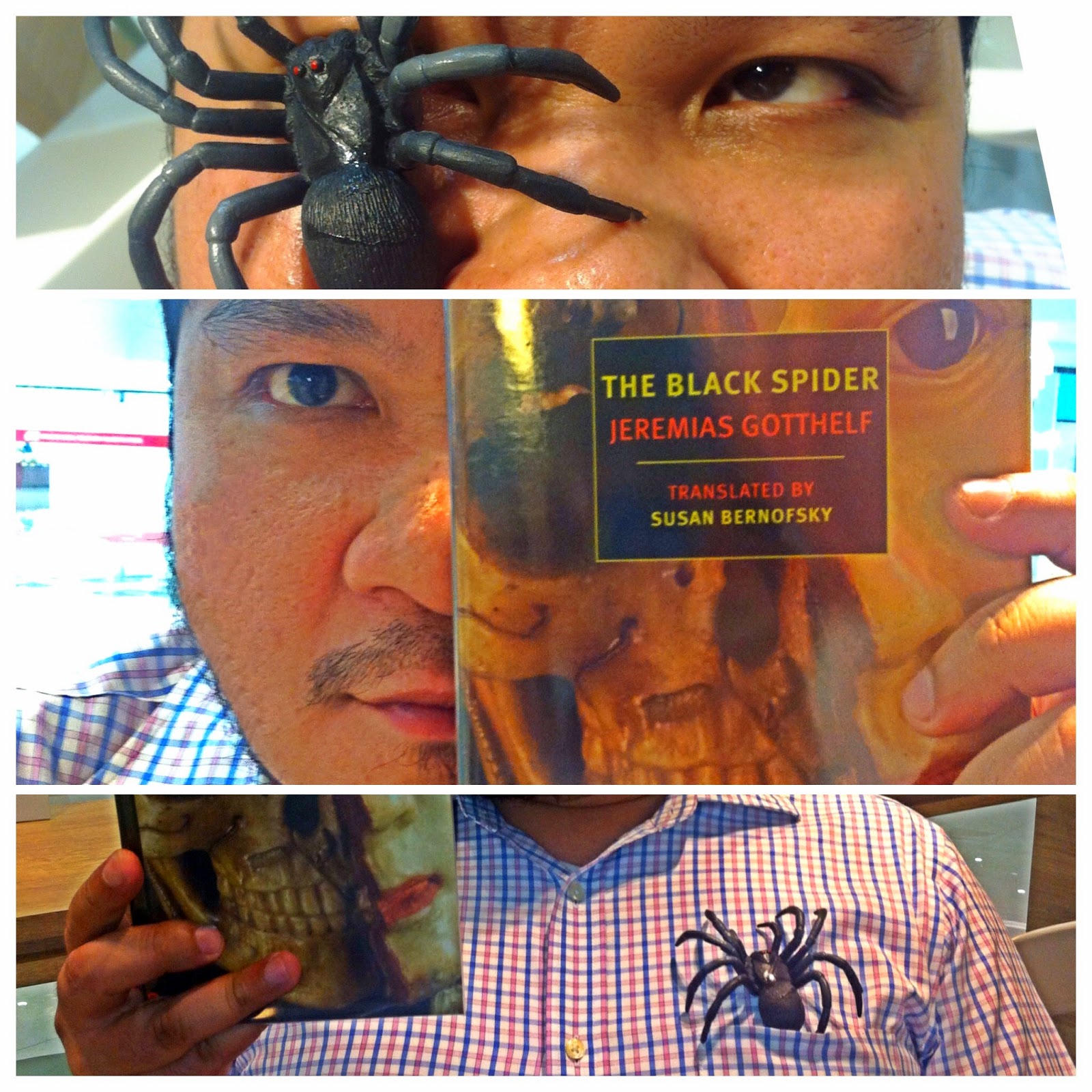
I love a good horror story. And after reading mostly the Victorians in my dead guy reading challenge, I believe the time is now ripe to go beyond the British realm. So I picked up Jeremias Gotthelf's The Black Spider. Gotthelf is a curiosity. He was a Swiss pastor who was a contemporary of Edgar Allan Poe. According to his biography, one difference between Gotthelf and Poe is that Gotthelf believed in the reality of the demon he created in his short stories. This thought gives me goosebumps, as the monster he created in The Black Spider is quite the character.

Upon opening the novel, which was published in 1842, one might think that it isn't a horror novel at all. The opening lines paint a picture of quaintness and the mundane. Gotthelf begins with a very vivid, albeit poetic, description of the town of Sumiswald, where the events of the novel take place.
Above the mountains rose the sun, shining in limpid majesty down into a welcoming but narrow valley, where it woke to joyous life creatures that had been created to take pleasure in the sunshine of their days. From the forest's gilded edge the blackbird trilled its aubade while the amorous quail intoned monotonous minnelieder from amid the flowers sparkling in the dew-bespangled grass, and high above the dark firs, lusty crows danced nuptial roundelays or else cawed tender lullabies above the thorny little beds of their unfledged chicks.
But all will not be well at Sumiswald, for in The Black Spider, a dark period in the history of that little fictional town will be told. It begins with a brutal knight, one Hans von Stoffeln, who makes a most inhumane demand on the farmers of his estate. It's a demand so impossible for the residents of Susmiswald that one of the women, Christine, is forced to make a pact with the devil. The devil in The Black Spider is one I haven't encountered before. No horns, fangs, and serpertine eyes and tails here. What Gotthelf conjured is a tall, red-beared huntsman dressed all in green and with a red feather in his cap. All he asks in return is an unbaptized child.

So the knight is made happy and all seems well in the little town. Until the first child is born. Christine takes it upon herself to get the child and bring it to the devil. But she is thwarted, as the child is baptized as soon as it is born. Then the second child is born, and the same thing happens. All this time, a black mark has been growing on Christine's face. The mark grows and grows till little spiders come out of it and kill all the cattle in Sumiswald. When the third child is born, Christine hurriedly goes to the mother's house and steals the child. But alas, when she was about to hand the baby over to the green huntsman, a priest sprinkles holy water on these two. The devil flees, and Christine shrinks and transforms into a small spider, which the priest casts aside in rescuing the poor baby.
The story does not end here. It's too clean, yes? The black spider wreaks havoc in the town, appearing in one house, killing people, and then disappearing instantly, only to appear again in another place. It's at this point that I begin to think how The Black Spider is very similar in theme to the story of the pied piper of Hamelin. But instead of people realizing their fault and correcting it by doing what has been previously agreed on, the people of Sumiswald resort to their faith. (Gotthelf, after all, was a pastor.) Of course they can't give a child to the devil, whether it's baptized or not. It was up to one of the residents of Sumiswald to outwit the black spider and trap it in a wooden post.

Gotthelf's novel is a quick read. It's just a little over 100 pages. One assumes that this tale, written in the mid 1800s, would have a plot that took its time to unfold. No. The Black Spider's narrative pace is a hectic one. And an atmosphere of dread and creepiness pervades throughout the pages.

Nightmarish—that's how I would describe Gotthelf's novel. I couldn't help but look over my shoulder every now and then. Just to check whether an 8-legged thing is slowly finding its way into one of my pockets. Don't get me wrong, I love spiders. They kill pests, and they'd mostly leave you alone if you leave them alone too. But the spider in this novel is something you'd wish you'd never meet. You might as well practically kill yourself if you do. There's just no escaping it. It's evil incarnate.

Again, I'm grateful that NYRB has published this forgotten classic. It's wonderful reading about the traditions and customs of small towns in ages gone by. There's an opening scene about a baptism that's about to happen. I never knew that there was so much eating involved before and after the ceremony. I guess in olden times, one stuffs himself silly when a baby enters the Christian world. Fascinating trivia.

Read this book if:
  1. You have a thing for classic horror stories.
  2. You love spiders.
  3. You're looking for a quick and scary read.

Sunday, March 16, 2014

F is for Fowles

Twenty years ago, as soon as I finished reading The Magus by John Fowles, I can still remember my feeling of elation. It was my first Fowles, and I thought that I got mind-fucked by the novel. With its seamless transition between reality and fantasy, The Magus was an exercise in patience and stamina. Finishing it was a rewarding experience indeed. I never planned to read another Fowles novel, but I needed a letter F for my dead guy challenge. So, Fowles's debut novel it is. (Flaubert, I will tackle you another time. Promise.)

Ah, The Collector. What a totally satisfying thriller you are. You're still quite a suspenseful read, even though you were first published in 1963. And I now understand why you were the debut that brought Fowles to everyone's attention. You do remind me of those movies that feature deranged serial killers and psychopaths ("The Silence of the Lambs" and "Psycho"). But what sets you apart from these thrill-a-minute films is how erudite you seem to be. Reading you wouldn't just satisfy one's craving for a sickening story; you also allow us to go deep into both the minds of the characters—the captor and the captive.

The novel, all 300 pages of it, features just two characters. Frederick Clegg, the lonely clerk who collects butterflies in his free time, and Miranda Grey, the art student whom Frederick develops an obsession on. And Fowles just gives us 4 chapters. With the first chapter, it's all about Frederick's point of view. It recounts his unhealthy attraction to Miranda, his winning a substantial amount of money in a lottery, and his meticulous planning of Miranda's kidnapping. Frederick is the collector referred to in the novel for obvious reasons. We just know that, probably, not everything is right in his calculated mind. With his money, he buys a cottage with a basement where he keeps Miranda.

Cut to the next chapter and we get to know Miranda a bit more. The Collector isn't just about the battle of wits between Frederick and Miranda. It's more of an exploration of the minds of its characters. With Frederick, it's all about obsession and how he's determined to make Miranda a part of his collection. In Miranda's chapter, we read about Miranda's life before her abduction, her willingness to be romantically involved with an artist 21 years her senior, her plans of escape from Frederick, and her eventual desperation at the futility of all her attempts. Her chapter made us feel for Miranda, and we really hope that she would have escaped by the novel's end.
One just can't imagine what prison is like from outside. You think, well, there'd be lots of time to think and read, it wouldn't be that bad. But it is too bad. It's the slowness of time. I'll swear all the clocks in the world have gone centuries slower since I came here. 
I shouldn't complain. This is a luxury prison. 
And there's his diabolical cunning about the newspapers and radio and so on. I never read the papers very much, or listened to the news. But to be totally cut off. It's so strange. I feel I've lost all my bearings. 
I spend hours lying on the bed thinking about how to escape. 
Endless. [page 250]
The Collector messes up your brain too, in a beautiful way. The sexual tension between the two characters is just nail biting, even though Frederick and Miranda never really do it. Well, almost. There was this one time when Miranda attempts to seduce Frederick, but it doesn't go as planned. Frederick couldn't perform. Somehow, a psychiatrist has told Frederick that he'll never be able to do it with a woman. And it is at this point that you get to thinking—just what the hell is wrong with you, Frederick? Why couldn't you get it up? And why do you do a complete 180-degree turn when the object of your obsession offers herself up to you? All of a sudden, you think of Miranda as a charlatan.

I should read more John Fowles. Such a deft writer, that one. Comfortable in varied writing styles. Frederick's narrative is an exercise in control and in looming terror. Miranda's, on the other hand, spirals downward from being whimsical, introspective, and then surrendering. You literally feel her descent into madness and despair. It's a truly chilling account.

Read this book if:
  1. You love psychological suspense.
  2. You have an unhealthy obsession of things and, possibly, of certain persons.
  3. You know that that seemingly harmless dude sitting next to you in the bus keeps a woman prisoner in his basement.

Sunday, March 2, 2014

E is for Eliot

And I've finally read my first Eliot! Although I initially planned to read Middlemarch, I had to shift to Silas Marner while I was midway into the former. I wasn't getting the feels for Middlemarch. And besides, Silas Marner is reportedly the author's favorite among her novels. I still plan to go back to that doorstop that is Middlemarch but not until the latter part of the year though.

So the eponymous Silas Marner is probably the most sympathetic, the mostly easily likeable, character I've come across. The short novel (just a little over 200 pages) is really his story of redemption. It's a tale involving his fate because of the actions of the people who have wronged him and of how the presence of a child can force our humble character to make a 180-degree turn and look at life in a more positive light.

Because Silas Marner, a weaver, is really like Scrooge in the earlier parts of the novel. Having been falsely accused of stealing, he leaves the town of his birth and decides to live in the town of Raveloe. In that town, he amasses a somewhat substantial fortune from his daily toil of weaving. He spends every night holed up in his cottage and running his fingers through all that gold and money. (Well, honestly, I would do that too. Who wouldn't, yes?) Silas now chooses isolation, as he's been betrayed by people in his former hometown.

Enter a two-year-old girl, who finds her way to the cottage of Silas Marner after her mother dies from exposure. Silas decides to raise the girl as his own, thinking that the baby, who he named Eppie, is a blessing from above. At this point, Silas somehow has the idea that this baby rightfully belongs to him—that the baby is owed him, in fact. But there's more to Eppie though. It turns out that her dead mother was the wife of Godfrey Cass, the eldest of the two sons of a very wealthy person in Raveloe. At that time, Godfrey had his eyes on marrying Nancy Lammeter.

When Eppie was discovered by Silas who brings him to the village pub, Godfrey immediately knew that she was his daughter. Fearful that his marriage prospects to Nancy would be ruined, he decides to  keep his mouth shut. Godfrey's younger brother, Dunstan, has been missing as well. And we know early on that it was Dunstan who entered the house of Silas and took the money away.

The disappearance of the money and the arrival of Eppie have profound effects on the life of Silas. Before, it's as if the money served as all, screening off Silas from the happenings in the town. The townsfolk left him alone and considered him to be an eccentric. When they find out about the robbery, they reached out to Silas. They gave him food. They offered their advice. They acted neighborly and Christian. When Eppie came to his Silas's life, people were no longer afraid of him. With Eppie, Silas came into his own as a member of the community. No longer was Silas lonesome.
In old  days there were angels who came and took men by the hand and led them away from the city of destruction. We see no white-winged angels now. But yet men are led away from threatening destruction: a hand is put into theirs, which leads them forth towards a calm and brighter land, so that they look no more backward; and the hand may be a little child's. [page 150]
Cut to 16 years later, and of course there must be a wedding. Our Eppie has blossomed into a fine young woman, and she has received a proposal from Aaron, her childhood friend and the son of Mrs Dolly Winthrop. Aside from Silas, it is Mrs Winthrop whom I particularly like. Early on, she was always there to lend comfort to Silas, and it was she who was instrumental in bringing Silas to the Christian fold.

Towards the end of the novel, it is revealed to Eppie that her real father is Godfrey. This revelation serves its purpose of easing the guilty conscience of Godfrey, who have hidden this secret from his estranged daughter and his goodly wife. But Eppie will have none of it. She loves Silas, her working-class father. She loves living among the working class. She will not be made into a lady. And at this point in the novel, I admire Eppie for her chutzpah.

I really enjoyed Silas Marner. Eliot shows us a forgotten time in provincial England, where people take no hesitation in helping people in need. It's a time when you know all the people in the pub at the end of the work day. It's a time when it was relatively easy to start with a clean slate. Silas Marner is that kind of novel that you close with a feeling of hope. And these days, we all could be a little more hopeful.

Read this book if:
  1. You like novels set in provincial England.
  2. You know that people inherently are good.
  3. You believe in angels.

Sunday, February 23, 2014

The Rosales Saga Book #2: Tree

When your book club has a read-along, you do your best to catch up with. No questions. Never mind that you missed out on the discussion of the first book. There are still 4 more books anyway. And that's what happened to me when the book club decided to do a read-along of F. Sionil's José's 5-novel historical epic called "The Rosales Saga." Work kept me from participating initially, but I couldn't pass this up. It was just this weekend that I got to read the 2nd book in the saga. No worries though. Fortunately, the books are stand-alone works.

So, the 2nd book—Tree. A lot of things struck me as I finished the book. First is what I would call texture. Sionil José's description of setting is so detailed that you feel you're right at the center of events. Aside from the nuances of the place, there's a certain lyrical quality to the writing even when he simply describes the places the unnamed narrator goes to. Lots of atmosphere, vivid on the details, a keen eye even for the mundane and the prosaic.
As the rains subsided and the fields turned green, the mud settled and the river  acquired a clear, green hue. It would no longer be swift and it flowed with a rhythm, broken by small ripples in the shallows. It was at this time that we bathed in it and dove to its depths to discover what secrets it held. Now, too, the women took their washing to the banks and they would squat before wide tin basins, and whack at clothes with wooden paddles.
Another is how episodic the chapters seem to be. The book is really a coming-of-age tale of a boy, whose privileged family play a huge role among the townsfolk of a small town in Ilocos. Mostly, it is about the unravelling of the boy's relationship with his father, a powerful person under the employ of one Don Vicente. As a character, Don Vicente appears briefly in the novel, but his influence can be felt looming on every page. It's as if I were reading a local version of The Godfather, with Don Vicente as the head of the mafiosi and the boy's father, Espiridion, as his consiglieri. Espiridion is a character difficult to like. He has his fingers on all the comings and goings in town. Hardened, ruthless, with very few soft spots.

The chapters can indeed be likened to individual episodes. In one chapter, we read about a travelling circus who visits the town. In another, the unplanned marriage of two relatives who find themselves spending the summer in the house of Espiridion. In one chapter, there's an anecdote about a relative who finds out that the townsfolk have been cheated of their land and is determined to set things right. And in other chapters, we discover the unfortunate lives of the family's household help. A lot of these episodes don't end well. The righteous man commits suicide, the star of the circus show has an accident and never performs again, the help die from poverty. And the boy? He doesn't really come to terms with his father.

The book's spirit is not really an upper. Tree is a sad read. It shows you that the poor want for justice, and that a small impoverished town so far removed from the nation's capital can appear chaotic despite its calm veneer. The town may be picturesque, based on our unnamed narrator's eye, but it's rotten to the core. Peel the eggshell and what you get are centuries-old problems brought about by the corrupt feudal system of our colonists. And what stinks really bad is that these problems are no longer being wrought by white people but by the very same brown-skinned Filipino who doesn't think twice about making life bitter for his fellow citizen.

One closes Tree with a feeling of unease. Our ancestors never had an easy life. It was even more difficult during wartime. But what makes it even more uncomfortable is that a small town, without even knowing it, is waging its own war. The rich prey among the poor. The poor futilely fighting back and eventually accepting their sad circumstance. It's one picture that's very painful to see—people swimming upstream against forces of history, of terrible human nature, of the cruel fates, only to be swept away by the current, helpless, quietly sobbing, and eventually drowning.

Read this book if:
  1. You have a thing for historical epics set in the 1940s.
  2. You love unconventional coming-of-age stories.
  3. You know that sad books can be beautiful reads.