Showing posts with label teen angst. Show all posts

Sunday, September 22, 2013

Redeemed

Ah, the Printz medal. If a book has been awarded the Printz, even though it's just an honor book (shortlisted for the main award), then it's bound to have a few controversial themes. And A. S. King's Please Ignore Vera Dietz is anything but controversial. I know this is a cliche, but I think it's true and has to be said about King's wonderful young adult—this novel pushes the envelope.

Edgy, that's what Please Ignore Vera Dietz is. But it does have its flaws. Flaws which the reader might tolerate if only for the somewhat different storyline and narrative. So, who the heck is Vera Dietz and why the plea to ignore her? She's the novel's junior high school student protagonist. Vera is a character seeking redemption for her best friend, Charlie Kahn, who's recently died following a tragic incident involving the fire at the local pet shop.

Vera and Charlie have been best friends for so long, but something comes in the way in their friendship, specifically someone named Jenny who becomes Charlie's girlfriend. Vera is what we would call a, pardon the word, slut. She offers oral sex to Charlie who wisely refuses it. However, in an act of stupid revenge so typical of people her age, tells everyone at school that Charlie's father physically abuses her mother. Everything is blamed on Vera, as Charlie was made to believe. Charlie then tells everyone another secret involving Vera—that her mother was once a stripper.

Of course, everything spirals downhill from here. Vera's father a reformed alcoholic, is still hung up on the fact that his wife left them. Vera is probably headed toward the bleak path of alcoholism herself. Hey, if you were forced by your father to work your ass off (full time!) to save for college on top of maintaining an A average, then you'd probably drink yourself to death too. And it doesn't help that alcoholism does indeed run in Vera's family. But hats off to Vera! She decides one day to just simply stop and try to have a "normal" relationship with her father. Now I think that this is one of the novel's flaws. I was surprised that she could just stop. Just. Like. That.

If you're a junior high school student who's best friends with someone whom everyone thinks burned the town's beloved pet shop down and whose mother is actually a stripper, then you'd think that everyone should just ignore you. Something's nagging at Vera though—the thought that she should clear up Charlie's name concerning the fire. She owes it to herself, her dead best friend who she was in love with, and her best friend's family. In the end, she redeems Charlie's name, and when she does, she truly comes of age as she comes to terms with her father and her willingness to have control in her life.

A lot of readers may find it difficult to suspend their disbelief in some of the chapters of Please Ignore Vera Dietz. The chapters wherein we read Vera's thoughts are wonderfully candid. But those that feature the voice of the dead Charlie, the inanimate pagoda, and Vera's father require a bit of work. Sometimes, these chapters aren't believable enough. Plus, Vera's father shares flowcharts on how to deal with certain aspects of life, and these flowcharts feel iffy. They stick out of the novel like a sore thumb. If the point of these flowcharts is to show how methodical Vera's father is in making decisions, all right, they're fine then. Otherwise, they're just a waste of valuable page space.

I did enjoy Please Ignore Vera Dietz though. How ironic to have that title in the book, especially when the character of Vera Dietz, her aspirations, her insecurities, her addiction, her failed love life, and her angst are just so hard to ignore. They're quite compelling to read actually.

Read this book if:
  1. You like controversial young adult books.
  2. You have a best friend whom you were secretly in love with.
  3. You know the importance of redemption.

Monday, April 22, 2013

Of best friends, ex-boyfriends, and a very troublesome list

I'm currently in a David Levithan phase, which was happily triggered by the wonderful Boy Meets Boy. That's why I've been busy visiting bookstores for the past weeks, scouring the shelves for Levithan's young adult novels. And I'm thankful that Levithan has brought me out of that reading rut. So glad that that unfortunate phase is over, well at least for now.

My 2nd Levithan read is a collaboration with Rachel Cohn: Naomi and Ely's No Kiss List. The book is very cosmopolitan, with it being set in New York, having 2 fashionable and very open-minded teenagers as protagonists, and touching on the concept of friendship in the context of one's romantic relationships.

We all have that one person who always has our back. For Naomi, it has always been Ely. These two have always been inseparable, and I can't help but think that it's by default. They grew up in the same NYC apartment, went to the same high school and are now in NYU, and have come up with a list containing the names of boys that are officially off limits to any of them. I completely understand the concept of the list. One cannot date someone that your bff doesn't approve of, yes? For these two, their friendship is priority. Of course, Naomi isn't just your typical fag hag; she's in love with Ely, who unfortunately for her is also into boys.

Things get complicated when Ely kisses Bruce the Second, Naomi's boyfriend. While Bruce the Second isn't on the No Kiss List, it's just a given that current boyfriends are off limits. But is Bruce the Second gay? Levithan doesn't clearly say so. I'm getting the impression that Levithan is shying away from labels, which can really get very tricky and restrictive. When Bruce the Second's mom asks him if he's gay, he responds with, "I'm just not straight." Okay, I can totally work with that.

What I'm not okay is that there are quite a few unnecessary characters in the novel. They just come and go; they just muddle up the story. There's Bruce the First, Robin (a girl) and Robin (a boy), Gabriel the doorman, their fellow NYU undergraduates. It can be quite frustrating, especially when Levithan didn't give clear voices to the minor characters.

The resulting conflict between Naomi and Ely leads to a healthy realization. Both of them have always been associated with each other that their separation, albeit temporarily, makes them realize their individuality. Naomi comes to grips with the fact that it's futile holding out for Ely. And Ely is finally comfortable with having a "serious" relationship with someone that he might really be in love with.

Naomi and Ely's No Kiss List is a quirky but beautiful novel about friendship. And love too. We love our friends. It might not be the same way we love our partners, but this love is as important to us nonetheless.

Read this book if:
  1. You've had a bff all your life.
  2. You value the opinions of your close friends when it comes to the persons you date.
  3. You hate labels.

Tuesday, April 16, 2013

I fell in love with this book

It's been a while since I gushed over a book, and it feels great to be doing it now. Yes, I am seriously fawning over David Levithan's debut novel Boy Meets Boy, a novel published 10 years ago. As I closed the book last Friday night, I was swept away by the beauty of Levithan's story and his writing. I've now included it in my very short list of all-time favorite books.

The world that Levithan creates in this novel represents an ideal. If you're jaded, you'd think this would be speculative fiction. It's a world where teenagers, gay or straight, can date anyone they want to, without fear of being ostracized. It's a school where the star quarterback is also the homecoming queen. Parents, well at least the main character's parents anyway, do not think too much about their children's sexuality but shower them with all the love that they can give.

I found it very easy to relate to all the characters Levithan wrote about in Boy Meets Boy. Paul, the 1st 'boy' in the title, is so unlike in your typical teenager. He has no tinge of insecurity and knows what he wants. However, like your typical teenager, he becomes awkward when he meets 'Noah', a senior who just transferred to his school. Right from the start, I just knew that Paul should end up with Noah. If they didn't, I would just die. There's no hope for the world.

But hope isn't a concept that's wanting in Boy Meets Boy. Paul hopes that he ends up with Noah. He hopes to patch things up with Joni, one of his best friends, who's dating a schmuck. He hopes that he wouldn't bump into his ex, Kyle, who keeps popping up in all the wrong moments. In the latter part of the novel, Kyle makes amends with Paul and hopes that things turn out better for them as friends. And Paul hopes that the parents of his other best friend, Tony, would step down from their religious pedestal and see that there's nothing wrong with being gay.

If I knew that Boy Meets Boy would have memorable lines, I would have kept a highlighter with me while I was reading it. I just fell in love with the beautiful prose that Levithan wrote. Here are some of my favorites:
I find my greatest strength in wanting to be strong. I find my greatest bravery in deciding to be brave. I don't know if I've ever realized it before. . . I think we both realize it now. If there's no feeling of fear, then there's no need for courage. 
With some break-ups, all you can think about afterwards is how badly it ended and how much the other person hurt you. With others, you become sentimental for the good times and lose track of what went wrong.
Now, I don't believe in doing hugs halfway. I can't stand people who try to hug without touching. A hug should be a full embrace - as I wrap my arms around Tony, I am not just holding him, but also trying to lift off his troubles for a moment so that the only thing he can feel is my presence, my support.
Part of love is letting a person be who they want to be.
My only gripe is that the novel is too short! It's that kind of book that you just want to go on forever. You feel that you just need to know everything that happens to these quirky characters. You wish that there were a sequel. And it's the kind of novel that makes you want to write fan mail to the author and urges you to hunt for his other books. I love Boy Meets Boy, and I hope more people would love it too.

Read this book if:
  1. You know that it's only a matter of time before we get to that ideal world.
  2. You like boys meeting boys, or girls meeting girls.
  3. You love LGBT fiction.

Monday, January 2, 2012

Smells like teen spirit


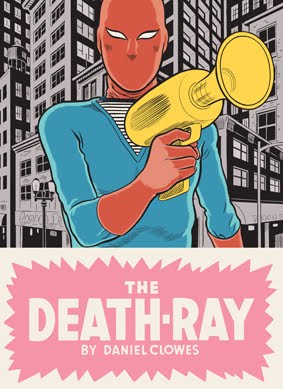
That's Andy's best friend above. Louie. That photo shows him shouting the P word to distract Andy from making the shot in a basketball game. Louie, however, isn't the main character in Daniel Clowes's Eisner- and Harvey-award winning graphic novel, The Death-Ray. Andy is.


The Death-Ray isn't about a superhero at all. It's a graphic novel about teen angst. Andy, the main character, somehow reminds me of Napoleon Dynamite. Almost every panel in this book depicts Andy as a loser. And it doesn't help that he's best friends with Louie, who is as much a loser as himself.


And so Andy and Louie go through their high school lives inconspicuously. Andy fancies himself to be the boyfriend of a blonde who he writes letters to frequently. The blonde lives next door. He also fantasizes about the African-American woman who takes care of his invalid grandfather. Things get a bit more exciting when Andy inherits the death-ray, a gun that zaps things to nothingness.


Of course, Louie tries to capitalize on Andy's weapon, urging Andy to zap the people that make their high school lives a living hell.

I was surprised to note that The Death-Ray is as much about a death ray than, say, The Da Vinci Code is about gay erotica. Andy is compared with Holden Caulfield in a lot of reviews. I haven't read Catcher in the Rye, but if HC is every bit as angstsy and introspective as Andy, then the comparison deserves merit.

Clowes's work is very episodic, with sections running at a page on the average. (The Death-Ray is a big book, so a page can have more than 20 panels.) There's plenty of space devoted to character development. By the novel's end, you see a part of yourself in Andy.

The drawings are very clean and a bit stiff IMHO. However, the stiffness works with Andy and Louie's apparent aloofness to the world around them. It's the kind of artwork style you'd expect to appear on a graphic novel that's more character centered than plot driven.

The Death-Ray has lots of panels showing faces and several lines of dialogue. The scenes involving the characters can be funny, though it isn't the usual in-your-face sort of humor. Again, it reminds me of the humor that's wonderfully employed in movies like "Napoleon Dynamite".


Daniel Clowes has earned a huge following, with his other works such as Wilson and Ghost World.

Read this book if:
  1. You like unconventional graphic novels.
  2. You identify with Holden Caulfield.
  3. You'll read anything that won the Eisner and the Harvey.