Showing posts with label classics. Show all posts

Wednesday, October 3, 2018

Peter's Pretentiously Pedantic and Prodigious Proust Project


Every year, I make it a point to read Marcel Proust's In Search of Lost Time, or at least the first volume, Swann's Way. And every year, I fail, big time. I can't recall a time when I made it past page 50. My editor self always feels attacked by Proust's looping sentences. And what the eff is the deal with describing one's going to bed in no less than 10 pages. Go to bed, get a kiss from mama. That's it. But not with Proust. Every act, however mundane, gets the royal treatment. Fortunately, there aren't any scenes set in the bathroom. Otherwise, we'll get long, winding sentences about a character's efforts and musings in doing the number 2.

But the hell with it—I am going in. I will read not just the first volume, but all effing seven. I will be so deep in In Search of Lost Time (or Remembrance of Things Past, if you go by C. K. Scott Moncrieff's translation) that I'll be sick of madeleines and long pages of French prose wherein nothing seems to be happening. I will laugh in the face of boredom. I will wallow in the fields of ennui. I will fight the urge to throw the books at walls or at annoying people. I will fart run-on sentences and elliptical clauses.

And why am I doing this? Because I have masochistic tendencies, and Proust's books will be my outlet. Because every time I see a picture of Proust, he seems to be mocking me. "Weakling!" "You're like the lowest form of reader? Merde!" "Tu pues du cul!" (I have my French teacher to thank for this wonderful bit of profanity. I think it means something like smelling like you came out of an ass.) Because I feel a special affinity for Proust. I mean, this was a guy who spent most of the daylight hours in bed and only left it just to go to dinner invites. The life! Also, he was gay. So we're like sisters.

But, but, but. This doesn't mean that I'll read all seven volumes in one go. There will still be the occasional suspense novel or the sappy gay romance or the latest hyped bestseller. If anything, I'll probably read a volume between one or two other books that I finish. Right now, I've rediscovered how enjoyable it is to read the Agent Pendergast novels by Douglas Preston and Lincoln Child. (I stopped reading the series a few years ago.) So Swann's Way after a couple of these thrillers. Because nothing makes a better palate cleanser than a French novel about French people doing French things (except for French kissing and the blowjob, which I heard the French apparently invented).

So I figure it'll take me at least 3 years for this project, no? But I'll be blogging about my progress every now and then. And probably, just to annoy some people, I'll follow Proust's writing style in my posts. It's like my "eff you" to Twitter shoutouts. Because why would you use just 140 characters to say something when you can go with 10,000? 

Wednesday, August 22, 2018

If I turned into a cockroach


I finished another story by Kafka recently—the one where the main character wakes up one day transformed as a cockroach, "The Metamorphosis." And can I just say that I loved the absurdity of it all. Like when you read The Idiot, you just swallow your disbelief and just run with it. Of all things that one can turn into, Kafka had to choose a cockroach, that vile insect that everyone seems afraid of. And my goodness let's not talk about the flying variety.

Now I'm not a person who's uncomfortable around insects. I love them arthropods—beetles, ants, termites, mantises, etc. Yes, some of these are pests, but as a Bio major, I know how important they are to the ecosystem. But cockroaches are another matter. I have always speculated what their roles are. Ah, one of the great mysteries of life. These critters should be annihilated. When we were in line at a temple in Bangkok, we saw a cockroach idly crawling near us. Of course, none of us dared to step on it because, you know, Buddhist respect for all life. I could imagine all the feelings of disgust and desire to scream and flee from the insect that they bottled inside. Of course, the bf and I were just amused. We come from a third world country; we literally sleep with these critters.

I have a weird affinity for spiders though. I can't bear to hurt these cute animals. When you meet a spider, keep in mind that it's probably more afraid of you than you are of it. And it'll probably sting only when provoked. Interestingly, this morning I saw a huge spider in the shower. Probably with a leg span as long as my hand. (BTW, I have huge hands.) So you can probably understand my dilemma. Should I risk it and take a shower? Or should I just splash water on my face and just put baby powder all over my sexy body? In the end though, I took a very quick shower (i.e., 2 minutes) at the farthest corner of the bathroom.

And crap, I have digressed in the two previous paragraphs. So let's go back to "Metamorphosis" and how I reveled in Gregor Samsa's transformation. Imagine waking up one morning being unable to immediately get out of bed because you've discovered that your body is now flat and you find it difficult to move your legs, all 6 of them. Then your family's, like, no biggie, we'll just lock you in your room and feed you every day. I find it ironic that Gregor would turn into a cockroach, that creature which seem to serve no purpose at all (except to make white people squirm). Prior to this metamorphosis, Gregor was the breadwinner in his family, earning enough not just for his family's day-to-day but also to pay his parents' debts. But you couldn't do that anymore if you're a cockroach, no?

Eventually, his family's tolerance to his new form reaches a tipping point—they can no longer stand having him in their house. At one point, in a hysterical set piece, his father was trying to step on him while Gregor was scurrying around the walls and the floor of the room. "Metamorphosis" is a sad story of a man caught in a surreal circumstance. Kafka doesn't even bother to explain this transformation. And why would he? It's the utter in-your-face absurdity that makes the story. 

Monday, August 13, 2018

Kafka virgin

My two favorite quotes from Kafka's The Trial
Our book club's selection for this month is Kafka's works, beginning with the novel The Trial. I've never read Kafka, and I have this notion that his works will read like those of Russian novelists such as Tolstoy and Dostoevsky. I have a special affinity for Tolstoy's and Dostoevsky's novels. I don't mind that their main characters are drunkards (or throw themselves in front of a moving train), they live in squalor, and the weather is always freezing. Somehow, pondering about life's biggest questions seems easier if you have these unfortunate conditions. Maybe I'm just a closet romantic, no? But Kafka's The Trial is completely different in tone and subject matter. And I am jarred. Well, at least for a few minutes.

The first thing that struck me about The Trial is its pace. The writing is so frenetic that it leaves you catching your breath—long paragraphs with hardly any punctuation, dialogue that you have to decipher as to who exactly is the one speaking the lines, and events happening one after another in a span of a few sentences. I love it. The pace is perfect in evoking an atmosphere of claustrophobia and unpredictability, as these characterize the situation tha Joseph K., the main character, is going through. What exactly can K. do when he wakes up one morning to find people in his apartment who are there to arrest him for a crime unspecified throughout the story?

But pacing aside, the novel's story is told straight through. But the range of situations that K. finds himself is so vast that it forces you to question the genre of the novel. Is it absurdist? Is it metafiction? Is it a satire? But cares about genre these days anyway? I don't. I just want a good story. So, these situations—they can go from being absurd one moment to sensual the next. And it is this absurdity that makes me forgive K.'s wrongful actions or, more often, inaction to be able to get himself out of that ridiculously surreal situation. How can one act rationally if the circumstances that go your way are irrational?

Bureaucracy is one of the prevailing themes of The Trial. No matter how many people that K. meets who can help him with his coming trial, no one seems to have a clear idea on how to help. K. is forced to consult a lawyer, listen to a preacher, and talk to a painter and court reporter. They all present a grim outlook for the trial. It's a bleak picture that Kafka paints in this story. It's not exactly entertaining, but it certainly makes you pause and think. I have so many questions after finishing the novel. Thank goodness for Google.

The cover of my copy of The Trial kicks ass.

Wednesday, July 11, 2018

Eye candy

I must admit it—I'm a book cover junkie. I mean, there's just no way that I'm gonna spend hard-earned money on a book with that has a bad cover. Books are expensive, no? And here in my corner of the world, I noticed that book prices have become quite steep lately. (It couldn't be because of that stupid effing TRAIN law, could it? But everything's seems pricier lately because of it.) Also, the book cover is like the cherry on a banana split or a sundae. It somehow completes that damn thing, making it prettier. Good ice cream and luscious cherry = one helluva dessert. If that cherry ain't shiny red and didn't have that stalk that people with dextrous tongues can tie into a knot (oooh, the possibilities!), then what's the point. I might as well just eat sugar to end my meal, which I may have done a few times before, in the past, like yesterday.

If you think you've written a fine novel or the next Harry Potter or some sexy piece of fiction that people would get their rocks off to, then wouldn't you want to have one eye candy of a cover? Yes, I know that beauty is subjective (what isn't?), but there are certain things in life that make you gasp because it's beautiful, yes? I'm not even talking about the principles of design, as I know nothing about them. I guess I'm just talking about a beautiful, well-designed cover in the same way that the US Supreme Court couldn't even give a good definition of what's pornographic. In their words, "I'll know it when I see it."

I love simple book cover designs. So no screaming typefaces and sloppy Photoshop. And also, no cliches like headless women for romance books. I know that my aesthetic taste differ significantly from many people, but when it comes to book covers, we bibliophiles can spot an ugly cover a mile off, right? It's this difference in our aesthetic tastes that make for interesting scenarios. Like clothes shopping with the bf, for example. I can recall countless times when I particularly liked a shirt or a shoe and then asked him if it looked good, and then felt thrown off when he said, "Eeeehhhh" or "Just choose another one" or my most dreaded "It's just okay." The thing is, I kinda trust him on these things. He's a graphic designer, and a damn good one. Still, farewell cute shirt, bye-bye awesome shoes. You could've been mine.

Anyway, I've digressed. So let's return to book covers. The photo below is a favorite.


I don't think these Signet Classic editions are in print anymore. Sad. So I get hold of them at secondhand bookshops. I've read a few of these babies when I was a teenager, and I have yet to met a book cover from this line that I didn't like. Let's break it down.

Lots of white space on this one. So it doesn't appear to be busy. Notice how the author's name stands out, with the clean serif typeface. Normally I don't like things written in all caps, but I'll take this one. The typeface used is so elegant that it doesn't come across as being loud. And the title! It's done in calligraphy! I'm a bit wary when I see calligraphic typefaces nowadays, as most of them are done by computer, which I think is sort of cheating. Beautiful calligraphy takes time to do. I know that the calligraphy on this cover is done by hand because of the slight letter differences. Look at all three letter Es. They have different  lead-in and exit strokes and different eyes (which is the enclosed part in the small letter e). Oy, typography orgasm!

The most awesome element of the Signet Classic book covers would have to the figures which are all hand painted. The two ladies in this cover have such intricate details in their composition. In a way, it's a painting within a painting, as the ladies' dresses serve as a canvas to smaller painted scenes. They don't make these kind of covers anymore, I think. Such a shame.

Of course, it wouldn't be the same if I weren't going to nitpick. One thing that I don't like about these editions is that the ink smudges. So after reading more than 10 pages, your fingers have this grayish smudge. This means only one thing though—you can't pick your nose after reading. 

Monday, July 20, 2015

Why read Edith Wharton's The House of Mirth

One can usually tell if a book is a favorite by having multiple copies of it.
The top one has foxed, but it's a beloved copy.
I read The House of Mirth twice using that old edition.
Sometimes, I just wish that I were filthy rich. Wait, who am I kidding? So let me rephrase: All the time, I just wish that I were filthy rich. In life, all you really need is 100 million dollars.

Which is exactly one of the reasons why I love Edith Wharton's novel, The House of Mirth. It's a novel that lets me peek into the world of New York City's old rich at the turn of the century. And the picture it shows isn't pretty. It's a ruthless place to be, in fact. NYC's upper crust society is so exclusive. If there's one word to describe them, it'll have to be anal. Damn tight, these folks are.

There are plenty of reasons to read The House of Mirth. Lily Bart, the main character of the novel, is such a polarizing figure that it's impossible not to have a strong feeling about her. Wharton's novel is basically about Lily Bart and her attempts to penetrate the old rich by marrying someone with money. Calling her an ambitious bitch would be an understatement.

But the novel ended so tragically that it broke my heart when I closed the last page. Lily Bart is all to blame for her fate. Yes, she found herself in a pit of vipers, but there were several instances when she could've had it good. There were lots of "almost" proposals from different men, but somehow, she manages to f--- it up! Oh, Lily Bart! I love you, even though the stars didn't really align for you.

I love The House of Mirth to bits. I love it so much that I even moderated a discussion of the novel for the book club. Needless to say, the discussion made it evident that there were two camps: the pro-Lily and the anti-Lily camps. It was tough staying neutral, being the facilitator. Even though in my mind, I had my hands around the necks of those self-righteous anti-Lily people.

Speaking of book clubs and the wealthy, last weekend afternoon saw the book club at a rather fancy tea place in the metro. We discussed Kevin Kwan's best-selling novel, Crazy Rich Asians. As the novel had crazy rich Singaporeans as characters, Joko, the moderator, opted to hold it at TWG, which is originally a franchise from Singapore.
The obligatory group photo after the discussion
I'm at the far left in the light green shirt.
I specifically asked the person to take the photo from this angle.
At this angle, one always appears thinner.
I'm not big on iced tea, as I always feel a bit bloated after drinking it.
But I was transfixed watching this lady make this fancy shmancy iced tea.
Iced tea at home: instant powder + water. Stir and then add ice.
When we feel a bit more extravagant, we add those cute little umbrellas.
The high tea set, or as would call it—the afternoon tower of carbs
Joko ordered several of these. (Thank you! Mwah!)
Scones, good. Scones + clotted cream + jam, better!
Other tea sets had macarons, which my seatmate and I kept on stealing.
Anyway, back to Kevin Kwan's novel. I did find Crazy Rich Asians entertaining. I didn't think too much of it, as it was just about crazy rich Singaporeans guarding their crazy ass money by keeping their crazy rich families very exclusive. So yes, there's interbreeding. And Kwan certainly knows all the big name fashion designers as there's never a page where a luxury brand isn't mentioned.

I got a bit railed up when somebody mentioned Edith Wharton and Kevin Kwan in the same sentence. Apples and oranges, people! Both novels had rich characters, but the similarities end there. You read The House of Mirth because you want to delve into the characters' minds. You read Crazy Rich Asians for the fluff and the mouth-watering descriptions of Singaporean food.

I would recommend both books though. So you see, I'm not a snob. One you take to the beach, and the other you read before going to bed. Crazy Rich Asians is funny as hell. It's gossipy, biting, and hysterical. I have to hand it to Kevin Kwan; he certainly knows what he's writing about—from the schools, clubs, hawker centers, and fashion boutiques, to Chinese traditions and class systems.
Just your nerdy Asian, playing with the fisheye lens
I recommend Crazy Rich Asians, but with a caveat.
After reading it, you'll realize that you're dirt poor.
And there's a sequel—China Rich Girlfriend. What's with the title?
Do R and I look rich? Well, maybe just crazy.
This was actually taken at a children's party, held just before the discussion.
I remember having 4 glasses of red during the party.
So I might've been a little tipsy during the discussion.
This past week, I discovered the joy of coloring books. I never realized how therapeutic and stress-relieving they are. I believe they're all the rage these days, well at least here in Manila. My only concern is that they're another thing to keep me from reading. But that's a happy problem. I love my happy problems. They make my boring life seem very exciting.
My current coloring book collection, bought from bookstores
For some strange reason, I find myself having 4, even though I just started last week.
R is an enabler. Every time I ask him, "Should I get this?" He always says, "YES!"
So I blame R. But he's très generous. The Art Therapy book came from him.
The first sheet that I finished, yesterday afternoon
Not too happy with what went on with the feet though.
Who has ever seen gray socks? Should've left those areas uncolored.
This came from the Japanese Prints book.
My second, which I did immediately after the Japanese print
I was looking for a P, but alas, there was none. Had to settle for S.
This came from the Typography Colouring Book.
By the way, I was multitasking—watching "Jane the Virgin" while coloring.
Never, ever underestimate the amount of time you plan to spend finishing a plate.
I actually paid attention to the timings. Goodness, 2 hours per plate!
Right now, I use colored pencils, but I'm thinking of getting markers too.
All those sharpening is driving me crazy.
R is so talented. He's a graphic artist by profession.
So all these are, like, peanuts to him.
He helped me out by rendering flesh tones to the skin areas.
By the way, I lost those blue glasses during the discussion.

Wednesday, June 17, 2015

Why read Faggots

Because it's Pride Month! Because this 1978 novel is groundbreaking. Because there's a sexy Winston cigarette man. Because it's a study of excess, and like all things excessive, it's heartbreaking to know what will happen later, when all things bright, care-free, pleasurable, and orgasmic come crashing down because of disease. Ah, Faggots, I couldn't recommend you enough.

Most people would know Larry Kramer as the playwright who penned "The Normal Heart," the play that has AIDS and the gay generation who first suffered because of it as its center. I love that play. If you haven't read it or seen it on stage, please do and have a box of tissues at your side. I guess the same thing can be said of Faggots. You still need a box of tissue, but for a different kind of body fluid. Wink, wink.
Of the 2,639,857 faggots in the New York city area, 2,639,857 think primarily with their cocks.
You didn't know that the cock was a thinking organ?
Well, by this time, you should know that it is.
― Larry Kramer, Faggots 
Faggots is a wonderfully dated work. I feel its appeal and charm grows through the years. It's somewhat of an autobiographical work, as the main character, Fred Lemish, is loosely based on Larry Kramer. Lemish is one of the many characters we meet in this kaleidoscope of a novel, where each character comes to grips with his sexuality, his place in the 1970s gay community, his continuous search for sex, love, and belongingness.

Never again will the gay community experience such excess, where it's de rigeur to go to bath houses, participate in orgies, be oblivious to people watching you as you engage in sex. The 1970s were a time when people actually had to go out of their houses to hook up. There wasn't any Grindr to speak of. There weren't any pics of your private parts going around. You have to see these intimate parts up close, usually in the club's bathroom. And if you approve, you take him home.

One of the characters in the novel is the handsome and sexy Winston man,
who is clearly a shoutout to the classic Marlboro man. 
The mustache was big among gay men in the 70s and the early 80s.
Hmmmm . . . mustaches. Reminds me of this very un-PC joke:
Why do gay men wear a mustache? To hide the stretchmarks. Tasteless, I know.
The 1970s was quite hedonistic, as it was the pre-AIDS era. Pretty much everyone humped like rabbits. We do know what happens after that period, yes? But that is a discussion for another day. In Faggots, it's all about drugs and sex. The novel portrayed the gay community back then in such an honest light that it showed some unflattering aspects of gay men. A few gay activist groups cried foul. Manhattan's one and only gay bookstore at that time even pulled the novel out of its shelves. I guess the truth really hurts. So Faggots basically pissed off both the straight and the gay communities.

In a way, I feel indebted to the characters in Faggots. These people belonged to a generation that was instrumental in LGBT equality. These were the first gay men who had the courage to go out in public and declare their sexuality. Yes, some of them were persecuted for it, and some of them died because of the unsafe sex they all practiced. But today's LGBT community would have never existed because of these people. For a few years back then, they partied, and they partied hard. But they will never party like that ever again. Their fight started the long battle toward equality. And it's still far from over though.

Even the title of the book is an indication of its now-classic status. I would never ever call someone a f-----. I don't want to go to gay hell. You can even get flak for calling someone this name, like what happened to this Gray's Anatomy actor. It's pretty much like the "n" word now. But unlike the "n" word, it's seldom used among gay men. Now, it's all about "queer." We have queer cinema, queer lit, queer everything.

We're here, we're queer, and we have fierce queer faces. LOL.
With my good friend Orly, who blogs about theater, books, and whatnot.
My goodness, it took so many takes just to get this shot. (27 takes, I think.)
That fierce look is so difficult to pull off! My cheekbones hurt.
In Faggots, there's no sugarcoating to what was happening to gay men in the 1970s. There's no bubblegum romance angle. There are no twee story lines. The novel feels very gritty, but it's also funny as hell. The dialog and the one-liners are a gas.
“Holy shit," somebody muttered in the dark.
"A virgin," sputtered another.
"I didn't know they still made them."
"He just did.” 
“Looking thirty, claiming forty, actually forty-five.” 
I do make it a point to read LGBT books every now and then. My favorite read last year was a gay-themed young adult novel (Aristotle and Date Discover the Secrets of the Universe). I consider Edmund White, Sarah Waters, and Alan Hollinghurst to be literary gods. I love Edmund White's A Boy's Own Story and The Farewell Symphony to bits. But I have never read a novel like Faggots. It's raunchy, hysterical, always on point, and fascinating. And it took me to a time when everyone scratched one another's itch, shoot drugs like there's no tomorrow, and basically live your queer life like it's the last day of this queer effing world.

One of the funnier queer novels I've read recently is Robert Rodi's Closet Case.
A bit dated, as the novel was published in 1993. Still campy and a riot though.
Again, so many takes just to get the right look for this picture.
You should've seen the photographer's face. It was fierce, but in a non-queer way.

Wednesday, June 10, 2015

Why read The Old Man and the Sea

Ah, Papa Hemingway. I just love your sparse sentences. Sometimes, I try out your writing style. Just the subject, followed by a short predicate. It reads like crap though. Like the sentences in this paragraph. Such a total waste of virtual real estate. So I bow down before you, Papa Hemingway. You make it seem so easy.

My first Ernest Hemingway read was A Farewell to Arms. That book made me an instant fan. I reread a few pages of it last month, as the book club's theme for May was all about Ernest Hemingway: his works and a bio. Then I realized that some of the lines spoken by the main characters are just so insufferable. I gag, but in a good way.

Here's a rather simpler way to show this to you, dear reader. Man asks, "Do you love me?" Woman responds, "No." Man asks again, "Do you love me?" Woman responds again, "No." Man asks for the third time, "Do you love me?" Woman finally admits, "Yes." To which the man says, "I like your hair." Argh!

The book club's swag during the discussion
I wonder if Papa H would approve of all these.
Somehow, I imagine him thinking, "Great. More stuff I don't need."
But I'm not here to talk about A Farewell to Arms. I love that book too much to talk badly about it. What I want to discuss is a much shorter work of Hemingway, which is The Old Man and the Sea. I'm not too sure how to categorize it—is it a novel, a short story (that's gone too long), or a novella? Let's just call this a novella. I love that I suddenly became all gung-ho and just decided that for you, dear reader.

Anyway, The Old Man and the Sea is the perfect book to read if you haven't read any of Hemingway's works. It's short, which will make you instantly decide if you like his writing style or not. It's also what I would like to call a gateway novel. It connects Hemingway's older works with his later fictions. It won the Pulitzer Prize, and I think it just might be the work that tipped the Nobel committee to award him the Nobel Prize for literature.

Wasn't Papa Hemingway a hottie? I get palpitations looking at this.
He served as an ambulance driver during  World War I.
Well, he can take me to the hospital anytime. 
I am partial to Hemingway's earlier works though. The Sun Also Rises and A Farewell to Arms are just brilliant. His later novels were hits and misses. The novel that preceded The Old Man and the Sea was very much lambasted by critics; it prompted Hemingway to write something that he said will be his best work. I don't think The Old Man and the Sea is his best though. But a lot of people from the book club liked it, which is good enough for me.

I don't think the novella is about man versus nature; it's more of a man-versus-himself kind of thing. The old man and the marlin that he has caught and held on for a few days are like mirror images. Only a great man can catch a formidable inhabitant of the sea. And having caught the marlin, the old man proved that he still had it in him. He still got his mojo. He rocks.

What I didn't get in the novella are all those religious references pertaining to the old man. He was supposed to represent Christ. He got wounds on his hands which some people compared to, ummmm, the stigmata. And when he finally went home after having spent several days in the sea holding on to that marlin, he collapsed in his bed in a position similar to Christ being nailed on the cross. Whatever. But the novella did make me crave for sushi. Mmmmm. . . Having fresh sushi—now that's a religious experience.

Oh, and this is the first official book club discussion that I attended this year. There's just been too much work. And I had to keep R. company, as the past few months were a very difficult period for him. Well, it definitely felt good to be back, and what better time than a discussion on one of my favorite authors.

R. (right) and I (left), after the book club discussion
Yes, we both wear reading glasses now.
No, we are not hipsters.
We also got the chance to read any biographical work on Ernest Hemingway. I didn't finish mine though. But thank goodness for Wikipedia, yes? From what I read of Papa Hemingway's life, he certainly did lead a very interesting one. War veteran at 19, married 4 strong women, lived in 4 continents, struggled with depression, took his own life. Compared to his, my life seems very much uneventful. But looking at what happened to Hemingway during his twilight years, I realized that uneventful is good.

I opted to read A. E. Hotchner's classic memoir of the time
he spent with Ernest Hemingway. It's a heartbreaking read.

Friday, August 8, 2014

Faulkner virgin


Yes, I hate to admit it—the Faulkner virgin is in the house! Ah, William Faulkner. In this part of the world, he's not as talked about as, say, Ernest Hemingway or Virginia Woolf or even D. H. Lawrence. I can't even recall a single humanities class in college that required students to read Faulkner.

But lately, we're having a bit of a Faulkner renaissance, yes? Does it have to do with the movie adaptation of As I Lay Dying starring James Franco? Could be. Heck, I'll read anything that has James Franco on the cover.  Oh, Franco. If only all slackers had brains such as yours.

Anyway, I chose to read Light in August because, well, it is August. But here in Manila we're not getting enough light lately, as cloudy skies and the monsoon rains are the norm. I'm still a few pages in the novel, and I can't even decide if I like Faulkner's writing style. It certainly is different.

Hopefully, by the end of this month, I'll be Faulker devirginized. And maybe, somewhere in the near future, I may find him in my bed again.

Monday, May 12, 2014

K is for Kipling

I have a certain feeling of ambivalence after reading Rudyard Kipling's Kim, my 11th writer in my dead guy challenge. After turning over the last page, I thought that it was merely a coming-of-age novel. But then I checked out the novel's summary online, and boy oh boy was I surprised. How could I have missed all those details! To say that I felt stupid would be an understatement.

Kim, the main character, is a boy of Irish descent living in India during the British empire in the 19th century. He's a ruffian, a jester, a street rat in Lahore. Then he befriends Teshoon Lama, a former abbot whose dream is to free himself from the Wheel of Things. Teshoon Lama is on a quest to find the River of the Arrow, and he and Kim find themselves in many adventures in their quest.

As the novel progresses, we witness how Kim grows from the unruly orphaned boy that he is to a chela (servant) of the lama, a student in an English school in Lucknow, a government appointee, a surveyor (a spy of sorts), and a key player in the battle between the British empire and the Russians. And this last role is where I have a problem with. I felt that Kim was never really offered a choice in his role as a spy. Everything was laid out for him to become one.

What I did like were the amusing parts where Kim and lama travel to many exotic locations in India. Also, I found their encounters with several characters (e.g., a prostitute, a sick child, a sorceress) charming. This is where Kipling's novel shines. As for the grand plot involving espionage, everything was like a blur. I would have preferred more details, more texture, on these parts of the novel.

Kim is still an entertaining read. Although one major aspect of my ambivalence toward is whether the novel can be enjoyed by children or not. I do see Kim in many bookstores under the children's section, and there's a Puffin edition of it. But the novel's political themes may be too overwhelming for young readers. I guess if the readers are guided to focus on the characters' adventures, then I guess it could very well work as a children's book.

Read this book if:
  1. You like your adventure stories set in exotic locations.
  2. You've always been curious about the actions of the British empire.
  3. You'll read anything by Nobel Prize-winning authors.

Monday, April 28, 2014

J is for James

Henry James is a novelist whom I feel I should be reading more of. I was in book love heaven with A Portrait of the Lady. And I was genuinely creeped out by his short story "The Turn of the Screw." But The Wings of the Dove was another matter. I found reading it, uhmm, difficult.

The novel's plot is classic Henry James. A couple, Kate Croy and Merton Densher, are ridiculously in love. However, Kate's aunt, Maud Lowder, is vehemently opposed to their romantic involvement, as Merton is just a lowly clerk without any money. Enter Milly Theale, an American millionaire who's terminally ill. Kate comes up with an idea of Merton accompanying Milly in Italy, hoping that Milly would fall made in love with Merton and leave some of her inheritance to Merton upon her death.

First, there are the characters. For some reason, I couldn't root for any of them. Kate comes off as being manipulative, Merton as a wuss, and Milly as a gullible expat. And am I bad person if I wish that Kate and Merton's romance be doomed? Even Aunt Maud feels a little oily for me.

Second, the narrative feels long and winding. Long paragraphs wherein characters just describe their mood made me want to fling this book at a wall. I almost did it though. Almost. But my A to Z challenge calls, and there's no way I'm going to switch The Wings of the Dove with two other Henry James novels that I have. I don't care about the American expat community in The Ambassadors, nor about the ending in The Golden Bowl, which is the only James novel where everything turns out well for the characters in the end. Blecch. Give me tragedy any time.

The ending of The Wings of the Dove almost had me screaming. Almost. Merton, you should've opened that envelope. You should've allowed yourself just a peek at what Milly left you. You owe it to yourself to have done so. Never mind about Kate. She had it coming. When she asked you to be close to Milly, she basically gave you away. Your falling in love with Milly was but natural.

I love the movie adaptation of this novel though. Helena Bonham Carter and Linus Roache were perfect for their roles. Alison Elliott's acting as Milly Theale was so beautifully subtle. The sense of place of the movie was spot on. However, in the novel, the setting can get a bit confusing, especially with James's penchant for long paragraphs and his focus on the characters' train of thought.

The Wings of the Dove is considered by many to be one of James's brilliant novels. But James was never really happy with it. He felt that his characters aren't that fully realized and that the novel's final structure was defective, whatever that means. I agree with James. I would have loved to read more about Kate and Merton and their relationship with Milly. I would have loved to read more about Milly's eventual falling for Merton. In the novel, Milly just . . . dies.

I'm guessing that The Wings of the Dove is one of those novels that gets better after a reread. It is a classic after all. And perhaps I just had way too many expectations about it. In any case, a reread is definitely in order.

Read this book if:
  1. You love doomed romances.
  2. You have a devious and manipulative romantic partner.
  3. You have a thing for Henry James and his long paragraphs.

Saturday, April 19, 2014

I is for Irving

Totally unexpected, this one. I know all about the big screen adaptation by Tim Burton, but that movie takes a liberal shot at Washington Irving's novella, The Legend of Sleepy Hollow. Liberal, like 50%. When I think about it, all the movie had in common with Irving's material is the Headless Horseman and Ichabod Crane. And Burton just borrows the name of the latter. Because when you break it down, Johnny Depp's character doesn't share any similarities with the Ichabod Crane that Irving writes about.

All right, so we have Ichabod Crane, who is not a member of the judiciary but is merely a humble schoolteacher. So humble, so insecure, and so clumsy. And he's not really the hero of the story as it will turn out. By the end of the story, Ichabod Crane is just one more casualty. Was he a victim of the Headless Horseman? Or was he just an unfortunate character who's fallen prey to a prank by Brom Bones. Brom and Ichabod are both wooing the town beauty, Katrina Van Tassel. It's really not made clear though if Katrina has directly denied Ichabod her hand. All we know is that at the end of the party, Ichabod leaves with very low spirits.

What caught me off guard was how humorous the story can be. Somehow, we feel that Irving is making light of the people of Sleepy Hollow. He loves them, make no mistake. But it's as if he's inviting the reader to see that these are people who tell creepy stories to amuse themselves. I'm amused as well. I'm amused at the brilliant way that Irving shows us how a town's beliefs, its superstitions, can influence the lives of the locals. And that despite these superstitions, they make do.

It's no wonder that Irving's stories have stood the test of time. These are the kind of stories that you tell each other at the campfire. These are the stories that you share to your friends to creep them out. While the Headless Horseman doesn't really appear till the end of the story, there's a sense of pervading gloom right from page 1 of The Legend of Sleepy Hollow. By the end of the story, if you're not creeped out by what happens to Ichabod Crane, then at least it will give you pause to think whether the Headless Horseman is real or not.

Read this book if:
  1. You love short creepy stories.
  2. You've seen the movie, and now it's time to read the book.
  3. Headless Horseman! Headless Horseman! Is there really any other reason for reading this?

Sunday, April 13, 2014

H is for Hardy

First, this is going to be short. I'll be writing a full post on my thoughts about Thomas Hardy's The Return of the Native over at The Project Gutenberg Project blog. I've been accepted as one of its contributors, and my first post goes live this Tuesday. The blog's all about discovering forgotten classics in the public domain.

While Hardy may not be considered "forgotten," I feel that he's not as popular these days as some classic authors. Jane Austen, for instance, has had numerous adaptations of her novels. Shakespeare has been reworked to death. Henry James and E. M. Forster enjoyed a revival due to the wonderful Merchant-Ivory films. But Hardy? Quite few and far between, if I may so.

Second, The Return of the Native caught me by surprise. Oh, Hardy, why did it take me this long to read you? The novel opens very slowly. But the drama that enfolds lures you in. Here are tragic characters all set out to enact the story that unfolds beautifully. Here's a novel that lets you look into the lives of provincial characters—their superstitions, their upbringing, their beliefs and mores.

Perhaps it's the depressing themes that make people shy away from Hardy. Yes, The Return of the Native can indeed be a downer. You wallow in it. You get lost in all the frustrations, the what-could-have-beens, the missed connections, and the futile romances of the people of Egdon Heath. But you know what? I'd gladly return to the fictional Wessex of Hardy, if only to read his brilliant stories. The themes may be depressing, but the writing is glorious.

Started reading this while waiting to board a plane
Read this book if:
  1. Depressing novels are your thing.
  2. You've always wondered about Hardy's fictional Wessex.
  3. You know what it's like to return to your hometown after years of being away.
Update:
My post at the Project Gutenberg Project blog is now up. Read it here.

Friday, March 21, 2014

G is for Gotthelf

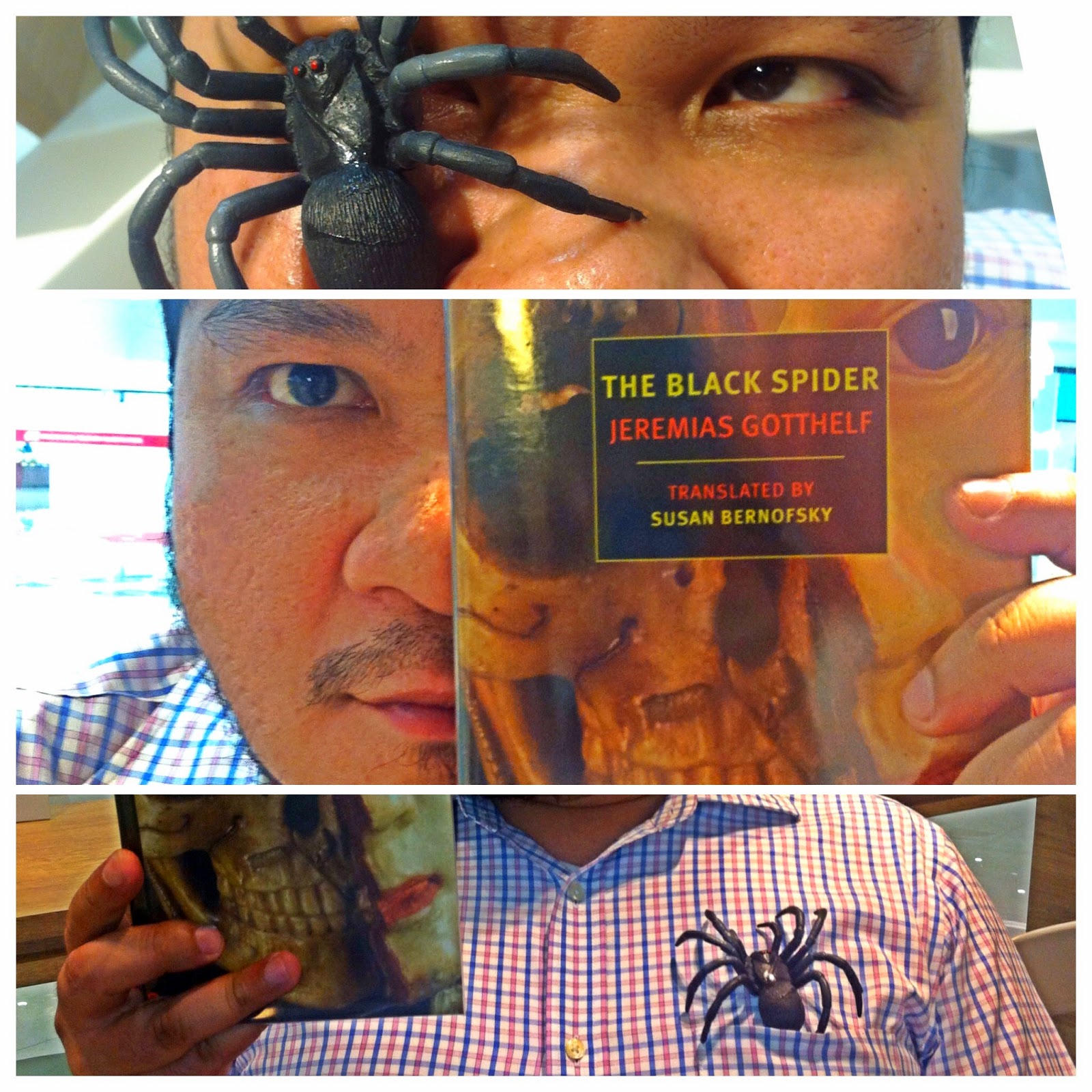
I love a good horror story. And after reading mostly the Victorians in my dead guy reading challenge, I believe the time is now ripe to go beyond the British realm. So I picked up Jeremias Gotthelf's The Black Spider. Gotthelf is a curiosity. He was a Swiss pastor who was a contemporary of Edgar Allan Poe. According to his biography, one difference between Gotthelf and Poe is that Gotthelf believed in the reality of the demon he created in his short stories. This thought gives me goosebumps, as the monster he created in The Black Spider is quite the character.

Upon opening the novel, which was published in 1842, one might think that it isn't a horror novel at all. The opening lines paint a picture of quaintness and the mundane. Gotthelf begins with a very vivid, albeit poetic, description of the town of Sumiswald, where the events of the novel take place.
Above the mountains rose the sun, shining in limpid majesty down into a welcoming but narrow valley, where it woke to joyous life creatures that had been created to take pleasure in the sunshine of their days. From the forest's gilded edge the blackbird trilled its aubade while the amorous quail intoned monotonous minnelieder from amid the flowers sparkling in the dew-bespangled grass, and high above the dark firs, lusty crows danced nuptial roundelays or else cawed tender lullabies above the thorny little beds of their unfledged chicks.
But all will not be well at Sumiswald, for in The Black Spider, a dark period in the history of that little fictional town will be told. It begins with a brutal knight, one Hans von Stoffeln, who makes a most inhumane demand on the farmers of his estate. It's a demand so impossible for the residents of Susmiswald that one of the women, Christine, is forced to make a pact with the devil. The devil in The Black Spider is one I haven't encountered before. No horns, fangs, and serpertine eyes and tails here. What Gotthelf conjured is a tall, red-beared huntsman dressed all in green and with a red feather in his cap. All he asks in return is an unbaptized child.

So the knight is made happy and all seems well in the little town. Until the first child is born. Christine takes it upon herself to get the child and bring it to the devil. But she is thwarted, as the child is baptized as soon as it is born. Then the second child is born, and the same thing happens. All this time, a black mark has been growing on Christine's face. The mark grows and grows till little spiders come out of it and kill all the cattle in Sumiswald. When the third child is born, Christine hurriedly goes to the mother's house and steals the child. But alas, when she was about to hand the baby over to the green huntsman, a priest sprinkles holy water on these two. The devil flees, and Christine shrinks and transforms into a small spider, which the priest casts aside in rescuing the poor baby.
The story does not end here. It's too clean, yes? The black spider wreaks havoc in the town, appearing in one house, killing people, and then disappearing instantly, only to appear again in another place. It's at this point that I begin to think how The Black Spider is very similar in theme to the story of the pied piper of Hamelin. But instead of people realizing their fault and correcting it by doing what has been previously agreed on, the people of Sumiswald resort to their faith. (Gotthelf, after all, was a pastor.) Of course they can't give a child to the devil, whether it's baptized or not. It was up to one of the residents of Sumiswald to outwit the black spider and trap it in a wooden post.

Gotthelf's novel is a quick read. It's just a little over 100 pages. One assumes that this tale, written in the mid 1800s, would have a plot that took its time to unfold. No. The Black Spider's narrative pace is a hectic one. And an atmosphere of dread and creepiness pervades throughout the pages.

Nightmarish—that's how I would describe Gotthelf's novel. I couldn't help but look over my shoulder every now and then. Just to check whether an 8-legged thing is slowly finding its way into one of my pockets. Don't get me wrong, I love spiders. They kill pests, and they'd mostly leave you alone if you leave them alone too. But the spider in this novel is something you'd wish you'd never meet. You might as well practically kill yourself if you do. There's just no escaping it. It's evil incarnate.

Again, I'm grateful that NYRB has published this forgotten classic. It's wonderful reading about the traditions and customs of small towns in ages gone by. There's an opening scene about a baptism that's about to happen. I never knew that there was so much eating involved before and after the ceremony. I guess in olden times, one stuffs himself silly when a baby enters the Christian world. Fascinating trivia.

Read this book if:
  1. You have a thing for classic horror stories.
  2. You love spiders.
  3. You're looking for a quick and scary read.

Sunday, March 16, 2014

F is for Fowles

Twenty years ago, as soon as I finished reading The Magus by John Fowles, I can still remember my feeling of elation. It was my first Fowles, and I thought that I got mind-fucked by the novel. With its seamless transition between reality and fantasy, The Magus was an exercise in patience and stamina. Finishing it was a rewarding experience indeed. I never planned to read another Fowles novel, but I needed a letter F for my dead guy challenge. So, Fowles's debut novel it is. (Flaubert, I will tackle you another time. Promise.)

Ah, The Collector. What a totally satisfying thriller you are. You're still quite a suspenseful read, even though you were first published in 1963. And I now understand why you were the debut that brought Fowles to everyone's attention. You do remind me of those movies that feature deranged serial killers and psychopaths ("The Silence of the Lambs" and "Psycho"). But what sets you apart from these thrill-a-minute films is how erudite you seem to be. Reading you wouldn't just satisfy one's craving for a sickening story; you also allow us to go deep into both the minds of the characters—the captor and the captive.

The novel, all 300 pages of it, features just two characters. Frederick Clegg, the lonely clerk who collects butterflies in his free time, and Miranda Grey, the art student whom Frederick develops an obsession on. And Fowles just gives us 4 chapters. With the first chapter, it's all about Frederick's point of view. It recounts his unhealthy attraction to Miranda, his winning a substantial amount of money in a lottery, and his meticulous planning of Miranda's kidnapping. Frederick is the collector referred to in the novel for obvious reasons. We just know that, probably, not everything is right in his calculated mind. With his money, he buys a cottage with a basement where he keeps Miranda.

Cut to the next chapter and we get to know Miranda a bit more. The Collector isn't just about the battle of wits between Frederick and Miranda. It's more of an exploration of the minds of its characters. With Frederick, it's all about obsession and how he's determined to make Miranda a part of his collection. In Miranda's chapter, we read about Miranda's life before her abduction, her willingness to be romantically involved with an artist 21 years her senior, her plans of escape from Frederick, and her eventual desperation at the futility of all her attempts. Her chapter made us feel for Miranda, and we really hope that she would have escaped by the novel's end.
One just can't imagine what prison is like from outside. You think, well, there'd be lots of time to think and read, it wouldn't be that bad. But it is too bad. It's the slowness of time. I'll swear all the clocks in the world have gone centuries slower since I came here. 
I shouldn't complain. This is a luxury prison. 
And there's his diabolical cunning about the newspapers and radio and so on. I never read the papers very much, or listened to the news. But to be totally cut off. It's so strange. I feel I've lost all my bearings. 
I spend hours lying on the bed thinking about how to escape. 
Endless. [page 250]
The Collector messes up your brain too, in a beautiful way. The sexual tension between the two characters is just nail biting, even though Frederick and Miranda never really do it. Well, almost. There was this one time when Miranda attempts to seduce Frederick, but it doesn't go as planned. Frederick couldn't perform. Somehow, a psychiatrist has told Frederick that he'll never be able to do it with a woman. And it is at this point that you get to thinking—just what the hell is wrong with you, Frederick? Why couldn't you get it up? And why do you do a complete 180-degree turn when the object of your obsession offers herself up to you? All of a sudden, you think of Miranda as a charlatan.

I should read more John Fowles. Such a deft writer, that one. Comfortable in varied writing styles. Frederick's narrative is an exercise in control and in looming terror. Miranda's, on the other hand, spirals downward from being whimsical, introspective, and then surrendering. You literally feel her descent into madness and despair. It's a truly chilling account.

Read this book if:
  1. You love psychological suspense.
  2. You have an unhealthy obsession of things and, possibly, of certain persons.
  3. You know that that seemingly harmless dude sitting next to you in the bus keeps a woman prisoner in his basement.

Sunday, March 2, 2014

E is for Eliot

And I've finally read my first Eliot! Although I initially planned to read Middlemarch, I had to shift to Silas Marner while I was midway into the former. I wasn't getting the feels for Middlemarch. And besides, Silas Marner is reportedly the author's favorite among her novels. I still plan to go back to that doorstop that is Middlemarch but not until the latter part of the year though.

So the eponymous Silas Marner is probably the most sympathetic, the mostly easily likeable, character I've come across. The short novel (just a little over 200 pages) is really his story of redemption. It's a tale involving his fate because of the actions of the people who have wronged him and of how the presence of a child can force our humble character to make a 180-degree turn and look at life in a more positive light.

Because Silas Marner, a weaver, is really like Scrooge in the earlier parts of the novel. Having been falsely accused of stealing, he leaves the town of his birth and decides to live in the town of Raveloe. In that town, he amasses a somewhat substantial fortune from his daily toil of weaving. He spends every night holed up in his cottage and running his fingers through all that gold and money. (Well, honestly, I would do that too. Who wouldn't, yes?) Silas now chooses isolation, as he's been betrayed by people in his former hometown.

Enter a two-year-old girl, who finds her way to the cottage of Silas Marner after her mother dies from exposure. Silas decides to raise the girl as his own, thinking that the baby, who he named Eppie, is a blessing from above. At this point, Silas somehow has the idea that this baby rightfully belongs to him—that the baby is owed him, in fact. But there's more to Eppie though. It turns out that her dead mother was the wife of Godfrey Cass, the eldest of the two sons of a very wealthy person in Raveloe. At that time, Godfrey had his eyes on marrying Nancy Lammeter.

When Eppie was discovered by Silas who brings him to the village pub, Godfrey immediately knew that she was his daughter. Fearful that his marriage prospects to Nancy would be ruined, he decides to  keep his mouth shut. Godfrey's younger brother, Dunstan, has been missing as well. And we know early on that it was Dunstan who entered the house of Silas and took the money away.

The disappearance of the money and the arrival of Eppie have profound effects on the life of Silas. Before, it's as if the money served as all, screening off Silas from the happenings in the town. The townsfolk left him alone and considered him to be an eccentric. When they find out about the robbery, they reached out to Silas. They gave him food. They offered their advice. They acted neighborly and Christian. When Eppie came to his Silas's life, people were no longer afraid of him. With Eppie, Silas came into his own as a member of the community. No longer was Silas lonesome.
In old  days there were angels who came and took men by the hand and led them away from the city of destruction. We see no white-winged angels now. But yet men are led away from threatening destruction: a hand is put into theirs, which leads them forth towards a calm and brighter land, so that they look no more backward; and the hand may be a little child's. [page 150]
Cut to 16 years later, and of course there must be a wedding. Our Eppie has blossomed into a fine young woman, and she has received a proposal from Aaron, her childhood friend and the son of Mrs Dolly Winthrop. Aside from Silas, it is Mrs Winthrop whom I particularly like. Early on, she was always there to lend comfort to Silas, and it was she who was instrumental in bringing Silas to the Christian fold.

Towards the end of the novel, it is revealed to Eppie that her real father is Godfrey. This revelation serves its purpose of easing the guilty conscience of Godfrey, who have hidden this secret from his estranged daughter and his goodly wife. But Eppie will have none of it. She loves Silas, her working-class father. She loves living among the working class. She will not be made into a lady. And at this point in the novel, I admire Eppie for her chutzpah.

I really enjoyed Silas Marner. Eliot shows us a forgotten time in provincial England, where people take no hesitation in helping people in need. It's a time when you know all the people in the pub at the end of the work day. It's a time when it was relatively easy to start with a clean slate. Silas Marner is that kind of novel that you close with a feeling of hope. And these days, we all could be a little more hopeful.

Read this book if:
  1. You like novels set in provincial England.
  2. You know that people inherently are good.
  3. You believe in angels.

Tuesday, February 11, 2014

D is for Dahl

First, an apology, dear reader. I know that I was supposed to read Dickens as my 4th dead guy (letter D). But halfway through Great Expectations, I realized that I've read it already! So I immediately dropped it and picked up a Roald Dahl, and Charlie and the Chocolate Factory is the only Dahl book in my shelves. Such a quick read, this book is.

I was surprised at how Charlie and the Chocolate Factory is so easy to like. Yes, there are stereotypical characters. And yes, these characters get what they deserve. At the onset (at least if you haven't seen the movie), one knows who will have an unfortunate hand dealt upon them, and who will be favored by the quick turn of events. Charlie and the Chocolate Factory is, after all, a children's book.

The novel's plot zooms through its 160 pages, which works well for young readers. There isn't a chapter wherein the characters just talk about things. Dahl makes sure that there's plenty going on on each page, and boy, there is a lot going on. One forgives Dahl for this breakneck pace, because the dialogue is witty, the characters charming, and the places bizarrely wonderful.

Perhaps an older reader like me would find fault in the storyline's predictability. Charlie gets his Golden Ticket eventually, and the other 4 children suffer fates commensurate to their flaws. Veruca Salt, a spoiled girl, is found to be a rotten nut. The chubby Augustus Gloop is made to traverse a thin pipe that can barely accommodate his girth. The novel's end though, when Willy Wonka decides to make Charlie Bucket his heir, is something we've seen coming from miles away.

Charlie and the Chocolate Factory is indeed charming albeit simplistic. It's the kind of book you love as a kid. It's one that you keep coming back to in your adult years for the sheer pleasure of reading something where the characters are clear cut. There are no gray areas in this book. And that's a good thing these days, when you never know if that kindly old lady next door will sneak into your house at night and slash your throat.

Read this book if:
  1. You like sugary sweet things.
  2. You know that chocolate is a food group in itself.
  3. You've always wanted to live in a chocolate factory.

Sunday, January 19, 2014

C is for Carroll

Ah, such gibberish this book is. Half of the time, I couldn't figure out what the hell was happening. My edition actually contains two works by Lewis Carroll—Alice's Adventures in Wonderland and Though the Looking Glass. I wonder why Penguin chose to just go with the first novel as the book's title. Ah, such is the mystery of life!

To say that both works are novels is like saying that a fruit cup is a dessert (oh, the humanity!) or that raisins are candy (no, just no). A friend on Facebook mentioned that one should read Carroll expecting to find a puzzle and not a story. Yes, there isn't a clear plot to the novels. What I felt as I was reading Carroll was that he was making things up along the way. Hmmmm. . . I wonder if there's any truth to my theory. I've read somewhere that Carroll made up these stories for the daughter of the dean of his college. That daughter's name? Alice.

But what glorious imagination Carroll has! I must give him that. I guess when you rid yourself of the stress of thinking up a plot, it frees up brain space so you can think of very inventive characters, yes? I love the Queen of Hearts, the Mad Hatter, Tweedledum and Tweedledee, the grinning Cheshire cat, the Duchess, the Mock Turtle, the Caterpillar and the March Hare! I'd love them more if I knew what they were all about though. But, as always, I take what I can get.

I play the Mad Hatter.
Actually, the hats prevented me from scratching my head.
Another thing I was surprised about this book was how Carroll is a genius when it comes to word play. His prose is richer for it, and it makes the dialogue between the characters funny. The word play distorts your sense of logic but in a good way. It's as if Carroll is poking fun at the reader if he'll get the humor.
'I quite agree with you,' said the Duchess; 'and the moral of that is – "Be what you would seem to be" – or, if you'd like it put more simply – "Never imagine yourself not to be otherwise than what it might appear to others that what you were or might have been was not otherwise than what you had been would have appeared to them to be otherwise." '
–page 79, Alice's Adventures in Wonderland  
'You couldn't have it if you did want it,' the Queen said. 'The rule is jam to-morrow and jam yesterday – but never jam to-day.'
'It must come sometimes to "jam to-day",' Alice objected.
'No, it ca'n't,' said the Queen. 'It's jam every other day: to-day isn't any other day, you know.'
–page 172, Through the Looking Glass
I play the Mad Hatter, again.
Because green is my color of the moment.
Also, wouldn't you know it, some of the poems Carroll included in this book is gibberish as well. But, what the hell, I just went along with it. And I found out that it could be terribly fun if you read some of these poems aloud. Just make sure you're alone though. Otherwise, people would just think you're on meth. Just a touch of meth, just a touch.
Jabberwocky 
'Twas brillig, and the slithy toves
Did gyre and gimble in the wabe:
All mimsy were the borogroves,
And the mome raths outgrabe. 
'Beware the Jabberwock, my son!
The jaws that bite, the claws that catch!
Beware the Jubjub bird, and shun
The frumious Bandersnatch!'
–page 131, Through the Looking Glass
And yet again, I play the Mad Hatter.
I'd do anything to ham it up with a fez.
What on earth is a "brillig"? How can one do an "outgrabe"? And what makes a Bandersnatch "frumious"? Or, more to the point, what the devil is a "Bandersnatch"? Madness, I'm telling you. (Although, in the latter part of the story, there is some attempt to explain this bit of a poem.)

All right, I didn't find Carroll as enjoyable as I hoped he would be. As children's stories, Alice's Adventures in Wonderland and Through the Looking Glass are puzzling to say the least. The characters though, they're another matter. They're the stuff of wonderful childhood dreams.

Read this book if:
  1. You like a little bit of gibberish every now and then.
  2. You love all the Alice movies.
  3. You fell through a hole at one point in your life.

Sunday, January 12, 2014

B is for Brontë

My first dead guy was Austen, and I didn't like her so much. Now my 2nd dead guy—Charlotte BrontĂ«—is something so completely unexpected. Jane Eyre is a marvelous read. And with its Gothic theme, I wonder why it took me this long to read it.

Yes, Jane Eyre is heavy on the melodrama, but I loved it. I loved the eponymous character, she of the head strong female, the kind of person every young girl should look up to. She knows what she wants, and even though she doesn't usually get it, she's prepared to say no to things just because it would be convenient for her. Marriage to a handsome pastor but is not made of love? No, thank you. Jane Eyre will have her Mr Rochester.

The premise is simple enough. Orphaned girl is taken in by an uncle who eventually dies too. Uncle's wife is a huge b***c, who makes life terrible for the 10-year-old Jane. Jane is transplated to a boarding school for orphans, where she stays for 10 years. For the last 2 years, she serves as teacher to the same school. But Jane has itchy feet, and she decides to apply as a governess to the ward of a certain Mr Rochester.

Lowering my expectations on the 1st page
Jane falls madly in love with Mr Rochester. What struck me about this attraction is that it's not at all based on beauty and gallantry. Rochester isn't handsome, he's a bit of a stuck up and very anal, and he seems to have this sense of entitlement which he never fails to remind his household staff. Yes, Jane's attraction isn't explained at all, and that's how I know that this is one good romance. Love doesn't need any justification. You just love someone. Period.

But Rochester has a secret: he's still married to a crazy woman whom he keeps in the 3rd floor of his house. This secret isn't revealed till the day of Jane's wedding to Mr Rochester. The two don't become husband and wife at this point though, for upon discovering this not-so-teeny-tiny a secret, Jane flees. In the last quarter of the novel, we read how Jane discovers her cousins, almost marries a parson named Mr St John Rivers, and comes into her inheritance upon the death of her uncle.

I totally get Jane.
Mr Rochester and Jane do end up as a couple though. And here is where the novel really shines. When Jane goes back to Thornfield, he finds Mr Rochester blind and in a nasty state. But it doesn't matter—she still loves him and she's prepared to make all the sacrifices for the sake of this love. Do you find this sappy, dear reader? I do. But it's the good kind of sappy, the kind of sappy that doesn't make you fling the book at the couple making out in the train.

I'd like to think of Jane Eyre as not just merely a love story. Oh, the love story is a huge part of it all right, but I think it's more of the journey of a character, from someone who seems to have nothing at all to a woman who knows that life is about the choices we make and the consequences of those choices.

Jane always found a way to redeem herself at various stages of her life. In Lowood, the boarding school, she refuses to acknowledge the lies being told about her. In her refusal to marry Mr St John Rivers, she knew that marrying someone just because it would be easy for them to go to India on a missionary tour is a mistake. When she found out Mr Rochester's secret, Jane believes that staying in Thornfield would always present a moral dilemma, as she'd always be in the presence of a man she loves and can never marry.

Yes, this book is a treasure.
To say that I had a blast reading Jane Eyre would be an understatement. I devoured the book. I kissed it when I finished it. I recommended it to friends. It's not a short read, being more than 400 pages, but it's a rewarding one. It's very moral without being preachy, romantic without being too sugary, dark and luminous in different parts. It really is, without a doubt, a classic.

Read this book if:
  1. You love strong female characters.
  2. You know that one should always marry someone you love and nobody else.
  3. You've always been curious about the works of the Brontë sisters.