Monday, September 5, 2011

Ooooh, nasty

Iain Banks's debut novel, The Wasp Factory, isn't for the weak of heart and stomach. There's animal torture, not one but three child murders, parental neglect and deception, gender confusion, to name a few. Needless to say, I loved it.

Frank Cauldhame, the 17-year-old "hero" of Bank's controversial novel, lives with his father in an isolated part of Scotland. Frank may appear to be your normal teenager who's curious all the time. But underneath that innocuous exterior is a monstrous individual, for Frank has some very twisted notions of fun.

First, Frank likes to torture animals. He beheads birds and small mammals. One of his favorite pastimes is getting mice from the petstore, putting them in his slingshot (or catapult as it's called in the novel), and then flinging them to their deaths. Also, he ties the heads of these animals in stick structures which he calls the Sacrifice Poles.

Second, Frank has murdered three children. The first was his cousin, who he managed to kill by placing a poisonous snake in his cousin's artificial leg. He also killed his younger brother by telling his brother to hit a German war bomb on the beach. And he murdered his cousin Esmeralda by letting her become entangled in a huge kite which Frank specifically built for the purpose of carrying his cousin away. Esmeralda's body is never found.

Then comes the initial conflict of the story -- his older brother, Eric, has escaped the mental institution where he's confined. Eric was once a promising medical student, but he was found to be setting fires to dogs in the neighborhood. Since his escape, Eric has been giving Frank phone calls much to his dismay and without the knowledge of their father.

Banks's debut novel, which was first published in 1984, truly deserves its widespread acclaim. It has even been chosen by a British poll as one of the top 100 novels of the 20th century. Banks's writing is visceral, often provoking a reaction of disgust from the reader. I, however, revelled in Banks's detailed narrative. And because of The Wasp Factory, I'd be willing to give Banks's science fiction novels a try.

In a way, The Wasp Factory is a coming-of-age novel, albeit in a very weird and gothic way. When Frank finally discovers who he really is from his father, it's enough to make your blood run cold.

Read this novel if:
  1. You're not afraid of violence in novels.
  2. You love debut fiction.
  3. You're into surprises at the end.

Friday, September 2, 2011

Confessions of a Filipino book blogger


Poke a stick right through me, roast me, and I'm done. I must admit that I'm way behind on my Philippine literature reading. If it weren't for the book club, I wouldn't have gotten to read works by Filipino writers.

Oh, the humanity! How dare do I call myself a Filipino blogger when the total Philippine works of fiction that I've reviewed on my blog can be counted by one hand! The shame of it all!

But maybe there's hope for me yet. After all, one of my favorite authors is a Filipino -- our national artist for literature, Nick Joaquin. Who wouldn't love a guy who's always seen holding a bottle of beer and being, ummmm, just a little bit wasted every waking moment. He's such a dearie. Maybe the secret to having that talent in writing is alcohol, and loads of it.


To say that Nick Joaquin's works are eclectic would be an understatement. He's written fiction for both young adults and adults, works of journalism, and even drama. For those who haven't even read or seen the play "Portrait of the Artist as Filipino," then you're missing out on a lot of good drama. My favorite works of young adult are still those written by NJ -- Pop Stories for Groovy Kids, which are retellings of well-known fairy tales.

So maybe it's high time I somehow become less of an anglophile and sample more works by Philippine writers. For a country known to be a nation of short story writers, perhaps the renewed interest in Philippine fiction would encourage Filipinos to write more novels. Now that's something to look forward to.

And hey, I'm attending the event below at this year's Manila International Book Fair. I hope to see you there!

This post has been made in line with the Filipino Fridays meme hosted by the organizers of the event. Check out other posts here.

Wednesday, August 31, 2011

Who/What is Skellig?

Sometimes, it just takes a simple story, albeit well written, to hold the reader's attention. And it also probably helps that you have no expectations regarding the book you're holding whatsoever. David Almond's Skellig is one such novel.

Skellig manages to impart profound ideas on love, healing, and friendship in just a few pages. To say that it's pithy would be an understatement. I think that it's a beautiful work of fiction which young adults should read. It never becomes cheesy nor cloying in its overall feel of hopefulness.

We are introduced to Michael, who has moved to a new home with his family. Michael's baby sister has been in and out of the hospital, and the novel makes the reader feel that the baby's death is a possibility. One day, Michael ventures into the garage and discovers a being hidden amid the dust and forgotten objects stored in the garage.

Almond doesn't give a clear notion of what this being, named Skellig, actually is. Is he an angel? Is he half-bird or half-human? Its only request is that Michael keep Skellig's existence a secret. But how could Michael do such a thing when clearly Skellig needs serious help -- he has arthritis and all he has been eating are insects and mice brought by the owls.

Pretty soon, Michael becomes friends with Mina, his neighbor who is raised by a very unconventional mother. Mina's mother doesn't believe in organized education where children are stifled by the confines of the classroom. Mina thinks freely and appears to be more learned than children her own age. It's only a matter of time before Michael introduces her to Skellig. And they discover that Skellig has wings.

Together, Michael and Mina help make Skellig better (e.g., cod liver oil for his arthritis), even though they have doubts as to what he really is. One thing's for sure though, Skellig is a mystical creature. Skellig may have been instrumental in making Michael's baby sister well. Michael somehow sees or dreams Skellig visit his sister at the hospital, hold her up, and leave. Skellig is never seen again.

It's clear that Almond values the importance of familial love and connections between friends and other people. As a friend, Mina becomes the trigger for Michael to develop his artistic side. Michael's mother and father never waiver in their hope that their baby would get better. For himself, Michael realizes the true nature of love -- love for his family, his friends, and even for someone who doesn't appear to be lovable at first impressions. Yes, without his love for Skellig, the mysterious creature would simply languish in their house. Forgotten and hopeless.

Read this book if:
  1. You believe miracles do happen.
  2. You have a couple of hours to spare. (It's a short read!)
  3. You know someone who could be an angel.

Monday, August 29, 2011

Getting a good dose of speculative fiction

If it weren't for Honey's wonderful decision to have Philippine Speculative Fiction 6 as the book of the month for August, I wouldn't even have bothered to pick this up. Good thing she did, for this turned out to be a very satisfying read, especially since I've been craving for fantasy and science fiction lately.

Now speculative fiction isn't just about sci-fi and fantasy, mind you. According to Honey, it can be any of the following genres:
  • Alternate History
  • Apocalypse/Holocaust
  • Coming of Age (as a species)
  • Contemporary Fantasy
  • Cyberpunk
  • Dystopian
  • Fairy Tales
  • Fantasy
  • First Contact
  • Horror/Dark Fantasy
  • Magical Realism
  • Science Fiction
  • Slipstream
  • Steampunk
Speculative fiction does appear to cover a broad spectrum, no? Except for slipstream (which I have yet to Google), I think I've read at least one fictional work for each of the sub-genres mentioned above. But it's my first time to read any of these within a Philippine context.

I would have to agree that almost all of these stories have a strong Filipino element, whether evident in the use of the language, the setting, the history, and the characters. The first story, "The Big Man" is wonderful in a very unconventional way. It presents a fictionalized account of an outstanding basketball player who might be, for all intents and purposes, be a character in Philippine folklore called the kapre. For a short story, it's quite lengthy, but the personal history that the writer has come up with is rich in detail.

My favorite story, however, is "The Grim Malkin" for it does not take itself too seriously. Compared with "The Big Man" which has a very pedantic feel to it, "The Grim Malkin" is pure geekiness. It's about a mismatched couple who go on a quest and manage to resurrect a cat-like entity who makes it clear that it's no big deal if it kills the couple. It's high fantasy on drugs. The banter between the cat and the man and woman is so humorous it begs for canned laughter.

Other notable stories (IMHO) are "Alternative Histories," "Ashland," and "On Wooden Wings." "Alternative Histories" is presented as a series of tweets from personalities in Philippine history if they had accessed to that social networking site. "Ashland" is marvelous in the writer's portrayal of a world so gray and silent. "On Wooden Wings" can be categorized as cross-over, for it works for both adult and young adult readers. And it's setting is a place where writers in this genre seldom touch on -- the Philippines' Islamic provinces.

I have yet to read the first 5 volumes of this series. But if they're just a fraction as good as the 6th volume, then I know I'll be happy. It's just too bad that the publishers only printed a few hundred copies of PSF 6, and that the earlier volumes are out of print. More people should read these.

Read this book if:
  1. You're into speculative fiction.
  2. You love suspending disbelief.
  3. You're curious how Filipino writers would write in this genre.

Thursday, August 25, 2011

In the future, the 80s are cool

The 80s were fun years. I was in grade school during this time, and I had fond memories of Saturday morning cartoons and console games. Ernest Cline's debut novel, Ready Player One, brought me back to this wonderful novel. It's not a period novel, contrary to what you might think. It's actually science fiction.

The year is 2044 and the world is, as expected, an economic, environmental, political, and societal mess. As a means of escape, people log in to a virtual world called OASIS, which has been created by James Halliday. OASIS can be likened to a universe. There are different worlds that people can visit. People can go to school, conduct their business, entertain themselves, among others, in OASIS. This virtual meeting place has become so ingrained in the lives of the people that OASIS currency is even more stable than real currency. Also, you can be anyone you want to be in OASIS.

Then James Halliday drops dead and leaves no heir for OASIS. Instead, he tells the millions of denizens of OASIS that this virtual world can be theirs if they find the three keys that are located in the vast OASIS universe. Of course, this game spawns a culture of hunters, called gunters, whose sole obssession is to obtain the keys. For 5 years, gunters have painstakingly studied the life of Halliday for clues and they have also meticulously gone through 80s pop culture, the decade that Halliday was very fond of. This isn't surprising though, as Halliday grew up in the 80s amid Ataris, coin-op games, and other console games.

Ernest Cline with his DeLorean. Love it!

But during one ordinary day, one person finally discovers the first key -- Wade Watts, or Parzival, as he is known in OASIS. However, Parzival would soon learn that finding the first key has its downside, as there would be several professional gunters who would be after him for information, some even threatening his life. It is at this stage that Ready Player One really takes off as a very entertaining and thrilling read.

Cline definitely knows his pop culture. This is evident in the various games the gunters have to go through to get a key and pass through a gate. In the first gate, for example, Wade has to play Joust, one of the very first vector graphic games. And there are so many references to Blade Runner, Atari, Back to the Future, early computers with laughably small RAM (think 16 kB), and the movies of John Hughes.

Ready Player One is one very funny novel, a book that is so refreshing to read because it doesn't take itself too seriously. Yes, Cline is one gifted writer. His descriptions of the various planets in OASIS and the virtual battles are vivid. And Cline has made me recall my favorite console games in the 80s: Pac Man, Galaga, and Pong.


But of course, my all-time favorite game is the one shown below. I can spend hours just playing it.


Read this book if:
  1. You love anything 80s.
  2. You're heavily into gaming.
  3. Most of your waking hours are spent online.

Sunday, August 21, 2011

Bad-ass classic

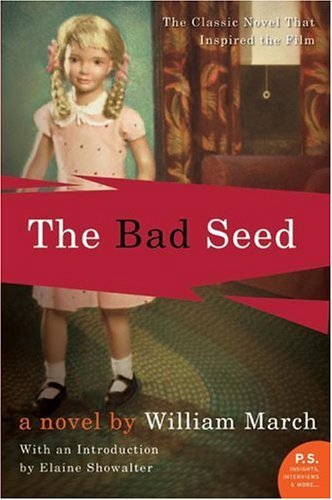
In 1954, a book was published that would take the publishing and reading world by storm. A book written by William March, who, despite having written other works of fiction, would always be known simply as the writer of this suspense novel. A novel that would be nominated for the National Book Award for Fiction, a rare feat considering the genre. A book that would inspire a Broadway play and countless Hollywood movies about murderous children. A book that would spark an endless debate about people's personalities. That book is The Bad Seed, which has been reprinted recently, much to reader delight.

So who is the bad seed in this novel? It's one eight-year-old Rhoda Penmark. By all appearances, Rhoda is all sugar and spice, complete with those dainty sundresses, cute pigtails, and adorable maryjanes. But it's all a veneer of course, for Rhoda manages to kill a boy of her own age simply because he bested her in a school computation. Also, she exacts revenge on a gardener who has somehow seen her for who she really is. There are other acts attributed to Rhoda in her earlier years, but March leaves it to the reader to decide. One thing is certain though -- Rhoda is "the" bad seed and she will continue to be one as she grows older.

One of the themes of The Bad Seed is that genetics plays a part in molding our personalities. March makes it evident that Rhoda, even with her doting mother, was predisposed to evil. (Later in the novel it will be revealed that Rhoda's grandmother had a similar streak.) Yes, Rhoda's father was always absent, but that's irrelevant: Rhoda is evil because evil is in her genes.

It is at this point that the reader may ponder on the question of nature vs. nurture. Can people do anything if a negative personality trait runs in their veins? I sure hope so. Still, it's a chilling thought -- being predisposed to do sinister acts. You never know if you'll wake up one day with the urge to repeatedly stab that pesky neighbor for playing Air Supply loudly in the middle of the night. Or push that officemate down the stairs for getting a paperclip from your desk without asking.

Despite being published in 1954, The Bad Seed still gave me the chills after reading it. And the ending was so unexpected that it gave me goosebumps. March's writing is as fresh and detailed even after more than 50 years. It's one of my most enjoyable reads for this year. In Rhoda Penmark, March has created an iconic character that we would all be afraid of.

Patty McCormack, the girl who played Rhoda, in the 1956 Oscar-nominated movie
People mentioned that it was she that should have been nominated instead of the actress who played her mother.

Read this book if:
  1. You have no doubts that children can be evil.
  2. You like classic suspense novels.
  3. You think that you just might be a bad seed yourself.

Thursday, August 18, 2011

Not another fantasy novel

But not just any fantasy novel, this one has endeared itself to me, and I'm not even big on this genre. Patrick Rothfuss's debut novel, The Name of the Wind, will appeal to just about any reader. There's adventure, romance, magic, and a coming-of-age tale in Rothfuss's doorstop of a book. (Question to you, dear reader: Why do fantasy novels always have to run for more than 500 pages?)

In The Name of the Wind, we meet Kvothe (pronounced "quothe"), a reclusive inkeeper in the provincial town of Newarre. Rothfuss makes it clear from the start that Kvothe and his assistant, Bast, are not the characters they appear to be. It turns out that Kvothe is something of a legend, one who has been labelled as "the kingkiller" among other things. Kvothe, all red hair and green eyes, is simply whiling away his days in Newarre, which appears as an insignificant speck on the map. (Another question for you, dear reader: Why do fantasy novels always have a spread-out map?)

However, terrible things are slowly happening in Newarre too. One day, a scribe who is more famously known as the Chronicler stumbles into Newarre and recognizes Kvothe. Kvothe offers a deal -- he will tell his entire life story to the Chronicler in a span of three days. Kvothe begins to account the early part of his life on the first day. Thus, The Name of the Wind is just the first part of the trilogy. (And yet another question for you: Why do fantasy novels always have to be part of a trilogy or a series?)

To say that Kvothe's life is one of endless trials and tribulations is an understatement. We learn that his family was of the Edema Ruh, a well-known and respected troupe of performers. One unfortunate day while Kvothe was running an errand, an evil force called the Chandrian kills the entire troupe, including Kvothe's parents. Orphaned and with no money, Kvothe is forced to live as a beggar and as a thief in the city. Then he remembers what his guardian, a Merlin-like character, told him -- to go to the University and learn to be an arcanist. (Question: Why do fantasy novels always have a character like Merlin?)

In the University, Kvothe earns a reputation for being a prodigy. He easily masters the principles of a form of magic called sympathy among other things. But of course, all is not well in this place of learning. He manages to get the ire of the first-born son of a nobleman. And also, Kvothe falls in love. But Kvothe never strays farther from his goal -- to learn more about the Chandrian and possibly avenge his parents' death. Of course, there has to be a dragon somewhere in the novel. (Another question: Why do fantasy novels always feature dragons?)

I was pleasantly surprised how I found myself totally liking this novel. Unlike other fantasy novels, The Name of the Wind has some parts that are lighthearted and funny. Rothfuss thus makes the entire narrative somehow engaging. There's a pervading element of thread, yes; but the reader is always hopeful that Kvothe will get what he so truly deserves. I learned that it took a few years for Rothfuss to finish this novel. I guess that explains the beard. (And my last question: Why do fantasy novelists always have to look like the person below?)

Patrick Rothfuss

Read this book if:
  1. You love fantasy novels.
  2. You're still waiting for the next book in George R. R. Martin's A Song of Ice and Fire.
  3. You're patient.