Showing posts with label suspense. Show all posts

Friday, January 9, 2015

And so the killing ends

Don't you just hate it when a book series with characters whom you've grown attached to finally ends? That's how it is when I turned the final page of the 3rd book of Barry Lyga's fantastic trilogy I Hunt Killers. The final installment, Blood of My Blood, is my 2nd read for 2015. And boy did it deliver.

For some reason, I can't help but think of the trilogy's protagonist as a uber handsome teenager with all the angst and grit that goes with being the son of America's most dangerous serial killer. I grew to love Jasper Dent. He's very grounded. Lyga makes the Jazz's character very realistic that you keep on going back to the time when you were at that age and had the same issues.

The I Hunt Killers trilogy is basically a cat-and-mouse story. Would Jazz finally be able to help the authorities catch his evasive serial killer of a father, Billy Dent, who's murderous spree spans several years? Would Jazz be the one himself to kill his father? What about Jazz's mother? Is she somehow involved in all this gore?

Blood of My Blood tied everything together and gave a truly satisfying ending to the nail-biting story. Yes, there were even a couple of mind-blowing twists to what the reader may have believed from the start. And I'm thankful that Lyga didn't proceed with the idea that Billy Dent may not be the father of Jazz after all. Having that premise would just mess up the notion that it's impossible to escape the things that your family imposes on you, genetic or otherwise.

Read this one during the first day of the year,
literally while the fireworks were still ongoing after 12 mn.
That's my just-got-out-of-bed look.
However, I would have liked to have read more of Jazz's best friend, Howie, in the final installment. That's one quirky character. I loved that teenage hemophiliac. Unfortunately, his character becomes a minor one. Blood of My Blood, after all, is the book that needs to have all the Dent family at center stage.

I highly recommend the series to people who are into thrillers. Looking back though, the series isn't just about that. It's a coming-of-age tale too. In Blood of My Blood, Jazz confronts his family, really see the evil that they have done, and learns that he does have free will. His name will forever be tied with his family, but that is not all that defines him. You really can't choose your family, but you can choose to go a different way.

Read this book if:
  1. You've seen The Silence of the Lambs at least 7 times.
  2. You've wanted to kill a family member at some point.
  3. You love thrillers.

Sunday, March 16, 2014

F is for Fowles

Twenty years ago, as soon as I finished reading The Magus by John Fowles, I can still remember my feeling of elation. It was my first Fowles, and I thought that I got mind-fucked by the novel. With its seamless transition between reality and fantasy, The Magus was an exercise in patience and stamina. Finishing it was a rewarding experience indeed. I never planned to read another Fowles novel, but I needed a letter F for my dead guy challenge. So, Fowles's debut novel it is. (Flaubert, I will tackle you another time. Promise.)

Ah, The Collector. What a totally satisfying thriller you are. You're still quite a suspenseful read, even though you were first published in 1963. And I now understand why you were the debut that brought Fowles to everyone's attention. You do remind me of those movies that feature deranged serial killers and psychopaths ("The Silence of the Lambs" and "Psycho"). But what sets you apart from these thrill-a-minute films is how erudite you seem to be. Reading you wouldn't just satisfy one's craving for a sickening story; you also allow us to go deep into both the minds of the characters—the captor and the captive.

The novel, all 300 pages of it, features just two characters. Frederick Clegg, the lonely clerk who collects butterflies in his free time, and Miranda Grey, the art student whom Frederick develops an obsession on. And Fowles just gives us 4 chapters. With the first chapter, it's all about Frederick's point of view. It recounts his unhealthy attraction to Miranda, his winning a substantial amount of money in a lottery, and his meticulous planning of Miranda's kidnapping. Frederick is the collector referred to in the novel for obvious reasons. We just know that, probably, not everything is right in his calculated mind. With his money, he buys a cottage with a basement where he keeps Miranda.

Cut to the next chapter and we get to know Miranda a bit more. The Collector isn't just about the battle of wits between Frederick and Miranda. It's more of an exploration of the minds of its characters. With Frederick, it's all about obsession and how he's determined to make Miranda a part of his collection. In Miranda's chapter, we read about Miranda's life before her abduction, her willingness to be romantically involved with an artist 21 years her senior, her plans of escape from Frederick, and her eventual desperation at the futility of all her attempts. Her chapter made us feel for Miranda, and we really hope that she would have escaped by the novel's end.
One just can't imagine what prison is like from outside. You think, well, there'd be lots of time to think and read, it wouldn't be that bad. But it is too bad. It's the slowness of time. I'll swear all the clocks in the world have gone centuries slower since I came here. 
I shouldn't complain. This is a luxury prison. 
And there's his diabolical cunning about the newspapers and radio and so on. I never read the papers very much, or listened to the news. But to be totally cut off. It's so strange. I feel I've lost all my bearings. 
I spend hours lying on the bed thinking about how to escape. 
Endless. [page 250]
The Collector messes up your brain too, in a beautiful way. The sexual tension between the two characters is just nail biting, even though Frederick and Miranda never really do it. Well, almost. There was this one time when Miranda attempts to seduce Frederick, but it doesn't go as planned. Frederick couldn't perform. Somehow, a psychiatrist has told Frederick that he'll never be able to do it with a woman. And it is at this point that you get to thinking—just what the hell is wrong with you, Frederick? Why couldn't you get it up? And why do you do a complete 180-degree turn when the object of your obsession offers herself up to you? All of a sudden, you think of Miranda as a charlatan.

I should read more John Fowles. Such a deft writer, that one. Comfortable in varied writing styles. Frederick's narrative is an exercise in control and in looming terror. Miranda's, on the other hand, spirals downward from being whimsical, introspective, and then surrendering. You literally feel her descent into madness and despair. It's a truly chilling account.

Read this book if:
  1. You love psychological suspense.
  2. You have an unhealthy obsession of things and, possibly, of certain persons.
  3. You know that that seemingly harmless dude sitting next to you in the bus keeps a woman prisoner in his basement.

Saturday, December 28, 2013

Of collaborators and resistance fighters

I guess I spoke too soon when I posted my 10 favorite reads for 2013 in the previous post. I never knew that I'd be making a late addition to it, and it's this debut novel by Laurent Binet—HHhH. Somehow, I'm glad that this would probably be the last book that I'll be reading for the year, for HHhH is one truly glorious read.

HHhH is Laurent Binet's debut novel, but it doesn't feel like it. This historical novel really makes other books in the genre feel like they've been written by history undergraduates who are just too lazy with their research. If there's anything that Binet pulls off in this novel, these are the meticulous details that make HHhH very richly textured.

HHhH stands for "Himmlers Hirn heisst Heydrich" or Himmler's brain is called Heydrich." Now, Heydrich: If there's one man more feared that Hitler during WW2, it was this blond who was responsible for carrying out the Jewish solution, the systematic killing of Jews. I can't imagine how one person can think of all those gruesome ways just to exterminate a group of people. But Heydrich was able to do it, until he died of an infection after an assassination attempt.

So HHhH is about how two exiled operatives living in London were able to change the course of this dark period in our history. And these two are Josef Gabcík and Jan Kubiš, a Slovak and a Czech, resistance fighters extraordinare. I have much admiration for these men after reading the novel. I wouldn't have the courage to go into enemy territory and plot to kill a person so close to Hitler. You know that if you've been tasked to do this mission, there really is no coming back.

Most of the chapters of the novel focus on Reinhard Heydrich though. It provides details from his youth up to his quick rise leading to Hitler's cabinet. The Blond Beast, everyone called Heydrich, for he really had those "prized" Aryan features—he was tall, had blue eyes, and striking blond hair. But what makes Heydrich truly Hitler's soldier is that he shared the Führer's plan—to rid all of Europe of Jews.

The novel's very postmodern in its narrative. Oftentimes, the narrator strikes a conversation with the readers, telling us how such and such detail were arrived at. And the narrator can be funny too, especially when he mentions how certain dialogues by famous men in history can never be truly confirmed. When the narrative makes way for conversation, the narrator is quick to point out this caveat. In a way, this technique seems to be quite endearing, as if the author makes fun of himself or at least criticizes the way he presents his story.

Because HHhH is about an assassination, it reads like a thriller and adventure story. How can it not be, no? At the part where the actual assassination is described, the reader is left breathless. And during the hair-rising climax when the resistance fighters were trapped in a church surrounded by Nazi stormtroopers, you can't help but root for them, even though you know that that's one situation where it's impossible to get out of.

I just wish that there were many historical novels written this way. History is exciting. We shouldn't be forced to read boring texts about events that influenced how we are now. I think this is why I loved HHhH so much. It shows us that history was made by people, and that these people thought of us when they risked their lives or did remarkable things.

Read this book if:
  1. You love historical fiction.
  2. You want to give postmodern novels a try.
  3. You are, like I am, fascinated by all things related to WW2

Wednesday, December 4, 2013

Horror-ish

And I've finally read my first Lessing! Yes, it's taken me this long to read one of her novels. I was originally gunning for The Golden Notebook, but when I looked at how thick it is, I died. Twice. The Fifth Child, running no longer than 150 pages, was perfect.

What a beautifully creepy novel The Fifth Child is. The story is pretty much straightforward. A young couple, Harriet and David, decide to move to a house of hotel proportions and have one child after another. Harriet and David have never been financially stable and have relied on David's well-to-do father for support. Things seem to go well with the family until the fifth child, Ben, was born.

All right, maybe the problem didn't start at Ben's birth but during the time Harriet was still carrying him in her womb. Ben was a difficult baby. Harriet often had to take sedatives just to keep Ben quiet inside her. Ben does appear to be an unusually strong baby. When Ben was born, nothing could have prepared the family of the sight of Ben. Besides being unusually strong for his age, Ben seems to resemble a Neanderthal, a monster in his parents and siblings' eyes.

If the other 4 siblings grew up with the attention (if not the love) of their parents, Ben didn't. Everyone seems to be afraid of him. Who wouldn't? When a cat and a dog die from strangulation, everyone thinks that it was Ben. And this thinking seems to be rightly so. Ben appears to act based on very primal instincts: eating ravenously, hurting people who view him with revulsion, and basically not communicating with any of his family. Eventually, the family decide to put Ben to an institution, even though Harriet has always been dead set against it.

Harriet does get Ben back after making an unscheduled visit and discovering that he has been drugged, fitted in a straightjacket, and covered in his own excrement the whole time he was at the institution. Harriet really tries to love Ben as much as she does her other children. But Ben's monstrous appearance and his wild disposition prevent her from doing so. She had to resort to having the teenaged gardener, whom Ben seems to like, watch over her son. It becomes inevitable that Ben becomes part of the gang of teenagers who terrorize parts of England.

Lessing shows us how one child can tear a family apart. The rest of Ben's siblings all leave for boarding school, as if wanting to put as much distance between themselves and their youngest. Harriet and David's marriage is never the same when they had Ben. Their house, which seemed to be their one prized possession, is eventually sold. And Ben only considers his friends as his true family.

I loved The Fifth Child. It's a horror novel that works on so many levels. On one level we see the family dynamic when one aberrant person joins the group. On another level we read about the horrors that Ben was capable of when he was growing up. And yet on another level we imagine the terror that could still happen, terrors brought about by Ben and his loutish friends. It's also a heartbreaking novel of loss, frustration, and what could have been. Somehow, I felt bad for the couple. I can't  help but imagine how everything would've turned out for them if Ben hadn't been born.

Read this book if:
  1. You'll read anything that's won the Nobel.
  2. You like your horror "literary."
  3. You're the black sheep of the family.

Tuesday, November 19, 2013

Not enough to turn me into a fan

Still on a graphic novel reading spree. Haven't felt reading anything heavy on text because of all the things happening around lately. Proust's Swann's Way would still have to wait. Although I've given myself this month to finish that. But for now, Batman.

Now I must admit that I'm not really big on the Caped Crusader. I found the movies (the Burton, the Schumacher, the Nolan) just fairly enjoyable. The vintage TV series was campy at best. When you say Batman, I just think of the costumes. Tight costumes. As in really tight. So tight that they'll show nipples and abs. Nipples so perky that you think, gee, it's really cold outside.

I found Arkham Asylum: A Serious House on Serious Earth at a bookstore. I thought, what better way for my Batman-ignorant self to be acquainted with this superhero than this stand-alone graphic novel. It's the 15th anniversary edition no less. Besides, the story's written by Grant Morrison and the artworks by Dave McKean. The latter is of The Sandman series fame. Sold.

Okay, the story. Now I know why I've never been fond of Batman. The guy's got so many issues. Prick him and he bleeds paternity, identity, and security issues. Slap him and your hand would feel numb by his intense coldness. I never got into Batman's brooding nature. If I were a millionaire, brooding would be the last personality I would have. Anyway, the story concerns with the inmates taking hostage the staff of Arkham Asylum. Their demand is simple: Have Batman go to the asylum and make him be one of them. The asylum residents are of a different breed altogether. They're all the enemies of Batman including Joker, Two-Face, Mad Hatter, Scarecrow, Croc, and a partridge in a pear tree.

Then I was quite disappointed that there isn't much action in Arkham Asylum. There is plenty of talking though. And lots of panels showing the dark history of Arkham house and how Batman was lured into going there. Blah blah blah blah. And how is Batman released from the asylum? Well, by a simple coin toss. Yes, a coin toss that was probably rigged by Two-Face. Oh, Two-Face, you spoil all the fun. To think you were my favorite villain! You should've been more villain-y.

What I really liked about the graphic novel is the beautiful panels, which were paintings done by McKean. The panels were very gritty. And they did effectively show the themes of horror and psychological suspense. Even the typeface used for Joker's dialogue was very artistic. Just look at some of the panels below.


I'm not really sure if I'll be reading another Batman graphic novel soon. Perhaps I'll just wait for that Batman vs. Superman movie. Ben Affleck vs. Henry Cavill! If only they'd do away with the costumes, no?

Read this book if:
  1. You fall for these brooding characters.
  2. You love a guy in tight outfits.
  3. You have this crazy idea of putting all your ex-boyfriends or ex-girlfriends in one house and then just seeing what happens.

Thursday, August 29, 2013

A Hitchcock interlude

Last weekend was a long weekend (again!) here in the Philippines. And I'm feeling the burn of finishing the book of the month for the book club. To say that I'm not getting the book is an understatement.

So I decided to just spend the day downloading movies. The weather last weekend was a bit gloomy, so I thought—suspense, classic movies, Hitchcock! I did a quick Google search on the movies made by Hitchcock and decided to watch 3: Rear Window, Rope, and Strangers on a Train.

Was James Stewart one of Alfred Hitchcock's favorite actors? He seems to be in most of them, no? Anyway, I didn't like Rear Window that much. I felt that it wasn't suspenseful enough. Grace Kelly is probably the most gorgeous woman ever though.


Now Rope was the movie that satisfied my craving for suspense. The murder happened in the opening scene, so the movie focused on whether the two murderers would actually be caught. Such chutzpah these two men have! They even hid the body in a trunk and then invited people to a party!


I've read Patricia Highsmith's novel, Strangers on a Train, which the movie is based on. The book was more menacing though. But Highsmith's plot was just perfect for Hitchcock: 2 strangers meet on a train and decide to commit murders for one another. Goosebumps!


I'm still loving my Hitchcock phase. So I'll probably see The Birds, To Catch a Thief, and Dial M for Murder next.

Sunday, August 4, 2013

Girl gone a-cuckoo


Ah, Rosamund Pike. You underrated British actress you. I can't wait to see you wow everyone in the big screen adaptation of Gillian Flynn's Gone Girl. You'd kill them all (pun intended). Blonde, sexy, and so talented–you're a natural for the part. I'm so happy they didn't go for the cookie cutter Hollywood actress. Rosamund Pike, it's your time to shine. But first, let's talk about the book.

I read my first Gillian Flynn thriller years ago, a dark Southern gothic entitled Sharp Objects. Then I read my second–Dark Places, and I also wasn't disappointed. With Gone Girl, I am on a Gillian Flynn high. Yes, all the raves and hype are merited. Gone Girl is pure mess-up-your-head, who-is-the-more-reliable-narrator, wait-until-you-get-to-the-twisted-ending fun.

The gone girl in the novel is Amy, whom Rosamund Pike will be playing. She's married to 34-year-old Nick. Nick and Amy now live in a small town in Missouri, after having been both laid off from their jobs in New York City. Nick decides to return to his hometown to care for his mother, essentially removing his moneyed and beautiful wife from her NYC roots. Gone Girl is written in chapters where we read the alternating points of view of Nick and Amy.

In the novel's first part, I have basically made up my mind that it was Nick who did it. You see, Amy has gone missing on the couple's 5th anniversary. Nick has a few skeletons up his sleeve: the very young mistress, his unexplained whereabouts on the morning of his wife's disappearance, and the enormous credit card bills, to name a few. And it doesn't help that Amy, in the chapters written as diary entries, comes off as one sweet, self-sacrificing wife who seems to be getting more and more afraid for her life because of Nick's violet tendencies recently.

But in the second part of Gone Girl, Flynn throws us a curveball. Amy might not be right in the head after all. The disappearance could have been the result of months of meticulous planning on Amy's part. All right, I'll say it–Nick could have been framed. What happens after that can be likened to a slow burn, a deep and satisfying unravelling of the fucked up mind of Amy and the lengths that she can go to punish her husband. Yes, she knows about the affair and she's determined not to just grin and bear it.

Gone Girl is so wonderful in its portrayal of a sick mind that you forget how slow it can be in the first few chapters. One wonders if Gillian Flynn can top this. Her novels just seem to get better and better. But before the next Flynn thriller hits the bookstores, I'm ecstatic that there's the movie to look forward to. And, Rosamund Pike!

Read this book if:
  1. You're a big fan of twisted endings in thrillers.
  2. You love the slow burn.
  3. You think it's a must to read the book first before the book comes out.

Sunday, July 21, 2013

Feels like Hitchcock

I've always wondered why there hasn't been a global Japanese crime fiction phenomenon. We all see Scandinavian crime novels everywhere. I say the Japanese ones should be just as popular. There's a certain darkness, an edginess bordering on the crazy, that make me love them.

Keigo Higashino's The Devotion of Suspect X is a different kind of mystery. For one, you know early on who committed the murder and how. Another, you read the novel to find out if the Japanese detectives will eventually find out who the killer is and weed out one red herring after another. It's very stimulating, this novel is.

The murder in question involves Yasuko, a single mother to Misato who works at a food stall. Enter Togashi, her ex-husband, a man whom she hasn't seen in 5 years. One day, Togashi walks into the lunch box shop where Yasuko works. For Misato, it's all deja vu, remembering the countless times Togashi has asked her money. Naturally, the meeting leaves a bad taste in Yasuko's mouth.

When Togashi goes to the apartment where Yasuko lives, he harasses her. Things get pretty ugly to a point when Misato, out of anger, clubs Togashi in the head. Togashi then retaliates and a skirmish ensues. Yasuko panics and ends up killing Togashi by strangling him. And this is where things get a bit complicated when they receive a call from Ishigami, their neighbor, with his offer to help dispose of the body. Ishigami is the novel's Suspect X, and his devotion refers to his affection for Yasuko. We learn that he doesn't frequent the lunch box shop where Yasuko works because of the food; he is just deeply infatuated with, nay, adores Yasuko.

The body is eventually found near a river and it's identified as Togashi. Of course, we should have a smart detective, and that comes in the person of Kusanagi, who becomes dedicated to finding out the killer. Everything points to Yasuko though, despite her weak alibi. Things get complicated when the detectives discover the connection between Yasuko and Ishigami, who we now learn is a math genius. While we do know that Ishigami was the one who crafted Yasuko and Misato's alibi, we are left to question how will the police look beyond the clues and finally get Yasuko.

But Higashino still has something up his sleeve in his novel. In The Devotion to Suspect X, we are introduced to Yukawa, a brilliant physics professor at the Imperial University, who serves as an unofficial consultant to the police regarding the cases that confound them. Yukawa, who is also affectionately known as Detective Galileo, somehow comes up with his own theory regarding who really did kill Togashi and how Ishigami, who appears to have been just an accomplice in getting rid of the body, could have actually committed murder. The ending is just too priceless to spoil.

What really made the The Devotion of Suspect X truly enjoyable is the apparent battle of minds between Ishigami and Yukawa. We learn that both went to the Imperial University and who were once good friends. Ishigami becomes a master of creating a deception, a veneer, which Yukama sees right through. As I said, how Yukama reveals the whole workings of the mystery is just too juicy to spill here.

I've heard that there a new Detective Galileo novel. And if it's half as good as The Devotion of Suspect X, I will happily gobble it up. Yukawa can be so charmingly geeky.

Read this book if:
  1. You love elegant plot twists.
  2. You have the patience to wait until the end for that satisfying reveal.
  3. You have a thing for Japanese crime fiction.

Thursday, April 11, 2013

We wish to inform you that your baby has now been replaced

During the weekend, I finished Brenna Yovanoff's young adult novel The Replacement and found myself being conflicted with my feelings toward it. It does have all the elements that I usually am partial too—the creepy atmosphere, the supernatural characters based on folklore, the subtle horror, and the romance not bordering on bubblegum. And yet, I'm not too sure if I really liked it.

The Replacement touches on a myth that seems to be common across different cultures: supernatural creatures living below the ground steal babies and replace them with one of their own. In Yovanoff's novel, this unfortunate incident seems to happen in the town of Gentry regularly. It's a situation that the town folk don't talk about openly; a few of them view it as a sacrifice to these mythical creatures. These babies are offered as a way of thanks for giving Gentry a few more years of prosperity.

Normally though, the replaced babies—these changelings—don't live long. But Mackie Doyle is an exception. He's now 16 but is apparently slowly dying. He gets long-lasting dizzy spells brought about by being near to objects made of iron; he passes out easily. The human world isn't an environment where he can thrive. He's living in it on borrowed time. But he finds out that he is drawn to the underworld where he originally came from, and it's a world that can offer him the chance to live. However, choosing the underworld means leaving his family behind and also the girl whom he has fallen in love with, Tate.

I was expecting that the romance angle of The Replacement would be a major element. Thankfully, it's not. More than anything, it is the concept of the family that Yovanoff chooses to highlight. We find out that the changelings don't survive long because the family knows that their babies have been replaced, and that this knowledge is what keeps preventing them from loving the changelings. In Mackie's case, it is not the love of his "parents" that made the difference, but the enduring, unselfish love of his older sister. His sister chooses to look beyond the fact that Mackie is no longer her original brother; she acknowledges that Mackie will be the only brother that she'll have.

I like Yovanoff's writing style. The slow burn, the musings of the characters, and the exploration of the importance of family and friends are pretty much enjoyable to read. But something is holding me back from loving The Replacement. I can't quite put my finger on it yet. Maybe I would have liked more exposition on the supernatural aspect of the novel. As it is, the mythical creatures don't even have labels of what they really are. The underworld, with its wonderfully ugly inhabitants, had a huge potential for development. Unfortunately, I was left wanting.

Still, I think I would read more of Yovanoff's works, as her writing is very beautiful and very fluid. She has 2 more novels that I've seen recently: The Space between Us and Paper Valentine. I've Googled the stories of these novels, and I think they're right up my alley.

Read this book if:
  1. You're fascinated with the idea of changelings.
  2. You understand the concept of " being beautifully ugly."
  3. You love creepy reads.

Tuesday, April 2, 2013

A thriller in monthly installments

Scholastic Philippines has recently launched a young adult series entitled "Conspiracy 365." The series comes out in 12 installments, so there's something to look forward to every month! How cool is that? At least we'll be spared the agonizing wait which, in the case of books in a series, usually lasts for years.


It's already April, so the 4th book is now out. "Conspiracy 365" is like a cat-and-mouse thriller, with the protagonist, 15-year-old Cal, must do everything to remain alive within the next 365 days. Very interesting premise, I must say.

If you've read my previous post, you'd know that I'm in a bit of a reading slump. Maybe these books will just be the solution to my reader's block. Besides, I think all 12 books would look good on one's shelf. They'd make very unusual conversation pieces.

Thank you, Scholastic, for these books. You really make reading fun! Of course, we will be forever indebted to you guys for publishing Harry Potter. 

Tuesday, December 25, 2012

F****d up girls

A very merry Christmas to you, dear readers! We're down to the last few days of 2012, and I do believe I mentioned that I'll be ending the year with young adult novels. Okay, here's another one: Pretty Little Liars by Sara Shepard.

I don't have much love to give to this book though, even though its themes are something I ordinarily would go for. It feels like ordering your favorite dish in a restaurant and then finding out that the chef scrimped on the ingredients.

Shepard's characters are all stereotypes. The overachiever who's jealous of her overachieving sister falls for her sister's boyfriend. The high school swimming star turns out to be a lesbian. The girl who just arrived from Europe has an affair with her English teacher. The formerly obese girl becomes the school slut who has kleptomania and an eating disorder.

The mystery angle feels watered down too. All 4 of these girls were once friends back in the seventh grade who pay homage to their queen bee. But QB disappears one day during a sleepover and hasn't been found for the last 3 years. But Shepard hints that QB might still be alive, for she sends threatening emails and text messages to the 4 girls. And these correspondences are filled with secrets that QB and the girls only know.

The premise does indeed look promising but the story doesn't deliver. There's no closure with any of the 4 girls. In fact, QB might have even played a role in letting them realize their mistakes. For example, the teacher discovers the text messages and calls off the affair.

Maybe it's the fact that Pretty Little Liars is just the 1st novel in a series, that it's not satisfying at all. It's "I Know What You Did Last Summer" without the blood and gore unfortunately. What we have are just high school girls who have too much money, too many issues, too many boys, and not enough brain cells. It's frustrating.

Read this book if:
  1. You love the TV series.
  2. You want to relive your high school days and then thank yourself that you had an uninteresting, albeit normal, high school life.
  3. You like books with dolls on their covers.

Thursday, February 9, 2012

Loving Lois Duncan (2)


Finally, I've completed all 8 of Lois Duncan's suspenseful young adult novels, which have been completely updated for this generation. I've started reading Duncan this year, and her books have always given me hours and hours of good thrills. Even though these books were written in the late 70s and early 80s, there's still a freshness and relevance to them, which still make the books satisfying reads.

Perhaps her most famous work is this, I Know What You Did Last Summer, which have been made into a movie in the early 2000s. The book though is just as fast paced (perhaps even more so) than the movie. Teenagers really do some crazy shit, and Duncan knows her teenage characters very much. You know something bad happens when people just cover up the mess they find themselves into.

Another of Duncan's more famous novel is Don't Look Behind You. Think of the movie "Cape Fear" crossed with a teenage slasher flick, that's what you get in this YA novel. It's about a family who is forced into the witness protection program. However, a hit man is out to get them, and that hitman is one creepy guy who has a very uncanny way of learning the family's whereabouts. In this novel, Duncan allows the reader to get a glimpse of the many challenges a family faces in that particular circumstance -- being unrooted from all their friends and family, living under assumed identities, and having that constant paranoia.

Daughters of Eve has been criticized as being overly feminist. In fact, some feminists have called the book as damaging to the feminist movement. The main characters are a group of high school female students who decide that they have had enough of living in a very patriarchal society. Of course, their methods of dealing with these problems tend to become violent, from vandalizing the school laboratory (with pig shit) to abducting and humiliating a two-timing high school jock, who happens to be a brother of one of their members.

Stranger with My Face is my favorite of the 8 novels though. The idea of having a doppelganger has always creeped me out, and this book, at first glance, seems to delve into that concept. But Duncan again surprises the reader when she injects elements of native American mysticism into her story. It's the kind of novel that makes you think about the possibility of an esoteric belief such as astral projection. I also think that it's one of Duncan's novels that has a very strong fantasy element. I guarantee you that you'll be creeped out as well.

Sunday, January 1, 2012

Loving Lois Duncan


It's only recently that I've discovered how enjoyable Lois Duncan's books are. Despite the books being written in the 70s and early 80s, Duncan's thrillers and suspense novels are as enjoyable as ever.

Duncan has written more than 50 novels in her career, but she's famous for a handful of books that have provided chilling entertainment to young adults. I believe these novels number about 8, with I Know What You Did Last Summer and Killing Mr Griffin as the most famous ones.

I've read four of these novels. And let me tell you, dear reader, that these are one of the most creepy books you'll ever read, young adult novels or otherwise.


In Summer of Fear, a family adopts the orphaned daughter of one of their kin. Turns out, she's a witch. It reminds me of those horror movies wherein the new member of the family wreaks havoc on everyone.


Locked in Time has elements of southern Gothic. I have always loved Gothic fiction, so reading this was a no-brainer. In this novel, a girl's youthful-looking stepmother and her children share a horrifying secret to staying young.


Killing Mr Griffin is the most entertaining of the 4. We've all had fantasies about playing a nasty joke on our strict teachers. In the novel, 5 teenagers kidnap their English teacher to scare him. Something goes wrong though, as Mr Griffin dies.


Duncan dabs on horror in Down a Dark Hall. The setting, a secluded boarding school, feeds on one's claustrophobia.


I read all four novels, one after the other, all in 2 days. Yes, they're that readable and entertaining. And yes, I'm going to read more.

Sunday, August 21, 2011

Bad-ass classic

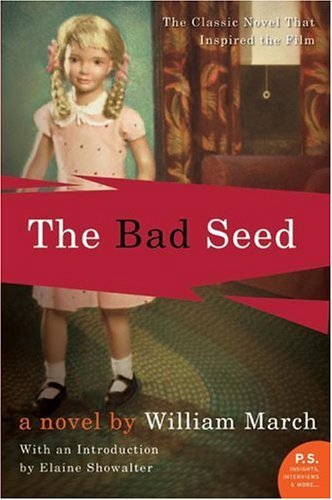
In 1954, a book was published that would take the publishing and reading world by storm. A book written by William March, who, despite having written other works of fiction, would always be known simply as the writer of this suspense novel. A novel that would be nominated for the National Book Award for Fiction, a rare feat considering the genre. A book that would inspire a Broadway play and countless Hollywood movies about murderous children. A book that would spark an endless debate about people's personalities. That book is The Bad Seed, which has been reprinted recently, much to reader delight.

So who is the bad seed in this novel? It's one eight-year-old Rhoda Penmark. By all appearances, Rhoda is all sugar and spice, complete with those dainty sundresses, cute pigtails, and adorable maryjanes. But it's all a veneer of course, for Rhoda manages to kill a boy of her own age simply because he bested her in a school computation. Also, she exacts revenge on a gardener who has somehow seen her for who she really is. There are other acts attributed to Rhoda in her earlier years, but March leaves it to the reader to decide. One thing is certain though -- Rhoda is "the" bad seed and she will continue to be one as she grows older.

One of the themes of The Bad Seed is that genetics plays a part in molding our personalities. March makes it evident that Rhoda, even with her doting mother, was predisposed to evil. (Later in the novel it will be revealed that Rhoda's grandmother had a similar streak.) Yes, Rhoda's father was always absent, but that's irrelevant: Rhoda is evil because evil is in her genes.

It is at this point that the reader may ponder on the question of nature vs. nurture. Can people do anything if a negative personality trait runs in their veins? I sure hope so. Still, it's a chilling thought -- being predisposed to do sinister acts. You never know if you'll wake up one day with the urge to repeatedly stab that pesky neighbor for playing Air Supply loudly in the middle of the night. Or push that officemate down the stairs for getting a paperclip from your desk without asking.

Despite being published in 1954, The Bad Seed still gave me the chills after reading it. And the ending was so unexpected that it gave me goosebumps. March's writing is as fresh and detailed even after more than 50 years. It's one of my most enjoyable reads for this year. In Rhoda Penmark, March has created an iconic character that we would all be afraid of.

Patty McCormack, the girl who played Rhoda, in the 1956 Oscar-nominated movie
People mentioned that it was she that should have been nominated instead of the actress who played her mother.

Read this book if:
  1. You have no doubts that children can be evil.
  2. You like classic suspense novels.
  3. You think that you just might be a bad seed yourself.

Thursday, August 11, 2011

A very peculiar read

Judging by its cover, you'd think that Ransom Riggs's debut novel, Miss Peregrine's Home for Peculiar Children, is a horror story. Unfortunately, it's not, but it's something much more wonderful. In a way, it's a coming-of-age book filled with mystery, suspense, and the occasional episodes of creepiness. And, I believe it can be a cross-over novel -- a book that can be enjoyed by both young adults and adults.

As a child, Jacob, the main character, has long been fascinated by the old photographs that his grandfather keeps. The photographs are by and large eccentric -- a girl seemingly hovering in the air, a scrawny boy apparently lifting a huge boulder, a girl staring at her reflection on a pond, with the reflected image consisting of two girls, a creepy pair of girls with their backs turned to the camera, a girl holding a globe of light in her hands.

The black and white photographs lend an air of mystery to the story. Of course, we all know that they're fake, yet somehow, there's a gothic feel to them. Here are some examples.


By the time Jacob is in his teenage years, his fascination for the photographs and the children on them has waned. But then his grandfather dies violently of mysterious causes. Jacob decides to go to the Welsh island where his grandfather's orphanage once stood, with the hope of finding the reason for his death.

Things turn more mysterious when Jacob reaches the island and finds out that the orphanage, which was run by Miss Peregrine, was bombed during World War II and with all of its residents killed. So how can it be that his grandfather failed to mention this very important detail? How did his grandfather survive the bombing? Adding another layer of mystery to all these, Jacob makes a startling discovery -- the children shown in his grandfather's photographs are alive! And they do have peculiar traits!

I don't want to write any more details. You just have to get your hands on this one, dear reader. It's one of the most pleasantly surprising reads I've experienced this year. What's more, there can be a sequel!

But I do would like to say that, production-wise, this is a very beautiful book. The vintage photographs appearing in the novel are real pictures that Riggs have gathered or have requested permission to reuse. The pictures effortlessly weave into the story, making the reader richer and more satisfying. Here are two of my favorite pictures:


Read this book if:
  1. You love cross-over novels.
  2. You like books with pictures. Who doesn't, no?
  3. You think you're a peculiar child yourself.

Friday, January 1, 2010

Walk away

When I find myself craving for a crime novel that has a noir feel to it, I immediately think of Patricia Highsmith. I love all her Ripley novels, especially the first one, The Talented Mr. Ripley, and I enjoyed A Game for the Living, which I read just recently. And just two weeks ago, I bought one of her more popular noir novels, Those Who Walk Away, which is a very entertaining read.

In Those Who Walk Away, we meet Ray Garrett, a man who has just lost his new wife after she committed suicide in Mallorca. While vacationing in Venice, Ray comes in contact with Ed Coleman, his former father-in-law, who blames Ray for his daughter's suicide. Ed tries to kill Ray twice in separate attempts -- the first by shooting him and the second by letting him drown. Unknown to Ed that Ray actually survived, Ray decides to follow Ed secretly around Venice. Eventually, Ed discovers him and the two engage in a very suspenseful cat-and-mouse game in this Italian island city.

Highsmith downplays the cat-and-mouse concept though, choosing to focus instead on the relationship between these two men. The narrative doesn't become melodramatic at all though; it still is very suspenseful. Ray and Ed pop into each other's lives at the most unexpected moments, and you're always kept on edge as to what these characters would do to one another. Highsmith's characterizations of Ed and Ray become so well-developed that the rest of her characters become irrelevant. Ed's mistress, Inez, doesn't seem to serve any purpose at all but to echo what is in everyone's mind.

When I think about it, readers who have been used to the current crop of thrillers and mysteries would find Highsmith's narrative slow. Highsmith's chapters don't usually end in cliffhangers. But what sets Highsmith apart from other authors is her ability to conjure an atmosphere of menace and dread in her novels. In Those Who Walk Away, you're kept on edge because you know that something bad, something terrible but probable, is going to happen.

Read this book if:
  1. You're into noir fiction.
  2. You love the Ripley novels.
  3. You've imagined yourself in a cat-and-mouse game.

Monday, December 7, 2009

The evil inside of us

I've been a fan of Patricia Highsmith ever since I read her Ripley novels. The Talented Mr. Ripley is still, in my own opinion, her best work, but the other Ripley novels are good too. (If you think the movie was great, well you're in for a treat if you read the novel. The characters are darker and less likable than the ones in the movie.) There's something about the novels of Highsmith that reminds you that there is evil inside all of us, and that some people more inclined to let loose their evil streak.

A Game for the Living, a non-Ripley novels, has all Highsmith's trademark of mystery and suspense. Leila Ballesteros, an artist, is found brutally murdered and raped in her apartment in Mexico by one of her lovers, Theodore Schiebelhut. Theodore immediately suspects Ramon Otero, his rival in his affections for Leila. Ramon eventually confesses to the murder, but his confession is soon dismissed as coming from a person who's lost his mind. Both men eventually develop a closer friendship as they find out who killed their beloved Leila.

Highsmith provides an excellent study in contrasts in the characters of Theodore and Ramon. Theodore is rich and a foreigner, one who feels like a fish out of water amidst Mexico's local color. Ramon is a local, a poor furniture maker. Theodore is rational and calculating; Ramon is brash and too emotional, often acting on his impulses. Throughout the novel, one can see how these characters complement each other, providing a balance in Highsmith's dark and slow-building narrative.

A Game for the Living isn't a page turner though. Highsmith chooses to focus on the relationship between Theodore and Ramon rather than the murder itself. The murder happens in the first few pages, while the rest of the novel delves on the slow decline of Ramon and the ever increasing paranoia of Theodore. The result is a superbly atmospheric novel about what men do when a person they love is taken away from them unexpectedly.

Read this book if:
  1. You're craving for a well-written mystery.
  2. You love the Ripley novels.
  3. You've had enough cheery novels lately.