Showing posts with label horror. Show all posts

Tuesday, September 11, 2018

Dark reads (also being artsy fartsy)

Sometimes, all I wanna do is curl up in bed with a novel that has a very dark plot. So dark that it feels like every time you open it, you're dipping your fingers in blood. I guess that's one reason why I'll never have a liking to Austen. But give me a novel where the women kill, where the world has gone into anarchic chaos, and a speculative world where the society is deeply matriarchal and religion is controlled by sorceresses. For some reason, the novels I chose for this post all feature women as major characters. Woot!


Yes, this novel is one of those that seems to ride on the popularity of Gone Girl and The Girl on the Train. It's not as suspenseful as those two novel though,but still entertaining. I guess I will never get tired of unreliable narrators.


This one I was 10% behind. It's some sort of a post-apocalyptic novel set in a world where people lose their shadows, and along with this loss goes their memories as well. It's a bit of a downer actually, especially when the protagonist couple get separated because the woman, after losing her shadow, decides to flee so that her husband is spared from all the tragedy that's bound to happen to her.


I've a thing for beautifully illustrated graphic novels,  much more if the story is so rich that every pagea is a delight This one is that rare comic. I love the world building and the religion-inspired imagery that the story conjures. Also, plus points for having relevant themes on feminism and race.

There's another thing that's happening this week, and that's our trip to Taiwan. Packing for trips gives me great anxiety. Do I pack an extra pair of shorts? How about underwear? Do I really need all these toiletries? Also, more importantly, should I bring two or three or four books? Or five?

Tuesday, August 28, 2018

J-horror, it's a thing

My love for Japanese horror, or J-horror, knows no boundaries. We've always known that the Japanese can come up with weird shiz, but the horror stories they're able to conjure is simply inexplicable. But in a good way. In a horrific kind of good way. It's not for everyone though, especially if you're turned off by body horror or perverse sexual elements. But hey, if you're reading horror, then shouldn't you be expecting to be disturbed and made uncomfortable with the story?

I'm not really big on manga, the comics made by Japanese writers and artists, but I will make an exception to Junji Ito, who is now one of my favorite writers and storytellers. I just discovered him this year, when I randomly pulled Shiver, his 2017 collection, from the shelf of a local bookstore. I say randomly because whenever I'm in a reading slump, I usually turn to the graphic novels section of the bookstore and check out titles without any rhyme or reason. I discovered lots of wonderful graphic novels this way—Mazzucchelli's Asterios Polyp, Beauchard's Epileptic, and Brosgol's Anya's Ghost, to name a few. Interestingly, it was the bf who got me into reading graphic novels. Before the bf (B.B.F.), my middle class upbringing taught me to look down at these works, which is totally the fault of my parents.

Perhaps the only reason why I don't have much love for manga is that its stories are terribly slow. I'd probably have more fun watching paint dry or looking for wrinkles slowly develop on my face. But with Junji Ito though, I just never know what to expect. Well, I've read only his short fiction collection so far, but what I've read lets me get my horror fix, which I've been rarely getting from the horror novels I've finished lately. There's just something off right from the first page of the story that you could subtly detect, whether it's the oddly proportioned face of a character, the too-perfect veneer of a house, or the cheery friend who seems to be hiding her broken self. I revel in these stories. It's not at all like "The Twilight Zone," but more like the copulation of Hitchcock (for the suspense), Stirling (for the speculative aspect), King (for the jump scares), and Barker (for the out-of-this-world body horror).

I can't get enough of the body horror that Ito tells in some of his stories. In one story titled "Glyceride," a man pops his many pimples and lets the oil drip onto his sister. In "Dissection Girl," a girl dreams of being dissected alive and goes through great lengths just to make it happen. And those are just the "tame" ones, dear reader. There are far darker and grosser instances of this kind of terror in Ito's work.

Another thing I find unsettling in many of Ito's horror stories is his depiction of women. The way he draws his female monsters amd ghosts gives you that slight icky feeling. The blank eyes and facial expressions, the uncomfortably svelte figure, their hair which seems to have a life of their own—stuff of nightmares, I tell you. And it's because of this that I'm really glad that I'm gay. Anyway, check out these "ladies" in the pictures below. Note how the style of the illustrations also give them both a sexual and a predatory feel. But again, these do nothing for me, sexually I mean.

"Blackbird" from Fragments of Horror (2013-2014)
"Whispering Woman," also from Fragments of Horror
I love J-horror in all its forms. Ju-On and Ringu still remain as two of my favorite horror movies. Coincidentally, both also have elements of body horror and female antagonists. One other thing to note about J-horror is that the horror just happens without having the need for an explanation. So there's usually no tedious back story that we all have to painfully go through. It's the same thing with Junji Ito's stories. Weird stuff just happens, like people being chased by floating heads, a woman being turned on by a house and eventually having sex with it, and a man having all the heads of his ancestors living on top of his head. It's just is, man.

The books in my bag last weekend

Tuesday, January 13, 2015

Not so fun anymore

My third read for the year left me wanting. Trese Volume 6, the Philippine graphic novel by Budgette Tan and Kajo Baldisimo arrived with much anticipation. I kept hearing that bookstores have run out of stock. So when I saw several copies in an out-of-the-way bookstore, I didn't think twice about getting it.

Yes, every time there's a new Trese volume, it's a major publishing event here in the Philippines. There hasn't been a local graphic novel that has sparked the interest and captured the imagination lately. Who wouldn't love a graphic novel that delves heavily in Philippine mythology and has elements of horror, action, and mystery?

Think Jim Butcher's The Dresden Files. Trese, a detective who comes from a very mysterious family, specializes in solving crimes of supernatural origins. All the tropes of a police procedural are here: Trese's close relationship with the local police force, the noir atmosphere, the couple of sidekicks who inject humor, red herrings, smoking guns.

Read this in the dead of night hoping it would be scary.
Huge disappoint, that was.
Yet somehow, when I read this latest installment, I didn't feel the same sense of wonder that I did when I finished the first three volumes. Gone were the horror, the fascination with seeing local monsters on the page, and the thrill of having discovered the perpetrators. The overall effect was just cheesy, to say the least.

And the characters . . . Trese still is the same Trese when you met her in the first volume. The Kambal, Trese's sidekicks, are still goofballs. The villains are cookie cutter creations that show no other emotions except the desire to wreak havoc in the city. Everything feels superfluous. I would've been happier rereading the early installments.

Baldisimo's illustrations are still superb though. I would've wanted Tan to make full use of the panels in developing the narrative. However, the dialogue felt "talky," as if the author felt the need to explain everything and not let the panels tell the story. The conversations also seemed unnatural and formal-ish. Trese is the kind of work that needs street-smart language, which unfortunately was severely lacking in this volume.

One good thing to come out of the sixth volume is that we do discover more details about Trese's family (her father and her siblings) and several other supernatural characters that are allied to Trese and her family. But this aspect still feels derivative. I kept expecting someone to just blurt out, "Avengers, assemble!"

I'm not so sure if I'd read the succeeding installments anymore. I've friends who are huge fans of the Trese series, and I hope that they persevere. Who knows, maybe the 7th, 8th, and nth volumes would be better.

Read this book if:
  1. You're curious about Philippine mythology.
  2. You like police procedurals, murder mysteries, noir, and crime fiction.
  3. You're a completist.

Sunday, May 25, 2014

Creepy dolls

Dolls are creepy. And what's even creepier is if dolls find their way in the hands of Susan Hill. Yes, Hill of The Woman in Black fame has a new ghost story, and it involves decaying house, two young cousins, and lots of Gothic atmosphere. I knew at the onset that I would like this.

In Dolly, we meet Edward Cayley, an orphan, who would spend one summer at his Aunt Kestrel's creepy house in Iyot Lock. Edward would be spending the summer with his cousin, Leonora von Vorst. While the two children almost have the same ages, they couldn't be more different. Edward is pensive and sensitive, and Leonora is terribly spoiled.

Everything seems to be quite an uneventful summer, notwithstanding Leonora's tantrums and complaints. But this is a ghost story after all, and there must be a turning point for these innocuous happenings. In this novel, everything changes on Leonora's birthday, when Aunt Kestrel presents Leonora with a beautiful lifelike doll. But it's not what Leonora had in mind though. Leonora then flings the doll to the wall, cracking its porcelain face and storms out of the room. Edward takes it upon himself to get rid of the doll by burying it outside the house.

Years pass and Edward recalls the many times he has spent other summers at his aunt's. Leonora, on the other hand, never returns. It's only upon the death of Aunt Kestrel when the two meet again to discuss the terms of the will. It appears that their aunt has left everything to Edward. And what about Leonora? She gets the doll her aunt gave her on her 9th birthday. Edward shows Leonora where he buried the doll and reveals it. What was inside the box shocked them. The doll has aged in all those years it was under the ground.

Dolly doesn't stop here though. We get to read how Edward has suffered many sleepless nights hearing a disturbig sound, a sound made by someone, or something, scraping on paper. Edward knows that it's the buried doll, of course. It's calling out to him, as if it were asking him to set it free.

In the novel's final chapters, we get to know how Leonora runs out of money and asks Edward to give her the house. She's down on her luck—divorced, with a 2-year-old baby daughter, and without money. Edward, now a successful man, agrees to have Leonora stay at Iyot Lock. But then makes a very unwise decision. He finds an intricate Indian princess doll in one of his trips and gives it to Leonora. She wouldn't accept it though, and sends it back to him. When he opens the package from Leonora, what the doll looks like now would haunt him. Gone were its beautiful Indian features. The doll now had the features of a crone.

Dolly is one chilling read. Like her other ghost stories, it's almost like a novella at 150 pages. It doesn't quite hold up to the scariness of The Woman in Black, the bleak mood of The Small Hand, or the sense of dread of The Man in the Picture. But it's still a very satisfying read. I just hope that Susan Hill never stops coming out with ghost stories.

Read this book if:
  1. You love short scary reads.
  2. You know that dolls are creepy.
  3. You'll read anything by Susan Hill.

Saturday, April 19, 2014

I is for Irving

Totally unexpected, this one. I know all about the big screen adaptation by Tim Burton, but that movie takes a liberal shot at Washington Irving's novella, The Legend of Sleepy Hollow. Liberal, like 50%. When I think about it, all the movie had in common with Irving's material is the Headless Horseman and Ichabod Crane. And Burton just borrows the name of the latter. Because when you break it down, Johnny Depp's character doesn't share any similarities with the Ichabod Crane that Irving writes about.

All right, so we have Ichabod Crane, who is not a member of the judiciary but is merely a humble schoolteacher. So humble, so insecure, and so clumsy. And he's not really the hero of the story as it will turn out. By the end of the story, Ichabod Crane is just one more casualty. Was he a victim of the Headless Horseman? Or was he just an unfortunate character who's fallen prey to a prank by Brom Bones. Brom and Ichabod are both wooing the town beauty, Katrina Van Tassel. It's really not made clear though if Katrina has directly denied Ichabod her hand. All we know is that at the end of the party, Ichabod leaves with very low spirits.

What caught me off guard was how humorous the story can be. Somehow, we feel that Irving is making light of the people of Sleepy Hollow. He loves them, make no mistake. But it's as if he's inviting the reader to see that these are people who tell creepy stories to amuse themselves. I'm amused as well. I'm amused at the brilliant way that Irving shows us how a town's beliefs, its superstitions, can influence the lives of the locals. And that despite these superstitions, they make do.

It's no wonder that Irving's stories have stood the test of time. These are the kind of stories that you tell each other at the campfire. These are the stories that you share to your friends to creep them out. While the Headless Horseman doesn't really appear till the end of the story, there's a sense of pervading gloom right from page 1 of The Legend of Sleepy Hollow. By the end of the story, if you're not creeped out by what happens to Ichabod Crane, then at least it will give you pause to think whether the Headless Horseman is real or not.

Read this book if:
  1. You love short creepy stories.
  2. You've seen the movie, and now it's time to read the book.
  3. Headless Horseman! Headless Horseman! Is there really any other reason for reading this?

Friday, March 21, 2014

G is for Gotthelf

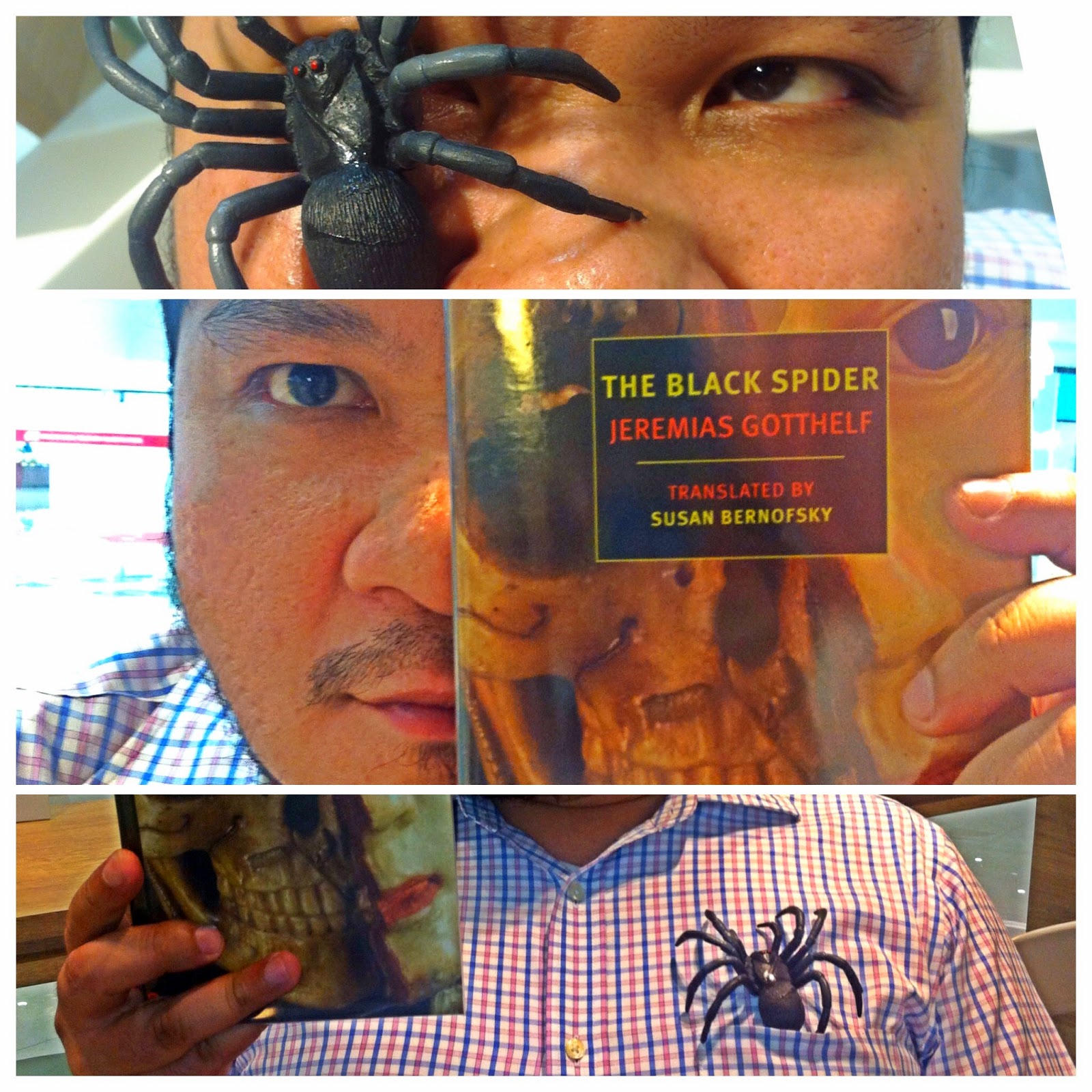
I love a good horror story. And after reading mostly the Victorians in my dead guy reading challenge, I believe the time is now ripe to go beyond the British realm. So I picked up Jeremias Gotthelf's The Black Spider. Gotthelf is a curiosity. He was a Swiss pastor who was a contemporary of Edgar Allan Poe. According to his biography, one difference between Gotthelf and Poe is that Gotthelf believed in the reality of the demon he created in his short stories. This thought gives me goosebumps, as the monster he created in The Black Spider is quite the character.

Upon opening the novel, which was published in 1842, one might think that it isn't a horror novel at all. The opening lines paint a picture of quaintness and the mundane. Gotthelf begins with a very vivid, albeit poetic, description of the town of Sumiswald, where the events of the novel take place.
Above the mountains rose the sun, shining in limpid majesty down into a welcoming but narrow valley, where it woke to joyous life creatures that had been created to take pleasure in the sunshine of their days. From the forest's gilded edge the blackbird trilled its aubade while the amorous quail intoned monotonous minnelieder from amid the flowers sparkling in the dew-bespangled grass, and high above the dark firs, lusty crows danced nuptial roundelays or else cawed tender lullabies above the thorny little beds of their unfledged chicks.
But all will not be well at Sumiswald, for in The Black Spider, a dark period in the history of that little fictional town will be told. It begins with a brutal knight, one Hans von Stoffeln, who makes a most inhumane demand on the farmers of his estate. It's a demand so impossible for the residents of Susmiswald that one of the women, Christine, is forced to make a pact with the devil. The devil in The Black Spider is one I haven't encountered before. No horns, fangs, and serpertine eyes and tails here. What Gotthelf conjured is a tall, red-beared huntsman dressed all in green and with a red feather in his cap. All he asks in return is an unbaptized child.

So the knight is made happy and all seems well in the little town. Until the first child is born. Christine takes it upon herself to get the child and bring it to the devil. But she is thwarted, as the child is baptized as soon as it is born. Then the second child is born, and the same thing happens. All this time, a black mark has been growing on Christine's face. The mark grows and grows till little spiders come out of it and kill all the cattle in Sumiswald. When the third child is born, Christine hurriedly goes to the mother's house and steals the child. But alas, when she was about to hand the baby over to the green huntsman, a priest sprinkles holy water on these two. The devil flees, and Christine shrinks and transforms into a small spider, which the priest casts aside in rescuing the poor baby.
The story does not end here. It's too clean, yes? The black spider wreaks havoc in the town, appearing in one house, killing people, and then disappearing instantly, only to appear again in another place. It's at this point that I begin to think how The Black Spider is very similar in theme to the story of the pied piper of Hamelin. But instead of people realizing their fault and correcting it by doing what has been previously agreed on, the people of Sumiswald resort to their faith. (Gotthelf, after all, was a pastor.) Of course they can't give a child to the devil, whether it's baptized or not. It was up to one of the residents of Sumiswald to outwit the black spider and trap it in a wooden post.

Gotthelf's novel is a quick read. It's just a little over 100 pages. One assumes that this tale, written in the mid 1800s, would have a plot that took its time to unfold. No. The Black Spider's narrative pace is a hectic one. And an atmosphere of dread and creepiness pervades throughout the pages.

Nightmarish—that's how I would describe Gotthelf's novel. I couldn't help but look over my shoulder every now and then. Just to check whether an 8-legged thing is slowly finding its way into one of my pockets. Don't get me wrong, I love spiders. They kill pests, and they'd mostly leave you alone if you leave them alone too. But the spider in this novel is something you'd wish you'd never meet. You might as well practically kill yourself if you do. There's just no escaping it. It's evil incarnate.

Again, I'm grateful that NYRB has published this forgotten classic. It's wonderful reading about the traditions and customs of small towns in ages gone by. There's an opening scene about a baptism that's about to happen. I never knew that there was so much eating involved before and after the ceremony. I guess in olden times, one stuffs himself silly when a baby enters the Christian world. Fascinating trivia.

Read this book if:
  1. You have a thing for classic horror stories.
  2. You love spiders.
  3. You're looking for a quick and scary read.

Sunday, March 16, 2014

F is for Fowles

Twenty years ago, as soon as I finished reading The Magus by John Fowles, I can still remember my feeling of elation. It was my first Fowles, and I thought that I got mind-fucked by the novel. With its seamless transition between reality and fantasy, The Magus was an exercise in patience and stamina. Finishing it was a rewarding experience indeed. I never planned to read another Fowles novel, but I needed a letter F for my dead guy challenge. So, Fowles's debut novel it is. (Flaubert, I will tackle you another time. Promise.)

Ah, The Collector. What a totally satisfying thriller you are. You're still quite a suspenseful read, even though you were first published in 1963. And I now understand why you were the debut that brought Fowles to everyone's attention. You do remind me of those movies that feature deranged serial killers and psychopaths ("The Silence of the Lambs" and "Psycho"). But what sets you apart from these thrill-a-minute films is how erudite you seem to be. Reading you wouldn't just satisfy one's craving for a sickening story; you also allow us to go deep into both the minds of the characters—the captor and the captive.

The novel, all 300 pages of it, features just two characters. Frederick Clegg, the lonely clerk who collects butterflies in his free time, and Miranda Grey, the art student whom Frederick develops an obsession on. And Fowles just gives us 4 chapters. With the first chapter, it's all about Frederick's point of view. It recounts his unhealthy attraction to Miranda, his winning a substantial amount of money in a lottery, and his meticulous planning of Miranda's kidnapping. Frederick is the collector referred to in the novel for obvious reasons. We just know that, probably, not everything is right in his calculated mind. With his money, he buys a cottage with a basement where he keeps Miranda.

Cut to the next chapter and we get to know Miranda a bit more. The Collector isn't just about the battle of wits between Frederick and Miranda. It's more of an exploration of the minds of its characters. With Frederick, it's all about obsession and how he's determined to make Miranda a part of his collection. In Miranda's chapter, we read about Miranda's life before her abduction, her willingness to be romantically involved with an artist 21 years her senior, her plans of escape from Frederick, and her eventual desperation at the futility of all her attempts. Her chapter made us feel for Miranda, and we really hope that she would have escaped by the novel's end.
One just can't imagine what prison is like from outside. You think, well, there'd be lots of time to think and read, it wouldn't be that bad. But it is too bad. It's the slowness of time. I'll swear all the clocks in the world have gone centuries slower since I came here. 
I shouldn't complain. This is a luxury prison. 
And there's his diabolical cunning about the newspapers and radio and so on. I never read the papers very much, or listened to the news. But to be totally cut off. It's so strange. I feel I've lost all my bearings. 
I spend hours lying on the bed thinking about how to escape. 
Endless. [page 250]
The Collector messes up your brain too, in a beautiful way. The sexual tension between the two characters is just nail biting, even though Frederick and Miranda never really do it. Well, almost. There was this one time when Miranda attempts to seduce Frederick, but it doesn't go as planned. Frederick couldn't perform. Somehow, a psychiatrist has told Frederick that he'll never be able to do it with a woman. And it is at this point that you get to thinking—just what the hell is wrong with you, Frederick? Why couldn't you get it up? And why do you do a complete 180-degree turn when the object of your obsession offers herself up to you? All of a sudden, you think of Miranda as a charlatan.

I should read more John Fowles. Such a deft writer, that one. Comfortable in varied writing styles. Frederick's narrative is an exercise in control and in looming terror. Miranda's, on the other hand, spirals downward from being whimsical, introspective, and then surrendering. You literally feel her descent into madness and despair. It's a truly chilling account.

Read this book if:
  1. You love psychological suspense.
  2. You have an unhealthy obsession of things and, possibly, of certain persons.
  3. You know that that seemingly harmless dude sitting next to you in the bus keeps a woman prisoner in his basement.

Wednesday, December 4, 2013

Horror-ish

And I've finally read my first Lessing! Yes, it's taken me this long to read one of her novels. I was originally gunning for The Golden Notebook, but when I looked at how thick it is, I died. Twice. The Fifth Child, running no longer than 150 pages, was perfect.

What a beautifully creepy novel The Fifth Child is. The story is pretty much straightforward. A young couple, Harriet and David, decide to move to a house of hotel proportions and have one child after another. Harriet and David have never been financially stable and have relied on David's well-to-do father for support. Things seem to go well with the family until the fifth child, Ben, was born.

All right, maybe the problem didn't start at Ben's birth but during the time Harriet was still carrying him in her womb. Ben was a difficult baby. Harriet often had to take sedatives just to keep Ben quiet inside her. Ben does appear to be an unusually strong baby. When Ben was born, nothing could have prepared the family of the sight of Ben. Besides being unusually strong for his age, Ben seems to resemble a Neanderthal, a monster in his parents and siblings' eyes.

If the other 4 siblings grew up with the attention (if not the love) of their parents, Ben didn't. Everyone seems to be afraid of him. Who wouldn't? When a cat and a dog die from strangulation, everyone thinks that it was Ben. And this thinking seems to be rightly so. Ben appears to act based on very primal instincts: eating ravenously, hurting people who view him with revulsion, and basically not communicating with any of his family. Eventually, the family decide to put Ben to an institution, even though Harriet has always been dead set against it.

Harriet does get Ben back after making an unscheduled visit and discovering that he has been drugged, fitted in a straightjacket, and covered in his own excrement the whole time he was at the institution. Harriet really tries to love Ben as much as she does her other children. But Ben's monstrous appearance and his wild disposition prevent her from doing so. She had to resort to having the teenaged gardener, whom Ben seems to like, watch over her son. It becomes inevitable that Ben becomes part of the gang of teenagers who terrorize parts of England.

Lessing shows us how one child can tear a family apart. The rest of Ben's siblings all leave for boarding school, as if wanting to put as much distance between themselves and their youngest. Harriet and David's marriage is never the same when they had Ben. Their house, which seemed to be their one prized possession, is eventually sold. And Ben only considers his friends as his true family.

I loved The Fifth Child. It's a horror novel that works on so many levels. On one level we see the family dynamic when one aberrant person joins the group. On another level we read about the horrors that Ben was capable of when he was growing up. And yet on another level we imagine the terror that could still happen, terrors brought about by Ben and his loutish friends. It's also a heartbreaking novel of loss, frustration, and what could have been. Somehow, I felt bad for the couple. I can't  help but imagine how everything would've turned out for them if Ben hadn't been born.

Read this book if:
  1. You'll read anything that's won the Nobel.
  2. You like your horror "literary."
  3. You're the black sheep of the family.

Tuesday, November 19, 2013

Not enough to turn me into a fan

Still on a graphic novel reading spree. Haven't felt reading anything heavy on text because of all the things happening around lately. Proust's Swann's Way would still have to wait. Although I've given myself this month to finish that. But for now, Batman.

Now I must admit that I'm not really big on the Caped Crusader. I found the movies (the Burton, the Schumacher, the Nolan) just fairly enjoyable. The vintage TV series was campy at best. When you say Batman, I just think of the costumes. Tight costumes. As in really tight. So tight that they'll show nipples and abs. Nipples so perky that you think, gee, it's really cold outside.

I found Arkham Asylum: A Serious House on Serious Earth at a bookstore. I thought, what better way for my Batman-ignorant self to be acquainted with this superhero than this stand-alone graphic novel. It's the 15th anniversary edition no less. Besides, the story's written by Grant Morrison and the artworks by Dave McKean. The latter is of The Sandman series fame. Sold.

Okay, the story. Now I know why I've never been fond of Batman. The guy's got so many issues. Prick him and he bleeds paternity, identity, and security issues. Slap him and your hand would feel numb by his intense coldness. I never got into Batman's brooding nature. If I were a millionaire, brooding would be the last personality I would have. Anyway, the story concerns with the inmates taking hostage the staff of Arkham Asylum. Their demand is simple: Have Batman go to the asylum and make him be one of them. The asylum residents are of a different breed altogether. They're all the enemies of Batman including Joker, Two-Face, Mad Hatter, Scarecrow, Croc, and a partridge in a pear tree.

Then I was quite disappointed that there isn't much action in Arkham Asylum. There is plenty of talking though. And lots of panels showing the dark history of Arkham house and how Batman was lured into going there. Blah blah blah blah. And how is Batman released from the asylum? Well, by a simple coin toss. Yes, a coin toss that was probably rigged by Two-Face. Oh, Two-Face, you spoil all the fun. To think you were my favorite villain! You should've been more villain-y.

What I really liked about the graphic novel is the beautiful panels, which were paintings done by McKean. The panels were very gritty. And they did effectively show the themes of horror and psychological suspense. Even the typeface used for Joker's dialogue was very artistic. Just look at some of the panels below.


I'm not really sure if I'll be reading another Batman graphic novel soon. Perhaps I'll just wait for that Batman vs. Superman movie. Ben Affleck vs. Henry Cavill! If only they'd do away with the costumes, no?

Read this book if:
  1. You fall for these brooding characters.
  2. You love a guy in tight outfits.
  3. You have this crazy idea of putting all your ex-boyfriends or ex-girlfriends in one house and then just seeing what happens.

Sunday, November 3, 2013

Fantastic storytelling


Ten years ago, I wouldn't find myself near a graphic novel. Those things are trashy and people who read and buy them should be looked down on. Pictures, panels, speech bubbles—these are not the elements of good literature. Yes, middle class Filipinos believed this horse shit. So for 3 decades, most of my reading consisted of books that just have text.

Enter Neil Gaiman's The Sandman, and everything I knew about the graphic novel genre would be strewn to the floor. In other words, I bit the dust. When I read the first page of my first Sandman compilation, I was like, "How come I'm reading this wonderful 'horse shit' only now? What glorious horse shit this is!"

It was my good friend R. who gave me my first Sandman compilation—Fables & Reflections, the 6th volume of the series. It's still my favorite volume, coincidentally. S far, I have 6 of the 12 volumes. Still a long way to go. And still many times in the future wherein I'd empty my wallet. Those graphic novels, they're just too damn expensive.

I've grown to the love the mystical world of the Endless: Morpheus (Dream) and his 6 six siblings (Destiny, Death, Delirium, Destruction, Despair, and Desire). The stories in The Sandman are a combination of horror, mystery, and fantasy. Fantastic storytelling, I tell you, dear reader. And one that you'd like to return to every now and then.

Our book for this month at the book club is actually the 4th volume, Season of Mists. It's a very dark read, and it's heavy on mythology. You'd get to meet Bast, Thor, Odin, the Japanese god of storms, faeries, fallen angels, and even Lucifer himself. You can't go wrong with these characters, right? More so if you find out that Lucifer has called it quits and has turned over the keys of hell to you.

Jon Snow: Who is the Sandman? What sorcery is this?
Me: You know nothing, Jon Snow.
How very timely to be reading The Sandman now! Gaiman has come up with a 6-issue bimonthly miniseries of a Sandman prequel. Woot woot! The first issue's just been released last 30 October, and I've been itching to get my hands on one. Finally, last Saturday I was able to get a copy. I could die now. Well, at least after I've read the 6th issue.

Monday, October 28, 2013

The book club works the night shift

So I just finished moderating the discussion for this month over at the book club. I co-moderated Stephen King's Night Shift discussion with R., who had all these great ideas to make the discussion a little different. And let me just say this—it was just so much fun to organize!

Of course, we went a little crazy. Filled up all the loot bags with candy and other knick knacks such as notebooks, toy rats, mini skeletons. Had 20 designs for the bookmarks. Had matching shirts made for the discussion. Sometimes, my OC self could not handle it!

The venue was a little bit unconventional. We rented this old house, the Thelmo ancestral house in Manila, to add a creepy vibe to the discussion. And we chose to hold the discussion late in the afternoon, around 5.30 pm, so that we'd spend the early evening hours at the house.

I think the members of the book club, the Flippers, enjoyed it! Thank goodness! They better! After all the months of preparation, the copious notes that we wrote, the game that we had at the opening, etc., I would die if it didn't turn out the way we planned.

Anyway, here are some of the pictures taken during the discussion, which I'd like to share with you, dear reader. These were taken by R., who was shuffling between the roles of being photographer and moderator.

The T-shirt design
R. tried to incorporate as many elements of Night Shift into the design
We had 4 T-shirts printed: 2 for us, 1 for Mitch (who helped us with the venue)
and 1 for the winner of the best in costume, even though costumes were optional
Food was potluck.
Here's Marie doing the finishing touches for her lemon squares.
Her lemon squares were actually round. Hehehe. But they were delicious!
Marie also helped out tidy the place. Thanks, Marie!
A corner of the old house
The old paintings of the Thelmo family added a very vintage touch.
And they were really creepy, in a wonderful way.
We started with an early dinner at 5.30 pm.
And knowing the Flippers, the food was just overflowing!
There were pies, chips, baked mussels, noodles, spring rolls, donuts, and more!
I guess a Flipper's biggest fear is to go hungry.
R. hamming it up with this prop.
For the life of me, I can't figure out the pop culture reference!
And look at the shirt!
After dinner, we proceeded to talk about the horror genre in general.
And then we had a quick game about the stories in Night Shift.
There were 4 teams which I designated as follows:
the rats, the worms, the children of the corn, and the quitters.
Then we went to the basement for another part of the discussion.
Here we talked about one aspect of horror in Night Shift that focused on the everyday:
suicide, deadly bets, serial killers, disease.
Oh, the house's caretaker shared something frightening with us.
She can sometimes here children in the empty basement!
Then we went to the house's courtyard. I think it was already past 7 pm.
Here we talked about King's supernatural horror,
the kind involving monsters, vampires, and what-have-you.
We also talked about 2 stories in Night Shift that were not specifically horror.
We held the last part of the discussion in another living room of the house.
I guess you can call it the parlor. (Who has a parlor these days?)
We asked the members to rate the book from 1 to 5, with 5 being the highest.
Judging from the scores they gave, most of them liked the book! Woot!
I counted 23 happy participants! Yay!
The last time R. and I moderated separately, we had 30+ attendees each.
This time, to control the number, we chose to make it an invite-only event.
I saw these cookies at a cake shop near my office.
And right there, I just knew that we should have them in our loot bags.
They taste great too!
Besides, who doesn't like cookies?

Monday, October 21, 2013

The book that started my love of the horror novel

During my first year of high school, I found myself in the library with a few minutes of spare time. I was browsing my high school library's bookshelves when a book's cover caught my attention. When a cover shows a partially bandaged hand with human eyes growing on it, you'd also be curious, yes?

Anyway, I ended up loaning the book from the library. When I got home, I remember plunking down on my bed, turning on the first page, and then closing the book at around 3 am in the morning. Yes, I read all the stories in one night, and that night would start my reading love affair with Stephen King.

I never looked back after reading Night Shift. I read one Stephen King work after another. And I think, at that time, I loved them all. No matter how cheesy the story lines can get, I devoured the book with a passion. The haunted car in Christine might be a bit comedic when you read it now, but in my teenage years, I was scared by the idea. The aliens in Tommyknockers? They creeped me out. Same thing with the clown in It. Cujo made me feaful of dogs for a short period. And when we checked into a hotel, I'm reminded of the twins in The Shining. Salem's Lot was my first ever vampire novel. In a way, that book was to blame for my pretty high standards for anything with vampires.

King also showed me that he can dabble in high fantasy too. The Eyes of the Dragon is one of my favorite King works. And I've read the first 3 books of his The Gunslinger series, which felt uneven. I guess it was with this series that made me realize that I've outgrown King, and that it was time to read other novels, horror and otherwise.

Because of my love for King, I eventually ended up reading Clive Barker and Peter Straub. Though both are not as prolific as King, I have a few Barker and Straub books that I particularly enjoyed. Peter Straub's Ghost Story introduced me to the Gothic tradition. And I still recall how I was floored after reading Shadowland, which is still my favorite Straub novel. As for Barker, reading him exposed to all things weird. My favorite Barker works are Imajica and Weaveworld. His Books of Blood? Possibly the best horror collection of short stories ever.

I'm glad that I started with Night Shift. It's a good place to begin one's journey to the many wonderful aspects of the horror novel. Horror isn't just about monsters, and vampires, and things rising from the dead. It's also about the everyday things that can take a horrific turn. It's about your sick relative, dying of cancer and forcing you to make a tough decision. It's your friend who goes through hell and back just to be rid of an addiction. It's about that quiet man in the corner who could possibly be the serial killer the police is looking for.

It's been a while since I read King. Last weekend, I finished rereading Night Shift in time for the book discussion this coming Saturday. 26 years ago, I read it in white heat. This time, I savored it, enjoying King's gift of characterization and envying him for his talent for description. It made me miss spending a cold night reading a King novel.

I think I stopped reading King after the mess that is Rose Madder and the inferiority of Nightmares and Dreamscapes as compared with other superb collections. Perhaps it's about time I do a bit of catching up. With his unbelievably prodigious ouput, I have my work cut out for me.

Monday, September 2, 2013

Lock me up in a room with these graphic novels and throw away the key

Glorious, glorious weekend. I spent a part of it reading Joe Hill and Gabriel Rodriguez's wonderfully dark series of graphic novels that begin with Locke & Key 1: Welcome to Lovecraft. If the rest of the series is half as good as this first installment, then I'm a happy camper.

Now, Joe Hill. 20th Century Ghosts, Horns, and Heart-Shaped Box are books right up my alley. Creepy, gory, frightful fun. I guess being a son of Stephen King does have its perks, no? I can just imagine the family dinner conversations. (My horror is better than your horror. Hehehe.)

The first Locke & Key isn't an all-out horror graphic novel though. It starts with a murder. Sam Lesser, an unstable teenager, murders his guidance counselor, leaving Tyler, Kinsey, and Bode without a father. The three siblings and their mother then move to their Uncle Duncan's house (named Keyhouse) in a town called Lovecraft. Sam is locked up not in a jail but in a juvenile detention center because of his age.

Keyhouse is one weird house, I tell you. Lots of locked doors and rooms, there's a girl in a well that speaks to the Bode, the youngest Locke sibling. Bode is the first to discover how a key can open the Ghost Door. When he passes through it, he leaves his body and moves in his spirit form.

We do learn that the girl in the well has a more significant role in the story than I initially thought. Sam thinks of the girl as his master. And somehow, she is still connected to Sam even though he's locked away, giving Sam tools that pave the way for his escape. Sam travels to Keyhouse as ordered by the girl. It's all gore and mayhem from here. Sam takes the Locke family hostage, and Bode finds the Anywhere Key and hands it to the girl.

Sam is eventually killed though, and the girl in the well escapes. By the end of the novel, we see the girl in the well morph into a man. Such a deliciously creepy end to the first series, don't you think? I'm so in!

Read this book if:
  1. You're looking to read a different kind of horror.
  2. You love graphic novels not involving superheroes.
  3. You like dark and wonderfully weird story lines. 
P.S. The illustrations are striking. Gabriel Rodriguez's panels are just too gorgeous. A few below.
When you go through the Ghost Door, your spirit leaves your body.
Basically, your physical body becomes dead.
The girl in the well house
One of the first few full-page panels
Sam Lesser knocking on the door of Locke's house to murder him

Saturday, November 3, 2012

Poe's the real deal

So today is the delayed Halloween party of the book club. Its theme is "Steampoe," literally a combination of steampunk and Edgar Allan Poe. I've read a few steampunk novels but have never sampled any of Poe's works. And I think that could be easily remedied.

Good thing that Penguin English Library has a book on Poe, which contains 19 very entertaining stories. The Murders in the Rue Morgue and Other Tales has all the classic Poe short stories: "The Masque of the Red Death," "The Pit and the Pendulum," and "The Tell-Tale Heart," "The Cask of Amontillado," to name a few. It's a beautiful collection of Poe's works, with the reader having no choice but to read each story in one sitting.

Ah, Poe, why did it take me so long to read your nightmarish, weird, Gothic, horrifying stories? I've always considered myself quite wide read when it comes to the horror genre, but now that I've read Poe's tales, most of the novels that I've read seem to be the work of amateurs. Poe's ideas are so wonderfully bizaare that you think it's either he's brilliant or he's one crazy SOB. I feel that only a person with a sick mind can come up with these dark tales.

Among the 19 tales collected in this anthology, my favorites would have to be "Ligeia," "The Fall of the House of Usher," and, of course, "The Murders in the Rue Morgue." I think "Ligeia" is one creepy ghost story, with the ghost finding her way back into her lover's arms and her lover eagerly welcoming her back. And the Gothic atmosphere of "The Fall of the House of Usher" is unparalleled. You can cut the menace and the creepiness with a knife.

Curiously, "The Murders in the Rue Morgue" is more scientific than anything. What the characters do to untangle the mystery is very unorthodox. Now who (or what) committed the brutal murders is a surprise in itself. While this tale may seem to be a detective story when you finish it, its opening is one that needs an empty stomach for its sheer gore. A woman and her daughter are found in their house dead. The daughter has been pushed feet first up the chimney; the mother is found with her throat slit so deep that when people remove the body, her head falls off. Say good-bye to your appetite, dear reader.

Poe died at the age of 40. Quite a shame to leave the world at that young age, when you think about it. Who knows what tales of violence, macabre, madness, and horror he would've written if he had lived longer? Do take the time to read (or reread) Poe, dear readers. Your world will be darker for it.

Read this book if:

  1. Horror is your genre.
  2. You love the unexpected twists in endings.
  3. You know that, sometimes, the world is a dark place.

Sunday, May 27, 2012

In-flight entertainment

I'm going on a trip again this week. And I don't want to be bored again by an airline's lousy in-flight entertainment. One time, they showed a movie without providing ear phones. Sucks, big time.

So I'm bringing these.


We all can use a little kink every now and then.

Thursday, February 9, 2012

Loving Lois Duncan (2)


Finally, I've completed all 8 of Lois Duncan's suspenseful young adult novels, which have been completely updated for this generation. I've started reading Duncan this year, and her books have always given me hours and hours of good thrills. Even though these books were written in the late 70s and early 80s, there's still a freshness and relevance to them, which still make the books satisfying reads.

Perhaps her most famous work is this, I Know What You Did Last Summer, which have been made into a movie in the early 2000s. The book though is just as fast paced (perhaps even more so) than the movie. Teenagers really do some crazy shit, and Duncan knows her teenage characters very much. You know something bad happens when people just cover up the mess they find themselves into.

Another of Duncan's more famous novel is Don't Look Behind You. Think of the movie "Cape Fear" crossed with a teenage slasher flick, that's what you get in this YA novel. It's about a family who is forced into the witness protection program. However, a hit man is out to get them, and that hitman is one creepy guy who has a very uncanny way of learning the family's whereabouts. In this novel, Duncan allows the reader to get a glimpse of the many challenges a family faces in that particular circumstance -- being unrooted from all their friends and family, living under assumed identities, and having that constant paranoia.

Daughters of Eve has been criticized as being overly feminist. In fact, some feminists have called the book as damaging to the feminist movement. The main characters are a group of high school female students who decide that they have had enough of living in a very patriarchal society. Of course, their methods of dealing with these problems tend to become violent, from vandalizing the school laboratory (with pig shit) to abducting and humiliating a two-timing high school jock, who happens to be a brother of one of their members.

Stranger with My Face is my favorite of the 8 novels though. The idea of having a doppelganger has always creeped me out, and this book, at first glance, seems to delve into that concept. But Duncan again surprises the reader when she injects elements of native American mysticism into her story. It's the kind of novel that makes you think about the possibility of an esoteric belief such as astral projection. I also think that it's one of Duncan's novels that has a very strong fantasy element. I guarantee you that you'll be creeped out as well.

Sunday, January 1, 2012

Loving Lois Duncan


It's only recently that I've discovered how enjoyable Lois Duncan's books are. Despite the books being written in the 70s and early 80s, Duncan's thrillers and suspense novels are as enjoyable as ever.

Duncan has written more than 50 novels in her career, but she's famous for a handful of books that have provided chilling entertainment to young adults. I believe these novels number about 8, with I Know What You Did Last Summer and Killing Mr Griffin as the most famous ones.

I've read four of these novels. And let me tell you, dear reader, that these are one of the most creepy books you'll ever read, young adult novels or otherwise.


In Summer of Fear, a family adopts the orphaned daughter of one of their kin. Turns out, she's a witch. It reminds me of those horror movies wherein the new member of the family wreaks havoc on everyone.


Locked in Time has elements of southern Gothic. I have always loved Gothic fiction, so reading this was a no-brainer. In this novel, a girl's youthful-looking stepmother and her children share a horrifying secret to staying young.


Killing Mr Griffin is the most entertaining of the 4. We've all had fantasies about playing a nasty joke on our strict teachers. In the novel, 5 teenagers kidnap their English teacher to scare him. Something goes wrong though, as Mr Griffin dies.


Duncan dabs on horror in Down a Dark Hall. The setting, a secluded boarding school, feeds on one's claustrophobia.


I read all four novels, one after the other, all in 2 days. Yes, they're that readable and entertaining. And yes, I'm going to read more.